
- Catalogs
- Mdoloris Medical Systems
- ANI MOC-9

ANI MOC-9

ANI MOC-9
Catalog excerpts

MEASURE THE ANS CONTROL SURGICAL STRESS IMPROVE OUTCOMES ANI MOC-9 The Analgesia Nociception Index The ANI MOC-9 is an innovative technology providing a measure of the parasympathetic tone to continuously evaluate patient comfort levels. ANI is unique in using the sympathovagal the balance between nociception and analgesia. Benefits of ANI technology: Predict hemodynamic reactivity Jeanne M et al., Clin J Pain, 2014. Titrate opioids Daccache G et al., Anaesthesia Critical Care & Pain Medicine, 2016. Predict post-extubation pain Boselli E et al., British Journal of Anaesthesiology, 2013. Reduce post-operative pain Henry D. Upton, et al Anesthesia & Analgesia july 2017. Diagnose the etiology of a hemodynamic event Logier R, et al IEEE Proceedings 2011. Hemodynamic stability Reduce length of stay Daccache et al., Anaesthesia Critical Care & Pain Medicine, 2016. Ramos et al J Clin Monit Comput. 2020 Feb 28.
Open the catalog to page 1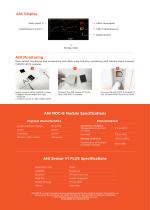
ANI Display Mean trend ANIm (averaged) Instantaneous Trend ANIi (instantaneous) Signal quality Energy value ANI Monitoring Root patient monitoring and connectivity hub offers plug and play monitoring with Masimo Open Connect TM(MOC-9TM) modules. 1 Apply sensors on the patient’s chest: • biggest sensor under the right clavicule • smallest sensor on the cardiac apex Connect the ANI Sensor V1 PLUS to an ANI MOC-9 module Connect the ANI MOC-9 module to one of three MOC-9 ports on Root ANI MOC-9 Module Specifications Physical characteristics Operating conditions Temperature at ambient humidity Weight...
Open the catalog to page 2All Mdoloris Medical Systems catalogs and technical brochures
 PTA
PTA8 Pages
 NIPE in NICU
8 Pages
 ANI in ICU
8 Pages
 ANI in OR
8 Pages
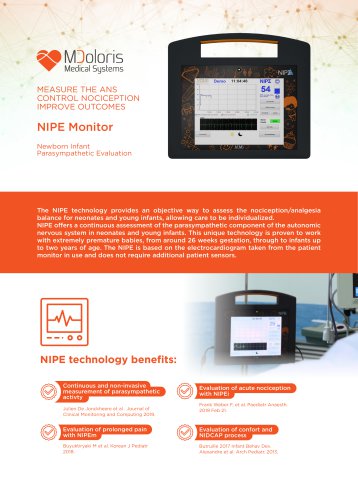 NIPE Monitor
2 Pages
 ANI V1 Monitor
2 Pages
- Patient monitor
- ECG patient monitor
- Intensive care patient monitor
- Compact patient monitor
- Clinical patient monitor
- Respiratory frequency patient monitor
- Patient monitor with touchscreen
- Continuous patient monitor
- Patient monitor with USB port
- Veterinary patient monitor
- Non-invasive patient monitor
- Patient monitor with integrated battery
- Bedside patient monitor
- Adult patient monitor
- Hospital patient monitor
- Pediatric patient monitor
- Surgery unit patient monitor
- Activity patient monitor
- Infant patient monitor
- Module for patient monitor