

Adolescent Scoliosis Patient brochure

Adolescent Scoliosis Patient brochure
This document by Medacta International offers guidelines on adolescent scoliosis, emphasizing that it should not replace professional medical advice and that surgeon instructions should be followed.
The spine is composed of 33 interlocking bones, including vertebrae and intervertebral discs, divided into five regions: cervical, thoracic, lumbar, sacrum, and coccyx, providing structural support and spinal cord protection.
Scoliosis is characterized by an abnormal lateral curvature of the spine, forming a "C" or "S" shape, affecting less than 1% of the population, mainly adolescents aged 10-16. Causes include idiopathic, congenital, and neuromuscular factors, with symptoms like uneven shoulders and prominent shoulder blades.
Most scoliosis cases are mild and do not require treatment. Non-operative treatments include observation, pain relief, and physical therapy, while surgery is considered for severe cases to correct and stabilize the spine using metal implants.
MySpine is a 3D printed, patient-matched technology for precise pedicle screw placement, offering benefits such as reduced radiation exposure and potentially shorter hospital stays.
Preparation involves stopping certain medications, fasting, and preparing the home to reduce fall risks. Patients should bring necessary items to the hospital, including medication lists and personal items.
Care involves a team of surgeons, nursing staff, and physical therapists. Open communication with the medical team and planning for post-surgery home care are encouraged.
Post-operative care includes monitoring in recovery, pain management, and rehabilitation. Patients may need to use a brace and follow specific activity restrictions.
Scoliosis has a genetic component and is not caused by lifestyle factors. Prevention is limited, with causes varying by type, including idiopathic, congenital, and neuromuscular origins.
The document provides information on scoliosis treatment options, surgical risks, insurance coverage, and post-operative considerations, with references to studies and tools used in spinal surgery.
Patients have both surgical and non-surgical options for treating scoliosis, with treatment choices based on individual factors such as age and activity level. Consultation with a doctor is advised.
Potential risks of scoliosis surgery include paraplegia, excessive blood loss, continued curve progression, failure of spine fusion, and infection. Patients should discuss these risks with their healthcare provider.
Patients are advised to confirm coverage with their insurance provider before surgery.
Metal implants may affect MRI scans and trigger airport metal detectors. Patients should carry an "Implant Passport" provided by their surgeon.
The document cites studies and references related to spinal surgery techniques, emphasizing the accuracy and safety of patient-specific guides for pedicle screw placement.
Medacta International SA provides contact details for further inquiries and emphasizes their commitment to improving orthopaedics and neurosurgery.
Catalog excerpts
Dear reader, Medacta International is pleased to provide you with these basic guidelines to help you and your family gain the best possible understanding of this pathology. Please treat this booklet as a guide only. If you require additional information, please consult your doctor. Always follow your surgeon’s instructions, even when they differ from those outlined in this booklet.
Open the catalog to page 2
Anatomy of the spine What is scoliosis What are the causes of adolescent scoliosis? What are the symptoms of adolescent scoliosis? Surgical treatment What happens during the surgery? Why would my doctor choose a MySpine surgery The MySpine advantage What to do before surgery Prepare your home What to bring to the hospital In the hospital 16 After the surgery 17 Frequently asked questions 18 This brochure has been produced to help you to feel comfortable and safe about your operation. It addresses questions you may have about the surgery and post-operative recovery.
Open the catalog to page 3
IN T R OD U CT ION The Spine, also known as the backbone or vertebral column, consists of 33 interlocking bones positioned on top of each other. It is made up of 24 separate bones interspaced with the “intervertebral discs”, with the sacrum (5 fused bones) and the coccyx (4 fused bones) at the base. The spine is a complex combination of interconnected bones, tendons, muscles, ligaments and nerves, any of which can become injured, misaligned or damaged leading to dysfunction. The spine provides the main structural support of the body allowing mobility, the ability to walk upright, and it gives...
Open the catalog to page 5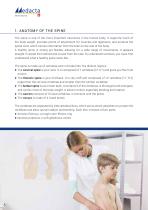
1. A N ATO M Y O F T H E S PIN E The spine is one of the most important structures in the human body. It supports much of the body weight, provides points of attachment for muscles and ligaments, and protects the spinal cord, which carries information from the brain to the rest of the body. A healthy spine is strong yet flexible, allowing for a wide range of movements. It appears straight if viewed from behind and curved from the side. To understand scoliosis, you must first understand what a healthy spine looks like. The spine is made up of vertebrae and is divided into five distinct regions:...
Open the catalog to page 6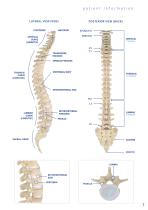
LATERAL VIEW (SIDE) POSTERIOR POSTERIOR VIEW (BACK) CERVICAL CURVE (LORDOTIC) TRANSVERSE PROCESS SPINOUS PROCESS THORACIC CURVE (KYPHOTIC) VERTEBRAL BODY INTERVERTEBRAL DISC LUMBAR CURVE (LORDOTIC) SACRAL CURVE INTERVERTEBRAL DISC VERTEBRA
Open the catalog to page 7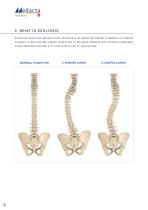
2 . W H AT I S S C O L I O S I S Everyone’s spine has natural curves. Scoliosis is an abnormal rotation in addition to a lateral curvature in the normally straight vertical line of the spine. Patients with scoliosis could have curves that look more like a “C” (one curve) or an “S” (two curves). NORMAL CONDITION C-SHAPED CURVE
Open the catalog to page 8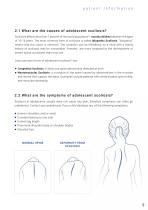
2 .1 W hat are the c auses of adolesc e n t sc oliosis? Scoliosis affects less than 1 percent of the world population[1], mostly children between the ages of 10-16 years. The most common form of scoliosis is called Idiopathic Scoliosis. “Idiopathic” means that the cause is unknown. The condition can be hereditary, so a child with a family history of scoliosis may be susceptible. Females are more disposed to the development of severe spinal curvatures than boys are. Less common forms of adolescent scoliosis[2] are: ■ Congenital Scoliosis: A fairly rare spine abnormality detected at birth ■ Neuromuscular...
Open the catalog to page 9
3. T R E AT M E N T O P T I O N S In 90 percent of cases, scoliotic curves are mild and do not require active treatment[3]. Non-operative treatment is preferred, including periodic observation, pain relievers and physical therapy. The most important factors to determine the treatment are: ■ Severity and the location of the curve ■ Age, gender and physical maturity ■ Associated symptoms It is very important to monitor curves in an adolescent patient, to prevent the progression of the pathology. In an adolescent with moderate curves, bracing could be an appropriate treatment option to prevent an...
Open the catalog to page 10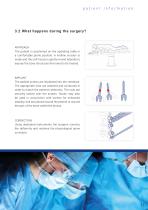
APPROACH The patient is positioned on the operating table in a comfortable prone position. A midline incision is made and the soft tissue is gently moved laterally to expose the bony structures that need to be treated. IMPLANT The pedicle screws are implanted into the vertebrae. The appropriate rods are selected and contoured in order to match the patient’s deformity. The rods are securely locked over the screws. Hooks may also be used in conjunction with screws for enhanced stability, and are placed around the pedicle or around the part of the bone called the lamina. CORRECTION Using dedicated...
Open the catalog to page 11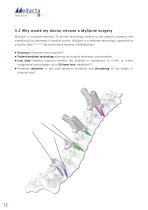
3.3 W hy woul d my d o c to r c h oose a M y S pi ne su rge r y MySpine is a patient-matched, 3D printed technology tailored to the patient’s anatomy and simplifying the placement of pedicle screws. MySpine is a validated technology supported by scientific data.[4,5,6,7,8,9] The main patient benefits of MySpine are: ■ Accuracy of pedicle screw position[5] ■ Patient-matched technology allowing for surgical technique customisation ■ Low dose radiation protocol benefits the patients in comparison to C-Arm or O-Arm navigational technologies: up to 30 times less irradiation![4] ■ Potential reduction...
Open the catalog to page 12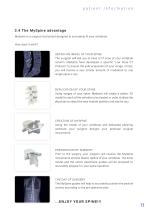
3.4 T he M y S pi ne ad van t age MySpine is a surgical instrument designed to accurately fit your vertebrae. How does it work? OBTAIN AN IMAGE OF YOUR SPINE The surgeon will ask you to have a CT scan of your vertebral column. Medacta have developed a specific “Low Dose CT Protocol” to ensure the safe acquisition of your image. In fact, you will receive a very similar amount of irradiation to one single spine x-ray! REPLICATION OF YOUR SPINE Using images of your spine, Medacta will create a plastic 3D model for each of the vertebra to be treated, in order to allow the physician to select the...
Open the catalog to page 13
4. P R E PA R AT I O N Depending on your condition, your recovery will be tailored to meet your needs. Your physician will determine the appropriate length of your hospital stay. Your recovery will continue at home or in a rehabilitation centre. It is important for you to make a commitment to follow your doctor’s instructions so you can get the most benefit from your surgery. Plan for assistance in your home after surgery. Consider your need for assistance in meal preparation, cleaning and other home activities. 4.1 W hat to do b efo re su r ge r y Ten days before surgery According to your conditions,...
Open the catalog to page 14All Medacta catalogs and technical brochures
 PowerSuture leaflet
2 Pages
 PowerKnot leaflet
2 Pages
 MectaQTH leaflet
2 Pages
 FairFix leaflet
2 Pages
 M-ARS ACL leaflet
2 Pages
 Adult Scoliosis Patient brochure
24 Pages
 M.U.S.T. SI Patient leaflet
8 Pages
 MySpine MC Patient brochure
12 Pages
 Sterile Implants leaflet
10 Pages
 M.U.S.T. leaflet
2 Pages
 M.U.S.T. MIS leaflet
2 Pages
 M.U.S.T. Mini leaflet
2 Pages
 MectaLIF leaflet
2 Pages
 MectaLIF Anterior leaflet
2 Pages
 MectaLIF TIPEEK leaflet
2 Pages
 Mecta-C leaflet
2 Pages
 Mecta-C Stand Alone leaflet
4 Pages
 MySpine S2AI leaflet
4 Pages
 MySpine MC leaflet
2 Pages
 MySpine leaflet
2 Pages
 HIGHCROSS leaflet
2 Pages
 GASTON leaflet
2 Pages
 MYHIP leaflet
2 Pages
 M-VIZION leaflet
5 Pages
 MPACT System leaflet
2 Pages
 VERSAFITCUP CC TRIO leaflet
2 Pages
 MINIMAX leaflet
2 Pages
 SMS leaflet
3 Pages
 MASTERLOC leaflet
2 Pages
 QUADRA System leaflet
2 Pages
 QUADRA-P System leaflet
4 Pages
 AMISTEM System leaflet
2 Pages
 AMISTEM-P leaflet
2 Pages
 AMIS EXPERIENCE brochure
28 Pages
 MYSHOULDER patient leaflet
8 Pages
 MYSHOULDER leaflet
4 Pages
 MOTO Medial patient leaflet
8 Pages
 GMK Sphere patient leaflet
8 Pages
 MyKnee patient leaflet
16 Pages
 Efficiency KneePack flyer
2 Pages
 GMK Revision System leaflet
2 Pages
 MOTO MEDIAL leaflet
4 Pages
 GMK UNI Anatomic leaflet
2 Pages
 GMK Efficiency leaflet
2 Pages
 MyKnee leaflet
4 Pages
 GMK Primary leaflet
2 Pages
 GMK Sphere leaflet
3 Pages


- Bone plate
- Analysis software
- Grasping forceps
- Endoscope
- Orthopedic surgery instrument kit
- Radiology software
- Reusable forceps
- Tablet computer software
- Tablet PC software
- Endoscopy forceps
- Interbody fusion cage
- Sealing forceps
- Bent forceps
- Planning software
- Tissue grasping forceps
- Suture thread
- PEEK interbody fusion cage
- Surgery software
- Femoral stem
- Anterior interbody fusion cage