- Catalogs
- Medical Protection
- BFE laboratory research report


BFE laboratory research report

BFE laboratory research report
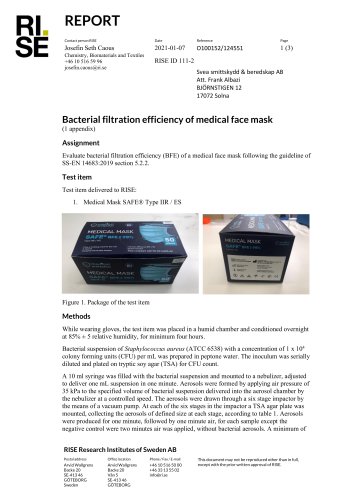
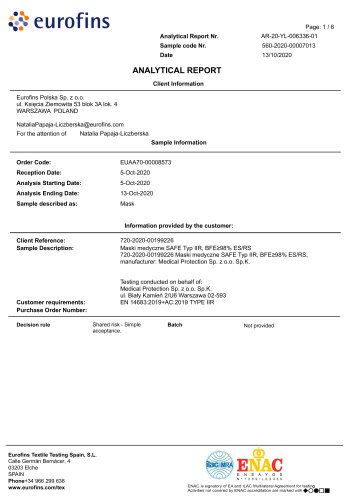
The study aimed to evaluate the bacterial filtration efficiency (BFE), microbiological cleanliness (bioburden), and breathability (differential pressure) of a batch of medical face masks from Medical Protection Sp. z o.o. Sp. K.
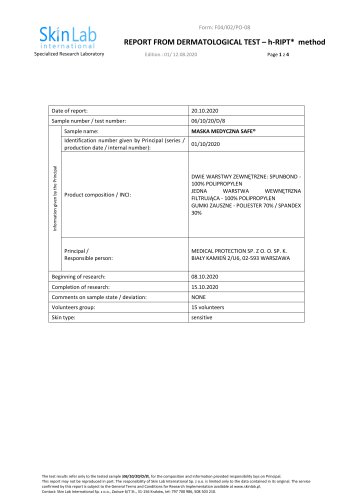
The test material included 15 medical masks made of non-woven fabric, measuring 17.1×9.3 cm, in blue with rubber bands.
The tests followed the European Standard EN 14683:2019+AC, assessing:
- Filtration efficiency of Staphylococcus aureus (Annex B)
- Microbiological cleanliness (bioburden) (Annex D)
- Breathability (differential pressure) (Annex C)
Bacterial Filtration Efficiency (BFE)
The BFE ranged from 98.1% to 98.9%, with an average of 98.7%, meeting the requirements for Type I and Type IIR masks (≥ 98%).
Microbiological Cleanliness (Bioburden)
The total bioburden ranged from 11.5 cfu/g to 22.9 cfu/g, averaging 16.2 cfu/g, complying with the ≤ 30 cfu/g requirement for all mask types.
Breathability (Differential Pressure)
The differential pressure ranged from 32.04 to 34.08 Pa/cm², meeting the requirements for Type I and Type II masks (<40 Pa/cm²) and Type IIR masks (<60 Pa/cm²).
The masks demonstrated a BFE of 99.7%, meeting the standards for Type I and Type IIR masks. The bioburden and differential pressure results also complied with the EN 14683:2019+AC standards for all mask types.
EN 14683:2019+AC Medical face masks - Requirements and test methods.
Catalog excerpts
Table of contents Aim of the tests Test material Test results Interpretation of results and conclusions
Open the catalog to page 2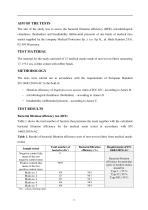
AIM OF THE TESTS The aim of the study was to assess the bacterial filtration efficiency (BFE), microbiological cleanliness (bioburden) and breathability (differential pressure) of one batch of medical face masks supplied by the company Medical Protection Sp. z o.o. Sp. K., ul. Biały Kamień 2/U6, 02-593 Warszawa. TEST MATERIAL The material for the study consisted of 15 medical masks made of non-woven fabric measuring 17.1×9.3 cm, in blue colour with rubber bands. METHODOLOGY The tests were carried out in accordance with the requirements of European Standard EN 14683:2019+AC in the field of: −...
Open the catalog to page 3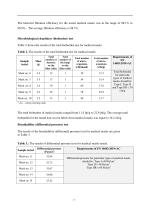
The bacterial filtration efficiency for the tested medical masks was in the range of 98.1% to 98,9%.. The average filtration efficiency is 98.7%. Microbiological cleanliness (bioburden) test Table 2 shows the results of the total bioburden test for medical masks. Table 2. The results of the total bioburden test for medical masks Sample tested Total number of bacteria on the filter (cfu) Total number of the fungi on the filter (cfu) Total number of microorganisms Total number of microorganisms Total bioburden for particular types of medical masks should be: Type I, Type II and Type IIR ≤ 30 cfu/g...
Open the catalog to page 4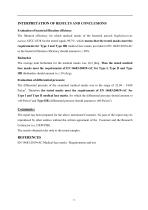
INTERPRETATION OF RESULTS AND CONCLUSIONS Evaluation of bacterial filtration efficiency The filtration efficiency for which medical masks of the bacterial aerosol Staphylococcus aureus ATCC 6538 for the tested equals 99.7%, which means that the tested masks meet the requirements for Type I and Type IIR medical face masks provided in EN 14683:2019+AC as the bacterial filtration efficiency should amount to ≥ 98%. Bioburden The average total bioburden for the medical masks was 16,2 jtk/g. Thus the tested medical face masks meet the requirements of EN 14683:20019+AC for Type I, Type II and Type IIR...
Open the catalog to page 5