


Pediatrics

Pediatrics
This document provides a comprehensive overview of the telescopic femoral nailing technique for pediatric patients with osteogenesis imperfecta. Based on the Bailey and Dubow method, this technique has been effective for over 25 years in addressing femoral fragility and deformities.
The procedure avoids knee arthrotomy by using a closed site nailing approach. Key features include a simple technique with minimal equipment and cost-effective implementation. The operative technique involves percutaneous centromedullary drilling under scopic control to ensure perpendicular entry and prevent axial deviation. Axial corrections are achieved through osteoclasy or percutaneous puncturing.
The procedure includes drilling through a counter-incision at the buttock, placing the female nail part followed by the male part, and using a small punch to impact the nail at the femur neck's upper edge.
Successful realignment of the femur using this technique is demonstrated, highlighting the aesthetic benefits of minimal incisions and simpler postoperative conditions.
Postoperative care includes options like a light cast or simple splint, emphasizing the avoidance of rotational anomalies. The technique allows for earlier intervention before significant femoral deformation occurs.
Ancillary equipment includes a long drill and a nail guide, with custom-made telescopic nails based on telemetric X-rays. The nails are centromedullary and locked into the epiphyses, consisting of female and male parts.
The female part is secured with a threaded pin, while the male part can be locked using various methods, including a pin or surgical thread.
The document outlines the tibial nailing technique, emphasizing extra-articular penetration and careful drilling.
This document provides comprehensive guidance on the telescopic nailing technique, highlighting its simplicity, cost-effectiveness, and benefits in pediatric orthopedic surgery.
The document also details the DMM nail and Fassier-Duval Telescopic Intramedullary System for patients with bone deformities like Osteogenesis Imperfecta and skeletal dysplasia. It includes specifications for femur, tibia, and humeral nailing techniques, extraction procedures, and advantages of these systems.
Details on distal fixation selection, the Rescue System 2.0 for component retrieval, and tibial derotation plates are provided, along with specifications for pediatric screw-plates and blade-plates for osteotomy.
Innovative systems like the Free-Gliding SCFE Screw System and Gap Nail System are described, designed to accommodate growth and reduce stress fractures in pediatric patients.
The document outlines intended uses for correcting deformities such as OI, skeletal dysplasia, and treating fractures and nonunions in various bones.
Catalog excerpts

Sommaire catalogue Distributeur/Distributor 34, Av du Dr Durand- 94110 ARCUEIL - FRANCE - tél. : [33] (0) 1 46 11 16 20 E-mail : [email protected] - Site Web : http://www.medicalex.info p 1/31 Z:\Catalogu
Open the catalog to page 1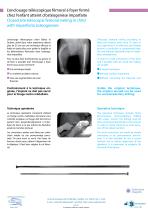
L’enclouage téléscopique fémoral à foyer fermé chez l’enfant atteint d’ostéogenèse imparfaite C losed site telescopic femoral nailing in child with imperfecta osteogenesis L’enclouage télescopique selon Bailey et Dubow, utilisé dans notre expérience depuis plus de 25 ans est une technique efficace et fiable en particulier pour pallier la fragilité et les déformations fémorales dans l’ostéogenèse imparfaite. Telescopic femoral nailing according to Baily and Dubow, used since 25 years in our experience is an effective and reliable technic in particular to compensate fragility and femoral deformites...
Open the catalog to page 2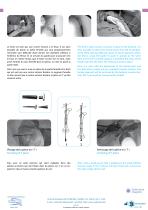
Le foret est sorti par une contre incision à la fesse. Il est alors possible de placer la pièce femelle qui sera progressivement remontée sans difficulté étant donné son diamètre inférieur à l’intérieur du fémur en se servant du guide pour la pousser vers le haut en même temps que le foret est tiré vers le haut. Juste avant l’entrée du clou femelle dans le genou, on met en place la partie mâle. Voici une vue avec la mise en place de la partie femelle et le foret qui est sorti par une contre incision fessière. Le segment femelle va être ressorti par la contre incision fessière, la pièce en T va...
Open the catalog to page 3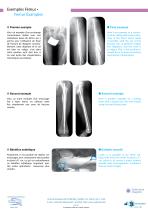
Exemples Fémur • Femur Examples Premier exemple First example Voici un exemple d’un enclouage correctement réalisé avec une ostéoclasie basse du fémur qui a permis avec l’utilisation du foyer de fracture de réaligner convenablement cette diaphyse et le col est bien en valgus. c’est dans cette position qu’il doit être si on veut éviter des complications mécaniques secondaires. Here is an example of a correctly done nailing with a low osteoclasy of the femur which made it possible, with the use of the fracture site, to properly realign this diaphysis, and the neck is in valgus. This is the position...
Open the catalog to page 4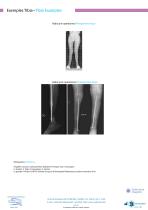
Exemples Tibia • Tibia Examples Radio pré-opératoires/ Preoperative Xrays Radio post-opératoires/ Postoperative Xrays Bibliographie / References Fragilités osseuses, ostéosynthèses palliatives Principes «bio» mécaniques G. Finidori, Z. Pejin, V. Topouchian, C. Glorion La gazette n°46 de la SOFOP (SOciété Française d’Orthopédie Pédiatrique), octobre-novembre 2016 Sommaire chapitre Distributeur/Distributor 34, Av du Dr Durand- 94110 ARCUEIL - FRANCE - tél. : [33] (0) 1 46 11 16 20 E-mail : [email protected] - Site Web : http://www.medicalex.info p 5/31 Z:\Catalogue Juillet 2021\Chap9_Pedi
Open the catalog to page 5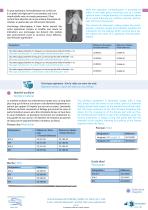
En post opératoire, l’immobilisation est confié soit à un plâtre très léger pelvi-cruro-jambier, soit à une simple attelle voire un simple pansement. Il faut surtout faire attention de ne pas induire d’anomalie de rotation, en particulier une rétroversion fémorale. After the operation, immobilization is provided by either a very light pelvic-crural-leg cast, or a simple splint or even a simple dressing. It is important above all to avoid inducing any rotation anomaly, particularly a femoral retroversion. L’enclouage télescopique à foyer fermé permet des suites opératoires simples et modifie sans...
Open the catalog to page 6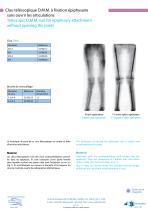
C lou téléscopique D.M.M. à fixation épiphysaire sans ouvrir les articulations T elescopic D.M.M. nail for epiphisary attachment without opening the joints Clou / Nail Diamètre Broche de verrouillage Diamètre du clou Avant opération Before the operation 15 mois après opération 15 months after operation La technique de pose de ce clou télescopique est simple et évite d’ouvrir les articulations. The technique of placing the telescopic nail is simple and avoids opening the joints. Les clous télescopiques sont des clous centromédullaires verrouillés dans les épiphyses. Ils sont composés d’une partie...
Open the catalog to page 7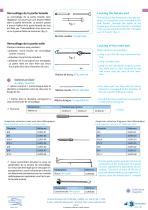
Verrouillage de la partie femelle Locking the female part Le verrouillage de la partie femelle dans l’épiphyse est assuré par une broche filetée dans la partie terminale. La broche passée à travers l’œillet de la partie femelle du clou est fixée par l’’intermédiaire d’un écrou serré sur la partie filetée de la broche. (fig. 2) The nailing of the female part into the epiphysis is insured by a pin threaded in the end. Passed through the eyelet of the female part of the nail, the pin is attached with a screw tightened onto the threaded part of the pin. (fig. 2) Broche coudée / Angled pin Verrouillage...
Open the catalog to page 8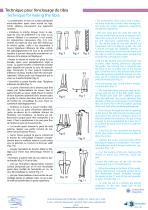
T echnique pour l’enclouage du tibia Technique for nailing the tibia • La pénétration se fait à la surface préspinale extra-articulaire après avoir écarté les ligaments adipeux sous-jacents aux ligaments rotuliens • Introduire la mèche longue. Forer le passage du clou de préférence à la main ou au moteur. Réaliser à ce moment, à ciel ouvert, les ostéotomies nécessaires (Fig. 3-5). L’ensemble du trajet du clou doit être réalisé par la mèche guide celle-ci est descendue à ; travers l’épiphyse inférieure du tibia, contrôlée radiologiquement de face et de profil de manière à pouvoir descendre exactement...
Open the catalog to page 9All Medicalex catalogs and technical brochures
 External fixations
5 Pages
 Various
14 Pages
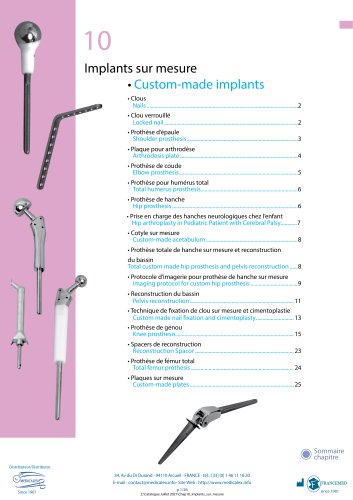 Custom-made implants
26 Pages
 Spine
Spine15 Pages
 Prostheses
9 Pages
 Nail-plates and blade-plates
12 Pages
 Thorax
24 Pages
 plates
23 Pages
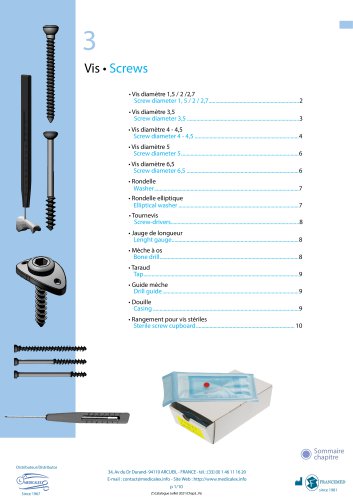 Screws
10 Pages
 Staples
4 Pages
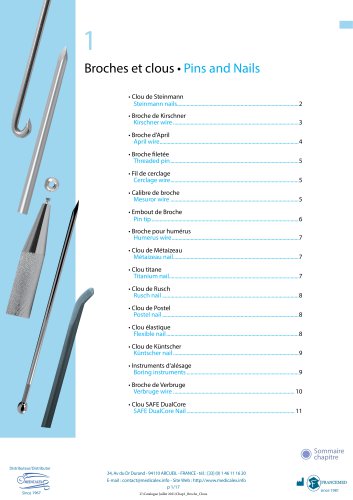 Pins and Nails 2024
17 Pages
 SAFE DualCore Universal Nail
8 Pages
- Medical dolly
- Bone plate
- Logistics trolley
- Compression plate
- Hospital trolley
- Metallic compression plate
- Locking compression plate
- Surgery forceps
- Instrument trolley
- Titanium compression plate
- Orthopedic surgery instrument kit
- Distal compression plate
- Compression bone screw
- Drill
- Bent forceps
- Metal trolley
- Metallic compression bone screw
- Proximal compression plate
- Arthrodesis nail
- Forearm compression plate