
- Catalogs
- medis Medizinische Messtechnik
- CardioScreen® 2000

CardioScreen® 2000

CardioScreen® 2000
- Non-Invasive Measurement: The device allows for 100% non-invasive measurement of haemodynamic parameters.
- Real-Time Monitoring: Continuous, beat-to-beat monitoring and recording of curves and parameters.
- Connectivity: Compatible with Windows Panel PCs, patient monitors, and allows offline data analysis and export.
- Ease of Use: Requires only four sensors and offers flexible configurations based on customer needs.
- Channels: Includes Impedance Cardiography, Blood Pressure, Pulse Wave Velocity, and Ankle-Brachial Index.
- Dimensions: 310 x 90 x 260 mm, weighing approximately 2 kg.
- Power Supply: Operates on 100-240 V AC, 50/60 Hz.
- Peripheral Arterial Occlusion: Uses the Ankle-Brachial Index for early diagnosis and follow-up of peripheral arterial occlusive disease.
- Hypertension Management: Identifies haemodynamic modulators to optimize hypertension treatment.
- Cardiovascular Risk Assessment: Evaluates arterial stiffness and vascular age using Pulse Wave Velocity.
- Other Applications: Includes monitoring haemodynamic parameters, fluid management, and pacemaker optimization.
Catalog excerpts

DEVICE FOR CARDIOVASCULAR DIAGNOSIS AND SCREENING IMPEDANCE CARDIOGRAPHY (ICG) Changes in volume and velocity of blood in the aorta cause variations in the thoracic bio-impedance which is measured and displayed as the ICG waveform. Innovative algorithms are applied to this signal to provide key haemodynamic parameters non-invasively and continuously. By means of our unique ACM-Technology in combination with the new 4TECT Sensor-Application the accuracy of the measuring method could be considerably increased and its application could be made even more simple - a new generation of Impedance Cardiography. AORTIC PULSE WAVE VELOCITY (PWV ao ) The opening of the aortic valve is defined as the B-Point in the ICG signal. The arrival of the Pulse Wave (PW) is measured on the thigh using a pressure cuff and the Propagation Time (PT) is determined. From this the aortic Pulse Wave Velocity (PWVao) can be calculated. Beginning of ventricular depolarisation PEP Pre-Ejection Period Q Opening of aortic valve Maximum systolic flow Closing of aortic valve Opening of mitral valve Left Ventricular Ejection Time Propagation Time FEATURES Enables 100% non-invasive measurement of haemodynamic parameters Continuous (beat-to-beat), real-time monitoring and recording of curves and parameters Different device configurations available according to the customer's needs Only 4 sensors necessary Application-oriented through different screens for optimal data presentation in various clinical settings Standardised and operator-independent examinations Connectable to any Windows Panel PC (touch screen), PC or Notebook Integrable & connectable Heart Rate Blood Pressure Stroke Volume/Index Cardiac Output/Index Velocity Index Acceleration Index Heather Index Pre-Ejection Period Left Ventricular Ejection Time Systolic Time Ratio Corrected Flow Time Thoracic Fluid Content VASCULAR Ankle-Brachial-Index Propagation Time aortic Pulse Wave Velocity Systemic Vascular Resistance Interface to patient monitors, such as Philips/HP (VueLink / IntelliVue / IntelliBridge) Offline data analysis and data export (e.g. Excel) Selection of available parameters
Open the catalog to page 1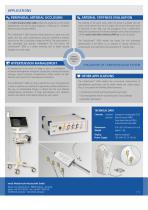
APPLICATIONS ARTERIAL STIFFNESS EVALUATION PERIPHERAL ARTERIAL OCCLUSION The Ankle-Brachial Index (ABI) enables the assessment of the overall cardiovascular risk and the early diagnosis or follow-up of peripheral arterial occlusive disease (PAOD). The CardioScreen® 2000 measures blood pressure on upper arms and ankles with four cuffs simultaneously using the oscillometric method. From this the ABI is calculated to diagnose PAODs. The measurement is fully automated and operator independent. For this reason, the CardioScreen® 2000 is a simple screening tool to detect vascular changes at an early...
Open the catalog to page 2All Medis Medizinische Messtechnik catalogs and technical brochures
 CardioScreen® 1000
3 Pages
 VenoScreen plus
2 Pages
 VenoScreen®
2 Pages
 VasoScreen®
3 Pages
Archived catalogs
 CardioScreen® 1000
2 Pages
 VenoScreen® plus
2 Pages
- Blood pressure patient monitor
- ECG patient monitor
- SpO2 patient monitor
- Portable patient monitor
- NIBP patient monitor
- Clinical patient monitor
- Heart rate patient monitor
- Continuous patient monitor
- Patient monitor on casters
- Cardiac output patient monitor
- Plethysmograph
- Body plethysmograph
- Computer-based patient monitor
- Hemodynamic patient monitor
- Patient monitor with separate sensor
- ABI patient monitor
- Cardiac output monitor
- Plethysmograph with venous occlusion
- Non-invasive cardiac output monitor