

Medmont E300 Corneal Topographer

Medmont E300 Corneal Topographer
The Medmont E300 USB Corneal Topographer is used in various corneal analysis and treatment procedures such as Orthokeratology, Keratoconus, Contact Lens fitting, Corneal Grafts, and PRK and LASIK procedures.
The device features a compact cone design with precision optics, using 32 rings and over 15,000 measurement points. It provides detailed topography data over a wide area, from a minimum ring diameter of 0.25mm to 14mm with Composite Capture, ideal for assessing corneal pathologies and contact lens fitting.
Automatic image capture with a simple alignment system stores the four best images. The software corrects defocused and off-centered images, ensuring high accuracy. An image scoring system informs users about image quality.
The software allows automatic fitting of RGP lenses, including multiple peripheral curves, toric, aspheric, and conic designs. It includes a database of standard lens designs and allows manual adjustments, with results shown on a simulated fluorescein display and tear film clearance graph.
The E300 USB offers configurable display options, presenting up to four images per screen. It includes Zernike analysis software for corneal height data and wavefront error analysis. Individual Zernike components can be displayed and analyzed.
Integration with practice management systems and other Medmont products is possible using Medmont Studio, improving practice efficiency. Multiple E300 USB units can share a database over a network.
- Rapid and precise computer-aided image capture
- Advanced image analysis for superior performance
- High capacity patient database
- Various map displays including tangential curvature/power, axial curvature/power, and wavefront error
- Comprehensive contact lens fitting options
- Shape descriptors and global indices
- Regression analysis for orthokeratology
- Microsoft Windows-based software with network compatibility
- Coverage: Standard Capture 0.25 - 11mm, Composite Limbus to Limbus
- Field of View: H12.5mm x V10.5mm
- Power Range: 10 – 100 Diopters
- Number of Rings: 32
- Measurement Points: 15,120
- Optical Working Distance: 65mm
- Repeatability: Test Object < 0.1 Diopters
- Dimensions: Width 350mm, Depth 350mm, Height 430mm +/- 15mm Stroke
- Weight: 5.5kg
- Power Requirements: 12V DC 500mA via USB Converter Box
- PC Requirements: Pentium IV, 2.8GHz, 512 MB RAM, 80GB HD, 1 x USB2 Ports, Windows 7/8, 17” Monitor
- Printer: Compliant to IEC 60950, Bubblejet/Laser, Colour/Black & White
- Backup: CD ROM/DVD/External Hard Drive
- Contact Lens Database: Comprehensive Contact Lens and Ortho-K Lens Database Standard
- According to Directive 93/42 EEC
- ISO 13485 Certified
Catalog excerpts

* When Accuracy Matters Medmont E300 USB Corneal Topographer When Accuracy Matters
Open the catalog to page 1
The E300 Advantage Largest Coverage of Any Placido Ring Topographer, Featuring the New TCC Algorithm, Providing Full Limbus to Limbus Coverage Exceptional Accuracy With a Standard Deviation of Error of 2 µm, GOLD Standard for Performing Orthokeratology Comprehensive Database of Contact Lens and Orthokeratology Lens Designs The Medmont E300 USB Corneal Topographer offers the practitioner extreme accuracy for the mapping of a patients cornea. Utilising a PC, the patients full corneal history can be stored and accessed quickly and efficiently. A huge range of display options is now available providing...
Open the catalog to page 2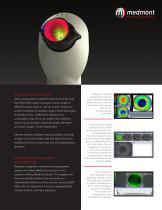
ANALYSIS AND DISPLAY Easily configurable to specific preference of the user, the E300 USB is able to present a wide variety of different display options, with up to four images per screen. Examples of multiple images of the same type to identify trends, a difference display and a combination map which can present four different views (e.g. axial power, tangential power, elevation and video image) of one examination. Zernike analysis software is also provided, including analysis of corneal height data and wave front error. Individual Zernike components can be displayed and analyzed. PRACTICE MANAGEMENT...
Open the catalog to page 3
SPECS COVERAGE Standard Capture: 0.25 -11mm Composite: Limbus to Limbus Extrapolated Data Point Coverage: Limbus to 18mm FIELD OF VIEW POWER RANGE MEASUREMENT POINTS OPTICAL WORKING DISTANCE 65mm REPEATABILITY Test Object < 0.1 Diopters FOOTPRINT Width: 350mm Depth: 350mm Height: 430mm +/- 15mm Stroke WEIGHT 5.5kg (Unit Only) POWER REQUIREMENTS 12V DC 500mA via USB Converter Box PC MIN REQUIREMENTS Compliant to IEC 60950 and Powered Via Medical Isolation Transformer. Pentium IV, 2.8GHz, 512 MB RAM, 80GB HD, 1 x USB2 Ports , Windows 7, Windows 8. 17” Monitor. PRINTER Compliant to IEC 60950 Bubblejet...
Open the catalog to page 4All Medmont catalogs and technical brochures
 DV2000
2 Pages


- Tablet computer software
- Tablet PC software
- Windows software
- Diagnostic software
- Fixed ophthalmic examination
- Capture software
- Image analysis software
- Keratometer ophthalmic examination
- Automatic keratometer
- Image capture software
- Ophthalmic software
- Android application
- Ophthalmic perimeter
- Android android application
- Standardization software
- Static ophthalmic perimeter
- Mapping software
- Test android application