
- Catalogs
- membraPure
- Product Guide 2026


Product Guide 2026
Product Guide 2026
membraPure GmbH is a leader in water purification systems and analyzers, specializing in TOC, amino acids, and ion analysis. Their systems are renowned for advanced technology and low maintenance, with a global presence through sales offices and a dealer network.
Founded in 1993, membraPure has expanded its product line to include analyzers like miniTOC, ARACUS, and IONUS. The company emphasizes innovation, holding several patents, and offers online service support. Manufacturing facilities have been expanded to meet increasing demand.
membraPure provides tools such as product finders and questionnaires to help customers select the right system configuration. They also offer application notes and literature for further insights into their products.
Water quality is categorized into types I, II, and III based on international norms (ASTM, ISO, CLSI), each suited for specific laboratory applications, with further classification by microbiological contamination levels.
membraPure offers various configurations for their water purification systems, including bench top, bench integrated, and wall-mounted options, to accommodate different space requirements.
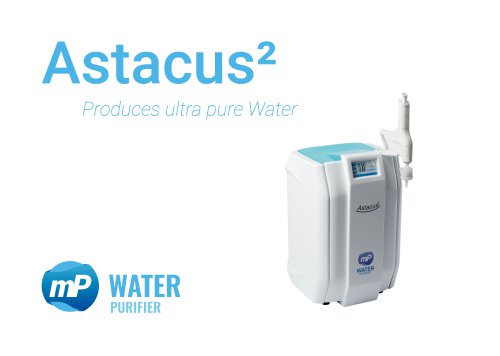
- Astacus²: Produces ultra pure water with a resistivity of 18.2 MΩ·cm and TOC < 10 ppb. Available in multiple configurations with optional TOC monitoring.
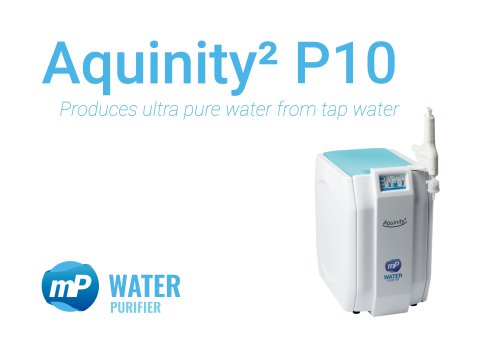
- Aquinity² P10: Converts tap water to ultra pure water with a resistivity of 18.2 MΩ·cm. Features a 10-liter storage tank and optional TOC sensor.
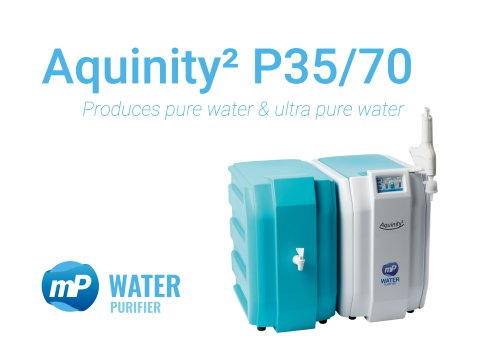
- Aquinity² P35/70: Produces both pure and ultra pure water, with a production rate of 10 L/h (optional 20 L/h). Includes a large external storage reservoir.
Each system is designed with specific technical parameters, including water quality, resistivity, TOC levels, and productivity rates. Systems are equipped with features like automatic recirculation and optional TOC sensors to maintain water quality.
Systems require pretreated or tap water with specific conductivity, pressure, and temperature ranges to ensure optimal performance.
membraPure's water purification systems are designed to meet diverse laboratory needs, offering flexibility in configuration and high-quality water output. Their commitment to innovation and customer support makes them a trusted partner in the field.
The document provides detailed technical specifications and configurations for water purification systems, specifically the Aquinity² and AquaRO²/EDI² series. These systems are designed to produce pure and ultra-pure water from tap water using reverse osmosis (RO) and electrodeionization (EDI) technologies.
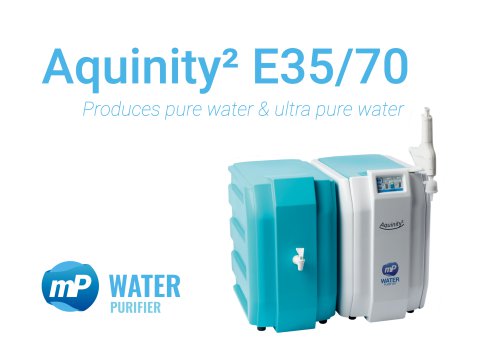
- Aquinity² E35/70: Produces pure water (<0.2 µS/cm) and ultra-pure water (0.055 μS/cm) with a production rate of 10 L/h, optionally 20 L/h. It includes features like automatic recirculation, UV lamp, and optional TOC sensor.
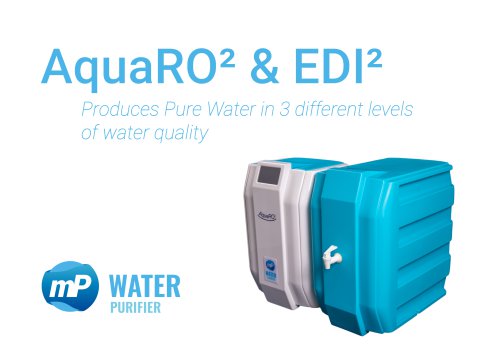
- AquaRO² and EDI²: Designed for producing pure water (10 μS/cm to 0.2 μS/cm) with a production rate ranging from 8 to 80 L/h. The systems can be configured with various tank sizes and optional dispensers.
- Ultra-pure water quality: Type I and Type II with resistivity up to 18.2 MΩ·cm.
- TOC levels: Varying from <10 ppb to <2 ppb depending on the model.
- RO rejection rate: >99% for ions, germs, and bacteria.
- Feed water requirements: Conductivity <2000 μS/cm, pH 4 to 10, temperature 5 to 35 °C.
The document lists various models with specific configurations for different applications such as Reagent, Analytical, and Life Science. Each model has a unique catalog number for identification.
Details the required modules and filters for initial installation and commissioning of the systems, including pretreatment and ultra-pure modules.
Several optional features and upgrades are available, such as μS-control, TOC monitoring, volumetric dispensing, and direct feed capabilities. These options enhance the functionality and adaptability of the systems.
The document provides a list of consumables and spare parts necessary for the maintenance and operation of the systems, including UV lamps, filters, and modules.
The document serves as a comprehensive guide for selecting, configuring, and maintaining water purification systems, ensuring high-quality water production for various scientific and industrial applications.
This document provides detailed information on the installation, commissioning, and options for the EDI² and AquaRO² series water purification systems, as well as the OptiPrep² and miniTOC systems. It includes specifications, available upgrades, consumables, spare parts, and technical specifications for each system.
- EDI² Series: Models include EDI² 10, 20, 40, and 80, with various configurations and upgrades available, such as dispenser function upgrades, direct feed capabilities, and collective alarm notifications.
- AquaRO² Series: Offers additional tank options, wall-mounted or bench-integrated configurations, and prefilter units for enhanced water purification.
- OptiPrep² Series: Designed for ultra-pure water production, featuring a combination of prefilters, mixed bed filters, and scavenger cartridges. It includes technical specifications such as water resistivity, TOC levels, and productivity rates.
- miniTOC System: Used for TOC monitoring in pure and ultra-pure water, utilizing UV oxidation and conductivity detection. It provides detailed specifications on operating range, accuracy, and sample requirements.
- Consumables for the AquaRO² and EDI² series include pretreatment and conditioning modules, while spare parts cover reverse osmosis modules and EDI cells.
- OptiPrep² consumables include activated carbon cartridges and mixed bed cartridges, with spare parts such as UV lamps and booster pumps.
- Installation kits and training are available for the miniTOC system, ensuring proper setup and operation.
- Consumable maintenance bundles are offered to streamline reordering and minimize system downtime.
- Detailed technical specifications are provided for each system, including dimensions, power requirements, and operational conditions.
- Feed water requirements and configurations for the OptiPrep² series are outlined, ensuring compatibility with existing systems.
- Options for extended warranties and validation documents (IQ/OQ/PQ) are available upon request.
- Various system extensions and upgrades are offered to enhance functionality and meet specific user needs.
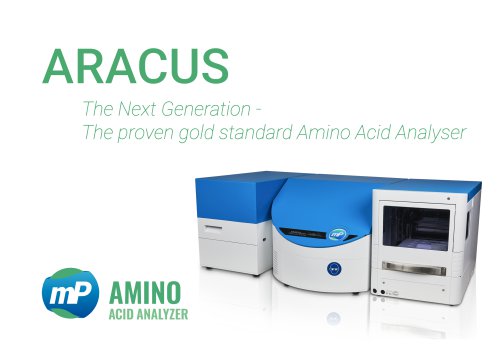
- ARACUS Classic: Standard setup with continuous analysis capability for up to 96 samples. Utilizes LED photometers for detection and includes a washing routine to prevent cross-contamination.
- ARACUS Advanced: Features an additional pump drive for improved signal-to-noise ratio and the option to use OPA for primary amines detection.
- ARACUS Lite: A budget-friendly version with reduced sample throughput and eluent consumption, suitable for high-speed and high-resolution columns.
- ARACUS IVD: Compliant with CE Regulation IVDR EU 2017/746, intended for medical diagnostics, including homocysteine detection.
- Method: Ion exchange chromatography with post-column derivatization using ninhydrin.
- Pump System: Double piston HPLC pumps with ceramic inlays, max pressure 400 bar, flow rate 0.01 - 10.00 mL/min.
- Detection: LED photometers (440 nm + 570 nm), optional fluorescence detector for OPA method.
- Autosampler: Two trays for 48 vials each, with cooling capabilities.
- Column Oven: Temperature range 5 – 160 °C, accuracy 0.1%.
- Includes various connectors, fittings, sensors, and pump components.
- Service kits available upon request.
- Installation and training provided at customer site or membraPure's facility.
- Options for manual or automatic configurations with potential upgrades.
- Linearity, retention time reproducibility, and peak area precision are specified for the test system.
- Various column kits and supplement kits are available for different separation needs.
- Custom methods and additional separation techniques available upon request.
- Hydrolysate and Feedstuff Systems: These systems utilize specific column and supplement kits for high-speed and high-resolution sodium analysis. The feedstuff standard is often spiked with MET-SOx, ORN, and TRP.
- Collagen and Advanced Systems: These systems are designed for more complex analyses, using advanced column kits and supplement kits tailored for specific applications.
- Kit Composition: Each kit contains various eluents, sample dilution buffers, autosampler dilutions, reactor wash solutions, and reagents for derivatization. The kits are designed for approximately 500 runs, but smaller kits for 100 analyses are available upon request.
- Customization: Customers can order individual components to tailor the analysis methods to their specific needs.
- Standard Solutions: Various standards are available for physiological, hydrolysate, feedstuff, canonical, and biogenic amine analyses.
- Spare Parts: A comprehensive list of spare parts for the ARACUS amino acid analyzer is provided, including maintenance kits, pumps, valves, and photometers.
- Sample Preparation: Services include hydrolysis, deproteination, and desalting of samples.
- Analytical Runs: Options for single, double, or triple runs are available, with detailed reports and discussions of results.
- Service Contracts: Various levels of service contracts are offered, ranging from basic phone support to comprehensive on-site visits and spare parts inclusion.
- Detection Variants: The ion chromatograph is available with conductivity detection or post-column derivatization with UV/VIS photometers, similar to the ARACUS amino acid analyzer.
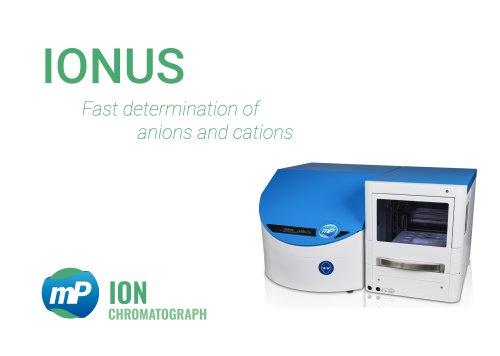
This document provides detailed information on the IONUS ion chromatograph, which is designed for the analysis of anions and cations in various applications, including research, development, and routine analysis. The chromatograph is compatible with columns from multiple manufacturers and can be customized for specific separation problems.
The IONUS system uses ion exchange chromatography in a single-channel configuration with an isocratic pump system capable of a maximum pressure of 400 bar and a flow rate of 0.1 – 10 mL/min. It includes a manual injection system with a 20 µL loop and an autosampler with space for 48 vials. The detection is performed using a conductivity detector with a noise level of 0.02 µS/1s and a range of 0-10 mS/cm. The system is controlled by iControl & Clarity software, which is 21 CFR Part 11 compliant.
The IONUS can be equipped with suppressor technology for improved sensitivity in anion analysis. For cases where suppressor technology is not used, an external UV/VIS detector can be employed for indirect UV detection. The system supports post-column derivatization (PCD) for applications requiring higher sensitivity, such as bromate detection.
The document lists various columns available for different applications, including standard and special applications for anions and cations. Columns are available in stainless steel and PEEK, with specifications tailored to specific analyses such as EPA 300 Part A and B.
The IONUS system requires specific items for installation, including an analyzer with an autosampler, software, and a column oven. Options include manual injection configurations, suppressors for anion analysis, and external UV/VIS detectors.
The document provides chromatograms demonstrating the separation performance of various columns for anions, cations, and organic acids. It also details the performance of the IONUS PCD in detecting bromate, transition metals, and organic acids using specific methods and reagents.
The IONUS ion chromatograph is a versatile and customizable system suitable for a wide range of analytical applications. Its compatibility with various columns and detection techniques makes it a valuable tool for laboratories with high demands on efficiency and accuracy.
The document outlines the use of specific columns and reagents for ion chromatography. For the determination of Chromium (III) and Chromium (VI), a column with Cat. No. 650-0132 is used with a 30 mM Ammonium nitrate eluent and a 2.0 mM 1,5-Diphenylcarbohydrazide reagent. Detection occurs at 340 nm and 530 nm.
Retention times for various acids and chromium ions are provided, indicating the separation efficiency of the chromatographic process.
The document lists various consumables and spare parts for the IONUS and IONUS PCD systems, including stock solutions, suppressor columns, and various fittings and syringes. It emphasizes the low maintenance and long service life of the system components.
Analytical runs are available for measuring anions, cations, and transition metals in samples. The document also details service contract levels (Bronze, Silber, Gold, Platinum) with varying levels of support and maintenance.
The appendix provides detailed content lists for standard amino acids and biogenic amines, as well as standard stock solutions for anions and cations.
Contact details for membraPure GmbH are provided for further inquiries and technical support.
Catalog excerpts
Product Guide 2026 membraPure GmbH Your trusted partner for more than 30 years Made in Germany membraPure systems – experts in water purification systems and related analyzers
Open the catalog to page 1
Version February 2026 This Product Guide is continuously updated. However, minor changes may not always be reflected in the printed version. We therefore recommend checking the digital version or contacting us directly for the latest information.
Open the catalog to page 2
Systems from membraPure – Water purification systems and analyzers for TOC, amino acids and ions at the highest level. Since 1993 we have been dealing with water purification systems. Over the course of time, we have continuously expanded our activities to include the associated analyzers like miniTOC, ARACUS and IONUS. For more than a quarter of a century, membraPure has been an established player in the international market for pure and ultra pure water systems, TOC, amino acid analyzer and ion chromatography. Our systems and applications have been advanced continuously and we have been granted...
Open the catalog to page 3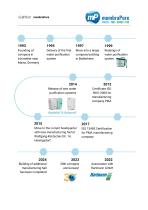
1993 Founding of company in Lorzweiler near Mainz, Germany Delivery of the first water purification system Move into a larger company building in Bodenheim Redesign of water purification system 2014 Release of new water purification systems 2012 Certificate ISO 9001:2008 for manufacturing company PMA Aquinity2 & Astacus2 2015 Move to the current headquarter with new manufacturing hall at Wolfgang-Kuntscher-Str. 14, Hennigsdorf 2017 ISO 13485 Certification for PMA manufacturing company 2024 Building of additional manufacturing hall has been completed 2022 Association with Hartmann GmbH
Open the catalog to page 4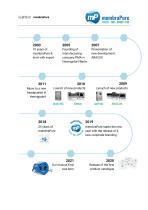
2003 10 years of membraPure & start with export Founding of manufacturing company PMA in Hennigsdorf/Berlin 2011 Move to a new headquarter in Hennigsdorf
Open the catalog to page 5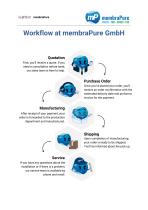
Workflow at membraPure GmbH Quotation First, you'll receive a quote. If you need a consultation before hand, our sales team is here to help. Purchase Order Once you've placed your order, you'll receive an order confirmation with the estimated delivery date and proforma invoice for the payment. Manufacturing After receipt of your payment, your order is forwarded to the production department and manufactured. Shipping Upon completion of manufacturing, your order is ready to be shipped. You’ll be informed about the pick up. Service If you have any questions about the installation or if there is...
Open the catalog to page 6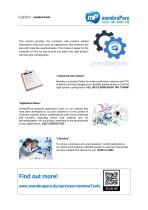
This section provides the customer with product related information resources such as applications and literature but also with tools like questionnaires. This makes it easier for the customer to find his way around and select the right product with the right configuration. “Customize your system” Besides our product finder for water purification systems and TOC anaylzers we have designed our detailed questionnaire to find the right system configuration. FILL OUT & SEND BACK! TRY IT NOW! “Application Notes” membraPure presents application notes on our website that have been developed on our own...
Open the catalog to page 7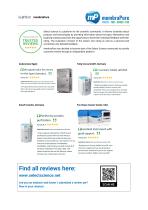
membraPure membraPureWATER-TOC-AMINO-ION Arabcomed, Egypt Select Science is a platform for the scientific community. It informs scientists about products and technologies by providing information about the topics themselves and by giving existing customers the opportunity to leave their individual feedback with their rating. The evaluation consists of the classic star rating as well as a personal and sometimes very detailed feedback. membraPure has decided to become part of the Select Science community to provide customer reviews through an independent platform. Tulip Cocoa GmbH, Germany C tVery...
Open the catalog to page 8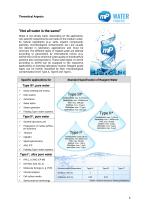
Theoretical Aspects "Not all water is the same!" Water is not simply water. Depending on the application, very specific requirements are made on the medium water. Its natural ingredients (e.g. salts, organic compounds, particles, microbiological contaminants etc.) are usually not desired in laboratory applications and must be removed. The different types of treated water are defined according to parameters by international norms (e.g. ASTM, ISO, CLSI) to which the water quality of membraPure systems also corresponds to. These water types I, II and III according to ASTM can be assigned to the...
Open the catalog to page 9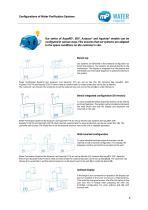
Configurations of Water Purification Systems Our series of AquaRO², EDI², Astacus² and Aquinity² models can be configured in various ways.This ensures that our systems are adapted to the space conditions on the customer’s site. Bench top Our systems are delivered in the standard configuration as bench top systems. The systems are placed directly on the workstation. The display is integrated into the system and the flexible and removable dispenser is attached directly to the system. Water Purification Systems like Astacus² and Aquinity² P10 are set up like this (1). Systems like AquaRO², EDI²,...
Open the catalog to page 10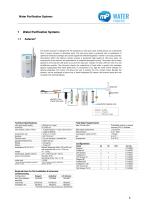
Water Purification Systems Water Purification Systems The system Astacus² is designed for the production of ultra pure water (0.055 μS/cm) out of permeate from a reverse osmosis or deionized water. The ultra pure water is produced with a combination of optimized mixed bed cartridges and can be tapped with a flexible dispenser. If water is not used, automatic recirculation within the Astacus² system ensures a permanent high quality of ultra pure water. All components of the Astacus² are assembled in an especially designed housing. The system can be easily opened by removing the side panel to access...
Open the catalog to page 11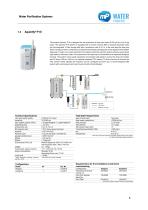
Water Purification Systems1.2 Aquinity2 PI 0 The system Aquinity2 P10 is designed for the production of ultra pure water (0.055 pS/cm) out of tap water. The Aquinity2 P10 system is equipped with a reverse osmosis (RO) to produce deionized water into the integrated 10 liter storage tank with a production rate of 8 L/h. In the next step the ultra pure water is produced with a combination of optimized mixed bed cartridge and can be tapped with a flexible dispenser. If water is not used, automatic recirculation within the Aquinity2 system ensures a permanent high quality of ultra pure water. All...
Open the catalog to page 12All MembraPure catalogs and technical brochures
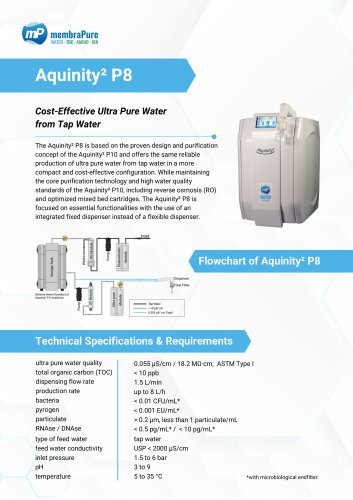 Datasheet Aquinity² P8
2 Pages
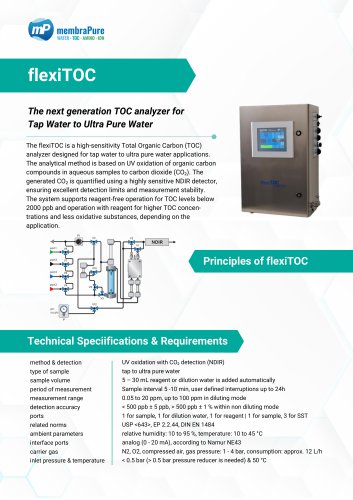 Datasheet flexiTOC
2 Pages
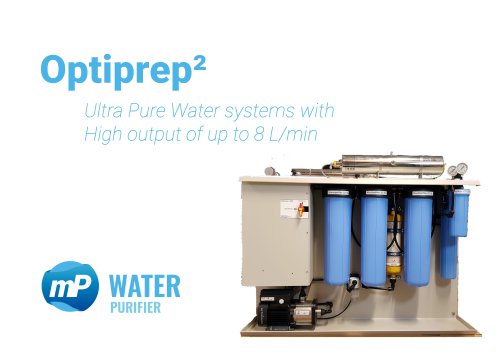 OptiPrep²
12 Pages
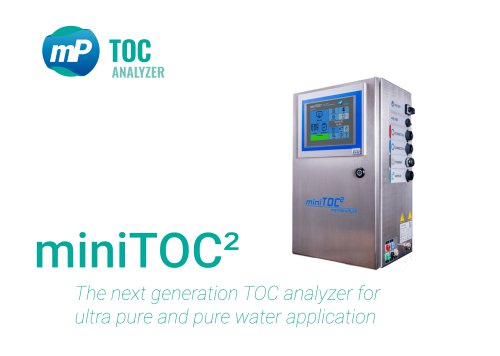 TOC Analyzer miniTOC²
12 Pages
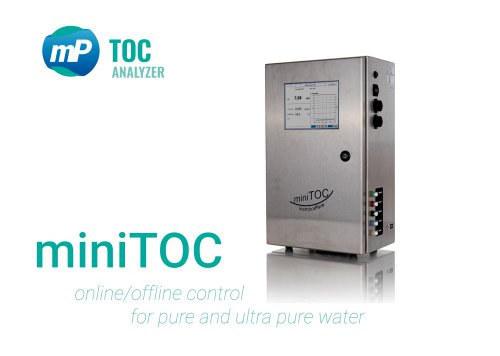 TOC Analyzer miniTOC
8 Pages
 Datasheet miniTOC²
2 Pages
 ARACUS - Amino Acid Analyzer
20 Pages

Archived catalogs
 uniTOC - online TOC Analyzer
8 Pages
 Product Guide 2025
56 Pages
 OptiLab² & OptiPrep²
12 Pages
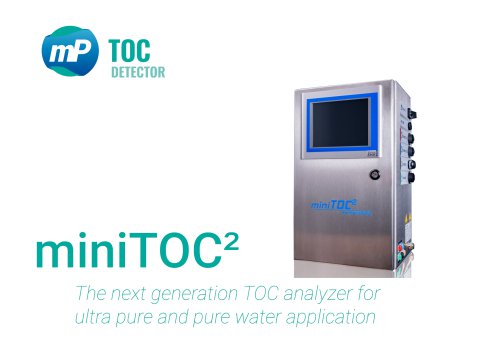 Broschure miniTOC²
8 Pages
 Aquinity² P10
12 Pages
 Aquinity² E35/70
12 Pages
 Aquinity²P35/70
12 Pages
 Series of AquaRO² & EDI²
16 Pages
 Astacus²
12 Pages
 Product Guide 2024
52 Pages
 Product Guide 2023
56 Pages


- Chromatography system
- Mobile disinfection system
- Reverse osmosis water treatment system
- UV disinfection system
- Electric disinfection system
- Liquid chromatography system
- Laboratory water purifier
- Reverse osmosis water purifier
- Research chromatography system
- UV/VIS chromatography system
- Modular chromatography system
- Laboratory monitoring system
- TOC analyzer
- Chromatography system for the pharmaceutical industry
- Ultraviolet chromatography system
- Real-time monitoring system
- Ion chromatography system
- Chromatography system with auto-sampler
- Ultrapure water water purifier
- Whole-room disinfection system