
- Catalogs
- Menarini Silicon Biosystems
- Ampli1™ Technical Bulletin

Ampli1™ Technical Bulletin

Ampli1™ Technical Bulletin
Whole Genome Amplification (WGA) is essential for obtaining sufficient DNA from single cells for analysis. The document discusses three main WGA methods: PCR-based, Random priming + PCR, and Random priming + isothermal amplification, each with unique advantages and limitations regarding ease of use, throughput, cost, and performance.
Ampli 1™ WGA Kit
The Ampli 1™ WGA kit is a non-random, optimized solution for amplifying single human cell genomes. It employs a specific universal PCR primer and a controlled PCR process to ensure balanced amplification, minimizing allelic dropout and noise in CNV analysis. This kit is suitable for various DNA testing applications, including sequencing and library preparation.
Key Considerations for Single Cell DNA Analysis
1. WGA Method Selection: Understand the different WGA methods available.
2. Sample Type: Determine if you are working with single cells or limited DNA input.
3. Genetic Analysis Type: Identify the type of genetic analysis you are interested in.
4. Cell Condition: Decide whether to use fresh or fixed cells.
Adapting post-WGA DNA preparation protocols is essential for maximizing accuracy.
Challenges with Single Cell and Diploid Cell Genomics
Single cell genomics requires minimizing amplification bias to maintain allelic balance. The Ampli 1™ WGA kit is optimized for this, ensuring consistent amplification across loci. For diploid cells, maintaining allelic balance is crucial to avoid errors like allelic dropout, which can significantly impact sequencing accuracy.
Handling Fresh vs. Fixed Cells
Fixed cells present challenges due to DNA cross-linking, which affects amplification efficiency. The Ampli 1™ WGA kit is less affected by these issues, making it suitable for fixed cells, such as those from patient blood samples.
Supported Protocols and Quality Control
The Ampli 1™ WGA workflow supports NGS library preparation and bioinformatics analysis for various sequencing technologies. The Ampli 1™ QC kit helps assess DNA integrity, guiding decisions on genomic analysis suitability. The Ampli 1™ LowPass Kit simplifies library generation for low-pass genome analysis, reducing labor and costs.
Conclusion
Choosing the right WGA method and adapting protocols based on sample type and analysis needs are critical for successful single cell DNA analysis. The Ampli 1™ WGA kit offers a comprehensive solution for various genomic applications, ensuring reliable and accurate results.
Overview of NGS Library Preparation
The document outlines the library preparation workflow for Next-Generation Sequencing (NGS) and highlights the use of the Ampli 1™ ReAmp/ds kit. This kit is designed to convert single-stranded DNA into double-stranded DNA with an additional PCR cycle, enabling extensive DNA generation from a single cell.
Key Specifications
The Ampli 1™ ReAmp/ds kit is suitable for converting and reamplifying DNA, ensuring accurate single-cell genome analysis. It is intended for research use only.
Procedures
The kit facilitates the conversion of single-stranded DNA to double-stranded DNA and allows for the reamplification of WGA products, starting from just 1 µL of output.
References
The document cites several studies and articles discussing PCR fidelity, amplification efficiency, and comparative studies of whole genome amplification and sequencing performance in single cells.
Contact Information
Menarini Silicon Biosystems provides contact details for their offices in Italy and the USA for further inquiries.
Catalog excerpts
Four things to know before you start your single cell DNA analysis
Open the catalog to page 1
Successful analysis of single cell genome starts with an appropriate Whole Genome Amplification step and ends with an optimized sequencing process which matches the characteristics of the adopted WGA. Going through the following 4 points will help you make an educated choice of the most appropriate workflow for a successful analysis of your single cell: 1. Different WGA methods exist in the market, do you know them all? 2. Are you treating real single-cells or just limited input DNA? 3. What type of genetic analysis are you interested in? 4. Are you planning to use fresh or fixed cells? And once...
Open the catalog to page 2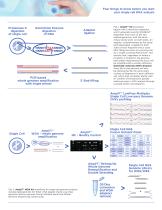
Four things to know before you start your single cell DNA analysis Proteinase K digestion of single cell Restriction Enzyme digestion of DNA Fig. 1. Ampli1™ Kit procedure begins with a restriction digestion, which generates exactly 19,046,047 fragments from each of the two haploid genomes, with the same 2-base sticky-ends on both sides. An adaptor, complementary to the sticky ends generated, is ligated to both sides of each fragment and is used, after filling the ends, as a priming site for a single universal PCR primer. This ensures that, regardless of where a mutation is located in the genome,...
Open the catalog to page 3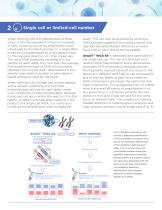
Single cell or limited-cell number When working with a limited amount of DNA, which is still the equivalent of tens to hundreds of cells, randomly occurring amplification bias introduced by the WGA process on a single DNA molecule is compensated by a comparable bias, on the opposite direction, on other molecules. The more DNA molecules are present in the sample for each allele, the more likely the average final amplified amount of DNA will accurately represent the original allelic ratio present in the sample, even when a random or semi-random based process is used for the WGA. When working with...
Open the catalog to page 4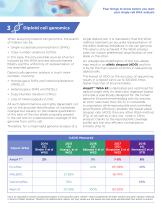
Four things to know before you start your single cell DNA analysis When analyzing haploid cell genomics, the events of interest can be: • Single nucleotide polymorphisms (SNPs); • Copy number variations (CNVs). In this case, the only possible sources of errors induced by the WGA process are polymerase fidelity and the uniformity of representation of the amplified genome. Diploid cells genomic analysis is much more complex, involving: • Homozygous SNPs and insertions/deletions (INDELs); • Heterozygous SNPs and INDELs; • Copy Number Variation (CNVs); • Loss of heterozygosity (LOH). All such determinations...
Open the catalog to page 5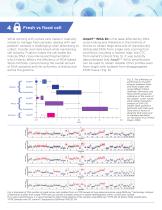
Fresh vs fixed cell While working with culture cells makes it relatively simple to manage fresh samples, dealing with real patients’ samples is challenging when attempting to collect, transfer and store blood while maintaining cell integrity. Fixation makes the cell stable but induces DNA cross-linking and fragmentation, which heavily affects the efficiency of MDA-based WGA methods, compromising the overall amount of DNA obtained and the uniformity of distribution across the genome. Ampli 1™ WGA kit is the least affected by DNA cross-linking and therefore is the method of choice to obtain large...
Open the catalog to page 6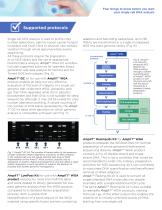
Four things to know before you start your single cell DNA analysis Supported protocols Single cell NGS analysis is used to profile copy number aberrations, identify known cancer hotspot mutations and focal CNVs or discover new somatic variation through whole genome/whole exome sequencing. All these protocols require the preparation of an NGS library and the use of appropriate bioinformatics analysis. Ampli1™ WGA Kit workflow includes supported solutions for seamless library generation and data analysis for Illumina and Ion Torrent NGS technologies (Fig. 2). Ampli 1™ QC kit for use with Ampli...
Open the catalog to page 7
www.siliconbiosystems.com Corporate Menarini Silicon Biosystems S.p.A. Via Giuseppe di Vittorio, 21 b/3 I-40013 Castel Maggiore (BO), Italy t: +39 051 9944100 f: +39 051 9944199 e: [email protected] U.S.A. Menarini Silicon Biosystems Inc. 10355 Science Center Drive, Suite #210 San Diego, CA 92121 t: 800 381 4929 f: 858 939 1817 e: [email protected] Choose accuracy for your single cell genome analysis MENARINI silicon biosystems 1. Cline J et al, Nucleic Acids Res. 1996 , “PCR fidelity of pfu DNA polymerase and other thermostable DNA polymerases” 2. Arezi B et al, Anal Biochem....
Open the catalog to page 8All Menarini Silicon Biosystems catalogs and technical brochures
 DEPArray™ NxT
20 Pages
 Forensics
2 Pages
 FFPE APPLICATION
8 Pages
 Ampli1™ ReAmp/ds Kit
2 Pages
 Ampli1™ LowPass Kit
2 Pages
 Ampli1™WGA KIT
8 Pages
- Detection kit
- Solvent reagent
- Blood detection kit
- Molecular biology reagent
- Research reagent
- Laboratory reagent
- Analysis software
- Molecular detection kit
- Enzyme reagent
- Histology reagent
- Whole blood detection kit
- Sample preparation system
- Visualization software
- Automatic sample processor
- Quality control reagent
- Laboratory testing system
- Collection tube
- Laboratory software
- Laboratory sample preparation system
- Benchtop sample preparation system