

ChromBook

ChromBook
Merck Millipore, established in 1904, is a leader in liquid chromatography, known for its innovative products and techniques. The company focuses on sorbents, analytical and preparative columns, sample preparation, thin layer chromatography, and biochromatography products, emphasizing quality and customer-focused solutions.
Merck Millipore offers high-purity HPLC solvents like LiChrosolv® and Prepsolv®, which are essential for accurate chromatographic results due to their low UV absorbance, low particle count, and low acidity and alkalinity.
The company provides a range of sample preparation products, including EXtrelut® for liquid-liquid extraction and LiChrolut® for solid-phase extraction, designed for efficient and reliable sample preparation.
Merck Millipore offers a variety of TLC and HPTLC products, including classical silica plates and high-performance silica plates, catering to a wide range of applications.
The company provides a wide range of HPLC columns, including Chromolith®, Purospher®, and LiChrospher®, suitable for various applications, including LC/MS and UHPLC.
Merck Millipore offers standardized sorbents and pre-packed columns for preparative chromatography, ensuring high method reliability and optimized throughput.
The SeQuant® SAMS membrane suppressor and CARS continuous regeneration system enhance detectability and simplify analysis in suppressed ion chromatography.
The company supplies high-purity solvents like SupraSolv® and UniSolv® for gas chromatography, along with sorbents, derivatization reagents, and standards for accurate and reproducible results.
Merck Millipore's ChromBook provides detailed insights into their chromatography products and applications, guiding users through the diverse world of chromatography with a focus on quality and innovation.
Prepsolv® solvents are tailored for scale-up from analytical to preparative separations, offering low residue on evaporation for optimal product yield and column protection. The Solvent Management System ensures safe and contamination-free solvent usage.
Merck Millipore systems produce ultrapure water, crucial for reducing water contaminants prior to liquid chromatography.
These solvents are available in various grades and packaging, suitable for both isocratic and gradient methods in modern analytical HPLC.
Detailed specifications for various solvents, including acetonitrile and methanol, are provided, highlighting their purity and other critical parameters.
These solvents set a new standard for HPLC solvent quality, enabling analysis in low ppb trace ranges and ensuring high UV-transmittance and baseline stability in LC-MS applications.
Designed for preparative chromatography, these solvents have extremely low evaporation residue and water content, facilitating scale-up from analytical to preparative scale.
Merck Millipore emphasizes user safety and reliability in chromatographic results, offering a range of solvent handling technologies and accessories.
The document outlines the process of producing ultrapure water suitable for HPLC, involving pretreatment and polishing steps.
Techniques include off-line methods like liquid-liquid extraction with EXtrelut® and solid-phase extraction with LiChrolut®.
Detailed product listings for water purification kits, ion pair reagents, and sample preparation materials are provided with ordering numbers.
EXtrelut® NT columns are used for efficient liquid-liquid extraction, overcoming the disadvantages of classical extraction methods.
LiChrolut® products are designed for selective extraction of components from complex samples, offering benefits such as time and solvent savings.
Material: Ethyl vinyl benzene divinyl benzene polymer. Particle Size: 40 - 120 µm. Specific Surface: 1,200 m²/g (BET method).
High adsorption capacity for polar organic substances, use of common solvents and buffers across the pH range, reduced solvent usage, and time savings.
Sorbent Type: Spherical silica gel with dual surface modifications. Particle Size: 25 µm. Pore Diameter: 60 Å.
Direct extraction and enrichment of hydrophobic, low molecular weight analytes, designed for HPLC analysis of biological samples.
The sample is injected onto a precolumn, which retains analytes while unwanted components are flushed out.
Includes gel, macroporous, fluid ion exchangers, and adsorber resins, each with specific applications.
Essential for high-quality separation and purification processes in various scientific fields.
The Samplicity™ Filtration System is designed to enhance sample preparation efficiency by outperforming manual filtration methods.
Merck Millipore offers a range of TLC solutions for fast and versatile separation of substances.
TLC Plates: Suitable for in-process control of drugs, purity checking, and identity testing of pharmaceutical compounds.
HPTLC plates have a mean particle size of 5-6 µm, offering faster analysis times and higher sensitivity.
These plates are suitable for analyzing basic or acidic substances, with good separation of compounds like gallic acid and its esters.
Cellulose plates are used for separating polar substances such as amino acids and carbohydrates.
Designed for peptide analysis, these plates offer highly efficient separations and are stable in aqueous solvent systems.
This document provides detailed information on thin layer chromatography (TLC) and analytical high-performance liquid chromatography (HPLC) techniques.
HPLC is essential for the separation, quantitation, and identification of compounds in various industries.
The document outlines a structured approach to HPLC method development, emphasizing the importance of defining method goals, understanding sample characteristics, and optimizing selectivity and system parameters.
The document serves as a comprehensive guide for professionals using TLC and HPLC, providing insights into best practices, equipment selection, and method optimization to ensure high-quality analytical results.
The process begins with selecting the appropriate HPLC method and system, considering the sample as the central focus.
Establishing a sample preparation procedure is crucial for effective HPLC analysis.
The choice of detector depends on several factors, including the chemical nature of analytes, potential interferences, and required sensitivity.
Selecting initial conditions involves choosing the mode of separation, column, and mobile phase.
Preliminary separations help in understanding the behavior of analytes under initial conditions.
The final step is method validation, ensuring that the developed method meets the required standards for accuracy, precision, and sensitivity.
The document emphasizes the importance of keeping the method simple and focusing on significant factors for achieving desired resolution.
The document emphasizes the importance of choosing the right column format to achieve high efficiency and resolution.
Smaller particle sizes offer higher separation efficiency, while larger sizes allow faster flow rates and are less prone to clogging.
Carbon load affects the hydrophobicity and retention times of compounds.
The document outlines the properties of solvents and buffers, highlighting the differences between isocratic and gradient elution.
Isocratic elution is suitable for samples with a narrow range of polarities, while gradient elution is recommended for complex mixtures.
Recommendations include avoiding gradients from 100% aqueous to 100% organic and maintaining a minimum percentage of each phase in mobile phase bottles.
After achieving satisfactory selectivity, parameters such as column dimension, particle size, and flow rate should be optimized.
The document concludes with a step-by-step guide for method development, from selecting the HPLC method and system to method validation, emphasizing the importance of each step in achieving optimal results.
The document outlines a specific HPLC method using phosphoric acid and acetonitrile with a gradient composition.
Validation is crucial for ensuring consistent results over time and across different laboratories.
Accuracy is defined as the closeness of measurements to the actual value, often expressed in terms of standard error.
Specificity ensures the method can accurately measure the analyte in the presence of other components.
Linearity refers to the method's ability to produce results proportional to analyte concentration.
The document provides a guide for selecting HPLC columns based on the chemical structure of analytes, stationary phase, sorbent specifications, and column dimensions.
The document serves as a detailed resource for developing and validating HPLC methods, ensuring reliable and accurate analytical results in pharmaceutical and chemical analysis.
Type A and Type B Particles: These are conventional and high-purity spherical silica particles, respectively, with modifications such as Octyl, Octadecyl, and amino bonding.
Reversed-Phase Chromatography: Utilizes hydrophobic interactions for separating medium to less polar compounds.
Selection Criteria: Based on chemical structure, stationary phase, sorbent specifications, column dimensions, and USP classification.
Monolithic Silica Technology: Offers faster analysis and lower operating pressure compared to traditional particulate columns.
Speed and Efficiency: Chromolith® columns provide up to four times faster analysis than 5µm particulate columns.
Chromolith® CapRod® is a monolithic capillary column designed for high throughput and sensitive proteomics-LC applications.
The columns are made from monolithic silica gel with inner diameters of 50 µm, 100 µm, and 200 µm, and lengths of 150 mm and 300 mm.
Chromolith® CapRod® columns provide excellent separation efficiency with reduced analysis time.
These columns are suitable for separating small molecules, peptides, and proteins, and are compatible with various Nano or Capillary LC systems.
The document provides detailed ordering information for various Chromolith® CapRod® products, including dimensions and contents of each package.
The document outlines recommended uses for different column types and provides flow rate ranges and maximum back-pressure specifications.
Examples of separations using Chromolith® CapRod® columns are provided, demonstrating their efficiency and repeatability in separating biological compounds and small molecules.
Chromolith® HPLC columns offer faster analysis, improved system security, and cost savings due to increased sample throughput.
The Chromolith® RP-18 and RP-8 endcapped columns are designed for reversed-phase chromatography.
The document outlines the use of Chromolith® columns in various HPLC setups, detailing mobile phases, flow rates, pressures, and detection methods.
Chromolith® columns offer ultra-fast results with low back-pressure, making them suitable for both UHPLC and standard HPLC systems.
The document includes examples of separations achieved using Chromolith® columns, such as the separation of antihistamines, carotenoids, and bioflavonoids.
Chromolith® columns are recommended for applications requiring high efficiency and fast separations.
Chromolith® NH2 columns are made from highly porous monolithic silica rods with a bimodal pore structure.
Chromolith® columns are used in analytical HPLC for separating complex mixtures.
To enhance the longevity and performance of Chromolith® columns, guard cartridges are available.
Chromolith® column couplers allow for the coupling of multiple columns to increase separation efficiency.
Chromolith® SemiPrep columns offer a direct scale-up from analytical to preparative LC.
The document includes detailed ordering information for various Chromolith® products, including performance columns, guard cartridges, and column couplers, with specific product numbers and dimensions.
Chromolith® Performance RP-18 endcapped columns are noted for their fast separation capabilities.
Scale-up from analytical to preparative columns involves linear transfer of methods, with adjustments in flow rate and injection volume based on column dimensions.
Chromolith® Prep columns are recommended for high-speed separations in preparative chromatography, offering better selectivity and reduced separation times.
Chromolith® Prep columns can operate at flow rates up to 400 mL/min, significantly higher than particulate columns.
Low pressure drop at higher flow rates and fast adsorption/desorption kinetics.
Purospher® columns are characterized by high purity silica with polymeric C18 modification and endcapping.
The document highlights the use of Tanaka and Engelhardt tests to evaluate the chromatographic properties of Purospher® columns.
Purospher® STAR RP-18 endcapped columns are versatile, suitable for separating a wide range of compounds with simple mobile phases.
The document includes detailed ordering information for various Purospher® STAR RP-18 endcapped column configurations, including different lengths and internal diameters.
Purospher® STAR RP-18 endcapped columns are available in various dimensions and particle sizes, primarily 3 µm and 5 µm.
The columns feature a polymeric surface modification that provides nearly perfect surface coverage, preventing polar interactions.
The columns are made from high-purity silica, ensuring tailing-free chromatography for acidic, basic, and chelating compounds.
Purospher® STAR RP-18 endcapped columns exhibit outstanding pH stability, remaining stable and reproducible across a pH range of 1.5 to 10.5.
The Tanaka test is used to compare the selectivity and performance of HPLC columns.
These columns can be used with 100% aqueous mobile phases without suffering from phase collapse.
The columns maintain efficiency and retention time over extended use, with stability tests confirming their robustness over 15,000 column volumes.
Various separation examples are provided, demonstrating the columns' effectiveness in separating compounds such as triptylines, catecholamines, sweeteners, hormones, and peptides.
To address ghost peaks in LC/MS applications, a three-step procedure is recommended.
The Purospher® STAR RP-18 and RP-8 endcapped columns are based on high-purity silica with endcapping, offering excellent peak symmetry and stability across a wide pH range (1.5 to 10.5).
These columns are suitable for high-throughput screening, QC analyses, process monitoring, and method development.
The document emphasizes the columns' ability to deliver tailing-free chromatograms, high efficiency, and excellent selectivity for both acidic and basic compounds.
Detailed ordering information is provided for various column configurations, including product numbers, particle sizes, dimensions, and package contents.
Purospher® STAR columns offer a versatile solution for a wide range of chromatographic applications, providing high performance, stability, and efficiency.
The document outlines the characteristics of LiChrospher® packing materials, which are spherical silica carriers available in various modifications.
The document provides examples of pharmaceutical and environmental analyses using LiChrospher® 100 RP-18 columns.
For optimal performance, the document recommends using specific cartridge holders for LiChroCART® columns and suggests compatible guard columns.
Detailed ordering information is provided for various LiChrospher® and Superspher® columns, including product numbers, particle sizes, dimensions, and package contents.
The tables in the document present critical data such as specific surface area, pore volume, and carbon load for different LiChrospher® materials.
Used for high-resolution separations of peptides and tRNA molecules.
Designed for high-resolution separation of polycyclic aromatic hydrocarbons (PAH).
Suitable for chromatography of acidic, neutral, and weakly basic compounds.
Optimized for the determination of basic substances with excellent properties for neutral and acidic substances.
Various separation examples are provided for each column type, demonstrating their application in different analytical scenarios.
Comprehensive ordering details for each column type, including product numbers, dimensions, and package contents.
Available in different particle sizes (5 µm and 10 µm) and packaging options.
Features both polar and hydrophobic properties, suitable for complex samples.
Versatile sorbent for reversed-phase, normal phase, and ion exchange chromatography.
Suitable for complex samples and exclusion chromatography.
Used for normal phase chromatography with polar properties.
Irregular shaped silica sorbent used in HPLC for over 25 years.
Particle sizes range from 5 µm to 10 µm.
The document includes examples of environmental analysis and separation of complex samples using different LiChrospher® sorbents.
LiChrosorb® RP-8 and RP-18 are silica-based materials with octyl and octadecyl derivatives, respectively.
Designed for alkaline stable HPLC separations, using alumina particles coated with polybutadiene.
These columns are ideal for separating polar and hydrophilic compounds using Hydrophilic Interaction Liquid Chromatography (HILIC) mode.
The document provides comprehensive information on the specifications, applications, and ordering details for various HPLC columns and packing materials.
The document lists multiple ZIC®-HILIC columns with varying dimensions and particle sizes, suitable for different analytical needs.
The document provides examples of separations using ZIC®-HILIC columns, such as the separation of cyanuric acid and melamine.
The document discusses the importance of chiral separations in pharmaceuticals and other industries.
Detailed ordering information is provided for various columns, including product numbers, particle sizes, dimensions, and package contents.
The document serves as a comprehensive guide for selecting and using ZIC®-HILIC and ZIC®-pHILIC columns in HPLC applications.
Available in various lengths (75, 125, 150, 250 mm) and internal diameters (2, 3, 4, 4.6 mm).
Available in lengths of 30, 125, 250 mm and internal diameters of 3, 4, 4.6, 10 mm.
Require a specific glass cartridge holder for use.
Available in various particle sizes and dimensions.
Includes a variety of sorbents like Purospher®, Superspher®, LiChrosorb®, and LiChrospher®.
manu-CART® cartridge holders are reusable and fit various cartridge lengths and diameters.
Use of guard columns is recommended for extending the life of the main column.
The document provides comprehensive details on the specifications, ordering, and usage of HPLC columns and accessories, emphasizing ease of use and cost-effectiveness.
The document outlines various types of HPLC columns, including Hibar®, LiChroCART®, Chromolith®, and SeQuant®, each with specific pressure limits and solvent restrictions.
Proper installation is crucial to avoid dead volumes that reduce separation efficiency.
Equilibration ensures consistent results.
Each column comes with a test certificate for separation efficiency and selectivity.
Silica-based columns are compatible with various organic solvents within specified pH ranges.
Column lifetime depends on sample and conditions.
Short-term storage can be in the eluent, while long-term storage requires specific solvents like acetonitrile.
Common issues include changing retention times, broad peaks, and ghost peaks.
Poor Sample Recovery: Issues such as absorption or adsorption of proteins can be mitigated by changing the HPLC mode or adding solubilizing agents.
Leaks at various points such as columns, detectors, and pumps can be addressed by checking and replacing fittings, seals, and rotors as necessary.
Differences in selectivity may arise from variations in mobile phase composition or solvent strength.
Problems like air bubbles or temperature changes can cause baseline disturbances.
High back-pressure can be caused by blockages or inappropriate solvent use.
Merck Millipore provides standardized silica gel packing materials for preparative chromatography, ensuring high purity and regulatory compliance.
The document includes tables detailing the characteristics of aluminium oxide packing materials and their typical technical data.
The document lists standardized silica gels with details on particle size, distribution, and content.
LiChroprep® is described as a reliable packing material for HPLC, known for its homogeneous silica gel matrix and narrow particle size distribution.
LiChrospher® is a spherical silica gel used in preparative HPLC.
This section discusses silanized silica gel as an economical alternative for product purification.
Florisil® is a magnesium silicate used for separating steroids, alkaloids, and antibiotics.
This section covers cellulose as a packing material for the separation of amino acids and bio-molecules.
Chromolith® Prep columns are highlighted for their speed, efficiency, and productivity in separations.
Hibar® columns are described as ready-to-use columns for transferring optimized separation methods.
The document provides comprehensive information on various chromatography packing materials, their specifications, applications, and ordering details.
Key parameters such as flow rate, tubing inner diameter, detector cell volume, and injection volume must be adjusted to prevent extra-column effects.
Focuses on minimizing extra-column volumes to maintain separation power.
Discusses the impact of void volume on separation efficiency and the importance of minimizing tubing length and diameter to reduce band-broadening.
Provides guidelines for suitable injection volumes based on column i.d. to avoid volume overload and maintain efficiency.
Explains how excessive sample mass can lead to non-Gaussian peaks and reduced separation efficiency.
Describes the benefits of adjusting column length for quicker separations or higher resolution.
Highlights the need to adjust for system dwell volume and detector flow cell volumes when scaling down.
Discusses the transition from analytical to preparative scale, emphasizing the need for scalable phases and the challenges of maintaining performance.
Use semi-micro flow cells for columns with 2.1 mm i.d. or smaller, and standard flow cells for larger columns.
Includes tables and figures illustrating flow rates for different column i.d., suitable injection volumes, and recommended mass loads.
Analytical and Preparative Scale Purification: This section provides examples of scaling analytical separations to larger scales.
The second example discusses a LiChroprep® application for Prostaglandins.
This section highlights the use of TLC as a quick scouting method to predict conditions for preparative HPLC runs.
Ion chromatography is crucial for verifying water and food safety.
The CARS system optimizes eluent suppression with the SAMS suppressor, ensuring low background conductivity and high analyte sensitivity.
Gas chromatography remains a widely used analytical technique across various fields.
This document provides detailed information on the use of high-purity solvents for gas chromatography (GC) and their applications in various analytical procedures.
The document outlines the specifications for SupraSolv® and UniSolv® solvents, which are designed for different GC applications.
SupraSolv® solvents are recommended for analyzing medium to high boiling substances, such as pesticides and PCBs, in environmental samples.
The document provides detailed ordering information for a range of solvents, including their purity levels, packaging options, and specific applications.
The document references international guidelines, such as those from the ICH, Ph Eur, and USP, for the analysis of residual solvents in pharmaceuticals.
For accurate GC analysis, the document recommends using solvents with the highest purity to avoid interference and ensure reliable results.
Derivatization is essential for analyzing substances with low volatility or stability.
The document provides ordering details for various derivatization reagents, including package sizes and product numbers.
Reference substances are used for identifying unknown compounds and as standards in quantitative analysis.
The document lists hydrocarbons (C5 to C19) and fatty acid methyl esters, providing product numbers, assay percentages, empirical formulas, and packaging details.
The document includes a subject index and contact information for Merck Millipore, facilitating easy navigation and further inquiries.
Catalog excerpts

Your guide to a fascinating Merck Millipore is a division of jMERCK
Open the catalog to page 1
Leading the way for over a century. Our journey began in 1904 with the development of an aluminum oxide for adsorption chromatography. Over the decades, numerous products and techniques followed. Many set new milestones. Each was recognized as important progress in the field.
Open the catalog to page 2
This spirit of innovation still continues relentlessly. Today, Merck Millipore is among the leaders in the science of liquid chromatography and is committed to the further development of sorbents, analytical and preparative columns, sample preparation, thin layer chromatography and biochromatography products. Whether for research and development, quality control or purification purposes, Merck Millipore products are most widely used throughout the world. How did we get where we are today? Through uncompromising quality and a strong customer focus. From the very beginning, our highest priorities...
Open the catalog to page 3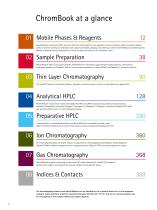
ChromBook at a glance 01 Mobile Phases & Reagents Merck Millipore’s high purity HPLC-solvents LiChrosolv® and Prepsolv® ensure separation results of excellent quality and provide highest safety in solvents-handling by combination with specially developed packaging and withdrawal systems. Merck Millipore Lab Water Systems provide on demand the best water quality of the most widely used solvent in the laboratory: water. Merck Millipore offers a top quality portfolio with EXtrelut® for solid phase supported liquid-liquid extraction, LiChrolut® for solid-phase extraction, LiChrospher® ADS for on-line...
Open the catalog to page 4
www.merck-chemicals.com/chromatography Visit our website and browse e.g. • Applications • Technical information • Information about current chromatography topics • Education material and much, much more ...
Open the catalog to page 5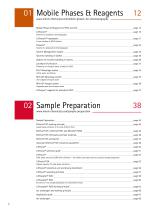
01 Mobile Phases & Reagents 12 www.merck-chemicals.com/mobile-phases-for-chromatography Mobile Phases & Reagents for HPLC and TLC Solvents for analytical chromatography LiChrosolv® hypergrade A new standard in HPLC solvents Solvents for preparative chromatography Solvent Management System Solvents handling in bottles Options for solvents handling in barrels Production of ultrapure water suitable for HPLC Elix® Advantage system Infinte water purification Milli-Q® Advantage system User-adapted ultrapure water Milli-Q® Integral system Integrated pure and ultrapure water LiChropur® reagents for analytical...
Open the catalog to page 6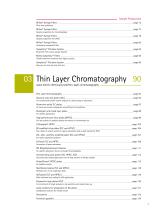
Sample Preparation Millex® Syringe Filters Filter with confidence Millex® Syringe Filters Sample preparation for chromatography Millex® Syringe Filters Sample preparation for UHPLC Millex® Syringe Filters Automation-compatible filter Samplicity™ Filtration System Break free from routine sample fitration Millex Samplicity™ Filters Provide maximum versatility with highest quality. Samplicity™ Filtration System Now you can truly do more with less. 03 Thin Layer Chromatography 90 www.merck-chemicals.com/thin-layer-chromatography Thin Layer Chromatography Classical silica TLC plates (TLC) For versatile...
Open the catalog to page 7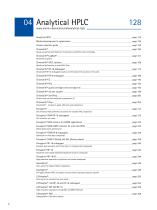
04 Analytical HPLC www.merck-chemicals.com/analytical-hplc Analytical HPLC Method development & optimization Column selection guide Speed and performance based on revolutionary monolithic silica technology Chromolith® CapRod® Monolithic capillary Chromolith® HPLC columns Speed and performance in monolithic form Chromolith® RP-18 endcapped columns are the fastest C18 columns in the world. Chromolith® guard cartridges and cartridge kits Chromolith® column coupler Chromolith® SemiPrep Perfect scale-up from analytical to preparative LC Chromolith® Prep Chromolith® – increase in speed, efficiency...
Open the catalog to page 8
Analytical HPLC LiChrospher® 100 RP-8 and RP-8 endcapped For reproducible reversed phase separation Excellent separations even with basic compounds Excellent for complex samples with polar and hydrophobic characteristics A versatile sorbent for both reversed phase and normal phase chromatography Excellent for complex samples with polar and hydrophobic characteristics and for exclusion chromatography Irregular shaped silica sorbent A successful packing material from the start Alkaline stable HPLC separations A stable reversed phase stationary phase optimized for applications up to pH 12 SeQuant®...
Open the catalog to page 9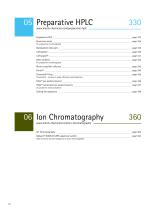
05 Preparative HPLC www.merck-chemicals.com/preparative-hplc Preparative HPLC Aluminium oxide Standardized silica gels Other sorbents Micro-crystalline cellulose Chromolith® Prep Chromolith® – increase in speed, efficiency and productivity Hibar® pre-packed columns Hibar® customized pre-packed columns SeQuant® SAMS & CARS suppressor system High sensitivity and low background in anion chromatography
Open the catalog to page 10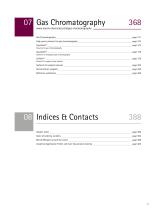
High purity solvents for gas chromatography Solvents for headspace gas chromatography Solvents for organic trace analysis Sorbents for packed columns Derivatization reagents Reference substances Subject index Index of ordering numbers Merck Millipore around the world Analytical Application Finder and more educational material
Open the catalog to page 11
Mobile Phases & Reagents First stop: Merck Millipore laboratories, Darmstadt, Germany. Here you are bound to find many steady hands and agile minds – busy producing breakthrough mobile phases and reagents, which will be used to analyze chemical compounds in everything from food to pharmaceuticals. The task involves selecting the best raw materials and performing countless purification steps. This obsession with quality is the reason mobile phases from Merck Millipore are found in every HPLC laboratory worldwide. From a city in southern central in Germany to the rest of the globe ...
Open the catalog to page 13
Mobile Phases & Reagents Contents Mobile Phases & Reagents for HPLC and TLC LiChrosolv® hypergrade Solvent Management System Solvents handling in bottles Options for solvents handling in barrels Elix® Advantage system Milli-Q® Advantage system Milli-Q® Integral system LiChropur® reagents for analytical HPLC Solvents for analytical chromatography A new standard in HPLC solvents Solvents for preparative chromatography Production of ultrapure water suitable for HPLC Infinte water purification User-adapted ultrapure water Integrated pure and ultrapure water
Open the catalog to page 14All Merck catalogs and technical brochures
 Filters and Supporting Hardware
48 Pages
Archived catalogs
 Milli-Q HR 7000
12 Pages
 SDS 500
8 Pages
 Milli-Q® Integral system
22 Pages
 Elix® Advantage System
20 Pages
 AFS® 8D and 16D Systems
8 Pages
 RiOs DI® Clinical
4 Pages
 Spectroquant® Prove
5 Pages
 Amnis® Imaging Flow Cytometers
36 Pages
 Provantage® Services
2 Pages


