1. Catalogs
  2. Merck
  3. Filters and Supporting Hardware

Filters and Supporting Hardware
Filters and  Supporting Hardware
1 / 48 PagesView full catalog

Filters and Supporting Hardware

Product catalog summary
Overview: This document serves as a comprehensive guide on filters and supporting hardware, detailing their characteristics, types, applications, and associated hardware. It aims to assist scientists in selecting suitable filtration products for research and industrial purposes.
1. Membrane Filter and Filter Paper Characteristics: This section discusses the essential properties of membrane filters and filter paper, emphasizing the need to align these characteristics with sample properties and desired filtration outcomes. Key factors include chemical compatibility, wettability, pore size, flow rate, analyte binding, optical properties, extractables, and retentiveness.
2. Filter Types by Characteristics: Filters are categorized by composition, such as Polyvinylidene Fluoride (PVDF), Mixed Cellulose Ester (MCE), and Polyethersulfone (PES). Each type is described in terms of chemical compatibility, wettability, pore size, flow rate, protein binding, optical properties, extractables, and sterilization methods.
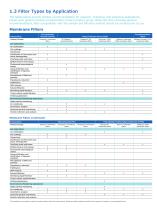
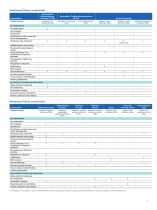
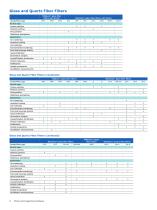
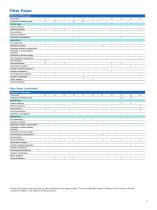
3. Filter Types by Application: This section provides product recommendations for various applications, including research, industrial, and analytical uses. It highlights the suitability of different membrane filters for tasks such as air sterilization, cell cytology, solvent filtration, and environmental monitoring.
4. Filter Product Tables: Detailed tables list various filter products, including cellulose, PVDF, PES, PTFE, and others, along with their specific characteristics and applications.
5. Supporting Hardware, Vacuum Pumps, and Pressure Vessels: The document concludes with a discussion on supporting hardware necessary for filtration processes, such as solvent dispensers, filter forceps, vacuum pumps, and pressure vessels.
Membrane Filters: The document details different types of membrane filters, including hydrophobic and hydrophilic Polytetrafluoroethylene (PTFE), nylon/polyamide, aluminum oxide, regenerated cellulose, cellulose acetate, cellulose nitrate, silver, polyvinyl chloride (PVC), and polypropylene (PP). Each type is associated with specific product groups such as Whatman®, Omnipore™, LCR PTFE, and Millipore® filters.
Applications: Filters are used in various applications including air sterilization, cell cytology, chemotaxis, clarification of cell lysates, epifluorescence microscopy, fluorescent bacteriological assays, general filtration, microdialysis of DNA and proteins, mycoplasma reduction, prefiltration, SEM analysis, solvent filtration, sterilizing liquid filtration, tissue culture media filtration, venting applications, environmental monitoring, alpha particle monitoring, air monitoring, gravimetric analysis, industrial particle monitoring, and particle collection and analysis.
Glass and Quartz Fiber Filters: These filters are categorized by grade and filter type, such as AP15, AP20, AP25, GF6, GF8, GF9, GF10, GF92, HGF61, HGF65, and others. They are used for air monitoring, analytical testing, cell collection, environmental monitoring, food and beverage testing, general filtration, gravimetric analysis, liquid/solution clarification, particle collection, prefiltration, sample preparation, and scintillation measurements.
Filter Paper: Whatman® filter papers are available in flat and prepleated grades, suitable for filtering coarse, medium, fine, and very fine particles. Applications include air monitoring, analytical testing, beverage testing, filtration of acidic/alkaline solutions, filtration of viscous liquids, food testing, gas detection, general filtration, gravimetric analysis, particle isolation/collection, sample preparation, soil analysis/monitoring, solution clarification, and water analysis.
MF-Millipore™ Membrane Filters: These filters are made from biologically inert cellulose acetate and cellulose nitrate, suitable for biological, analytical, environmental monitoring, and research applications. They are available in various pore sizes and are used for microdialysis of DNA and proteins, sterilizing filtration, bioassays, air monitoring, particle monitoring, and clarification of aqueous solutions.
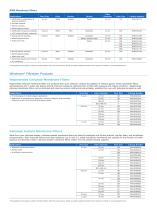
Reinforced Cellulose Membranes: Known as RW filters, these are rigid screen filters ideal for prefiltration of heavily contaminated liquids and gases. They are used before sterilizing-grade filtration and are made from non-shedding materials.
Support Pads: Cellulose support pads are used to reinforce filters during high pressure or fast flow conditions and can be used for microorganism culture when saturated with growth medium.
Quartz Fiber Filters: These filters are made from pure quartz fibers, offering inertness and stability, making them suitable for measuring heavy metal concentrations and small particle quantities. Applications include EPA PM10 and PM2.5 monitoring.
Qualitative Filter Paper: Designed for qualitative analytical techniques, these papers are used for general liquid clarification, soil analysis, air monitoring, and more. They are available in various grades and sizes, each suited for specific applications such as filtration of coarse particles, biological fluids, and organic extracts.
Quantitative Filter Paper: These papers are used for sample preparation and gravimetric analysis, available in ashless, hardened low ash, and hardened ashless formats. Applications include gravimetric analysis, determination of ash content in foodstuffs, and filtration requiring vacuum assistance.
Key Applications: The document highlights applications such as air and water pollution monitoring, chemical analysis of trace pollutants, filtration of bacterial cultures, and cell harvesting. It also covers specific uses in the food industry, environmental sample analysis, and industrial processes.
Product Specifications: Each product is listed with its grade, filter diameter, pack size, and catalog number, providing a comprehensive guide for selection based on specific filtration needs.
Supporting Hardware: Includes vacuum pumps, pressure vessels, and filter holders. Glass filter holders are used for research and small-scale filtrations due to their chemical resistance. Stainless steel holders are preferred for industrial applications requiring pressure filtration. Plastic holders offer durability and compatibility with aqueous and organic solutions.
Key Recommendations: Select filter paper based on particle retention needs and chemical resistance requirements. Choose appropriate filter holders based on the scale of filtration and material compatibility.
Solvent Dispensers: In industrial applications, solvent dispensers are crucial for particle and contamination monitoring. The Millipore® solvent filtering dispenser allows for easy dispensing of small solvent volumes without an external pump, while the Filterjet™ dispenser provides a concentrated jet spray for rinsing. Both use a 25 mm filter diameter.
Filter Forceps: Stainless steel filter forceps are recommended for handling membranes to prevent damage or contamination. They can be sterilized by autoclaving or flame-sterilization.
Vacuum Pumps: Two types of vacuum pumps are available: the High Output Pump, which offers greater power with a piston-driven design, and the Chemical Duty Pump, which is resistant to corrosive chemicals. Specifications include maximum vacuum, pressure, flow rate, and material details.
Pressure Vessels: Dispensing pressure vessels are used for large volume filtration and solvent dispensing. They require an external pressure source and meet ASME®-UM code requirements. Available in volumes from 1 gallon to 20 liters.
Millicup™-FLEX Disposable Vacuum Filtration Unit: This unit combines the convenience of disposability with the flexibility of traditional filtration apparatus. It is compatible with various solvents, reduces contamination risk, and is fully recyclable.
Contact Information: For orders or technical assistance in Europe, contact details for various countries are provided, along with a link to SigmaAldrich.com for further information.
See more

Catalog excerpts

Filters and  Supporting Hardware-1

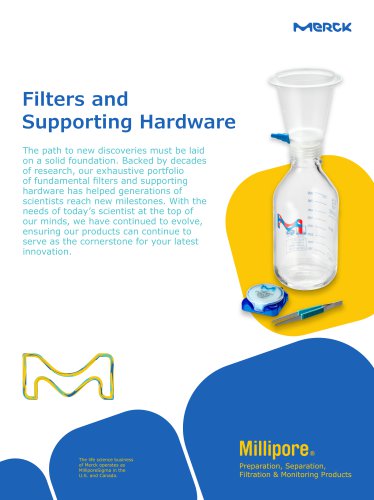
Filters and Supporting Hardware The path to new discoveries must be laid on a solid foundation. Backed by decades of research, our exhaustive portfolio of fundamental filters and supporting hardware has helped generations of scientists reach new milestones. With the needs of today’s scientist at the top of our minds, we have continued to evolve, ensuring our products can continue to serve as the cornerstone for your latest innovation. The life science business of Merck operates as MilliporeSigma in the U.S. and Canada.

 Open the catalog to page 1
Filters and  Supporting Hardware-2

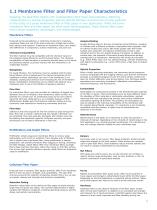
1.1 Membrane Filter and Filter Paper Prefiltration and Depth Filters 3 1.2 Filter Types by Characteristics 4 Glass and Quartz Fiber Filters 5 1.3 Filter Types by Application 6 Glass and Quartz Fiber Filters 8 1.4 Filter Product Tables 12 Polyvinylidene Fluoride (PVDF) 18 Aluminum Oxide (alumina) 27 Glass and Quartz Fiber Filters 28 1.5 Supporting Hardware, Vacuum Pumps, and

 Open the catalog to page 2
Filters and  Supporting Hardware-3

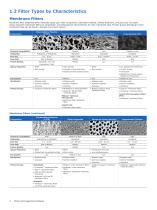
1.1 Membrane Filter and Filter Paper Characteristics Selecting the ideal filter begins with understanding their basic characteristics. Matching characteristics to sample properties and the desired filtration outcome can provide guidance on the utility of a given membrane filter or filter paper in your application. While the terms membrane filter and filter paper are often used interchangeably, these distinct filter types have unique properties, advantages, and disadvantages. Membrane Filters Produced by the precipitation or stretching of polymeric materials, membrane filters are one of the most...

 Open the catalog to page 3
Filters and  Supporting Hardware-4

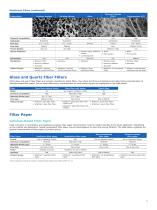
Membrane filter properties differ markedly based upon their composition, fabrication method, surface treatment, and pore size. The table below organizes membrane filters by composition, providing general characteristics for each membrane type. Product groups belonging to each membrane type can be found in the last row of each column. Polyvinylidene Fluoride (PVDF) Chemical Compatibility Pore Size Flow Rate Protein Binding Optical Properties Hydrophilic or Hydrophobic 0.1 - 5 pm Slow to Medium Hydrophobic: High • Plain surface Medium Hydrophilic 0.025 - 8 pm Medium Medium Medium to Low Hydrophilic...

 Open the catalog to page 4
Filters and  Supporting Hardware-5

Membrane Filters (continued) tPurity reported as nominal ash content, as determined by ignition of the filter at 900 °C in air

 Open the catalog to page 5
Filters and  Supporting Hardware-6

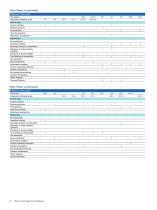
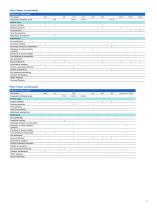
The tables below provide product recommendations for research, industrial, and analytical applications, based upon general physical characteristics of each product group. While this chart provides general recommendations, filter compatibility with the sample and filtration method should be verified prior to use. +This application only applies to specific membrane filters within the product group. Please see specific application details for the product of interest on www.sigmaaldrich.com

 Open the catalog to page 6
Filters and  Supporting Hardware-7

+This application only applies to specific membrane filters within the product group. Please see specific application details for the product of interest on www.sigmaaldrich.com

 Open the catalog to page 7
Filters and  Supporting Hardware-8

8 Filters and Supporting Hardware

 Open the catalog to page 8
Filters and  Supporting Hardware-9

Whatman® filter paper

 Open the catalog to page 9
Filters and  Supporting Hardware-10

Whatman® filter paper Filters and Supporting Hardware

 Open the catalog to page 10
Filters and  Supporting Hardware-11

Whatman® filter paper

 Open the catalog to page 11
Filters and  Supporting Hardware-12

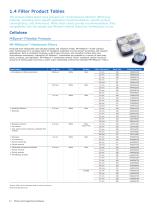
The product tables below have grouped our comprehensive filtration offering by material, providing more specific application recommendations, specific product characteristics, and dimensions. While these charts provide recommendations, filter compatibility with the sample and filtration method should be verified prior to use. CelluloseMillipore® Filtration ProductsMF-Millipore™ Membrane Filters Produced from biologically inert cellulose acetate and cellulose nitrate, MF-Millipore™ mixed cellulose ester membranes are a versatile choice for biological, analytical, environmental monitoring, and...

 Open the catalog to page 12
Filters and  Supporting Hardware-13

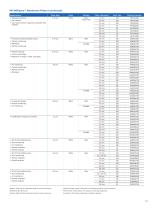
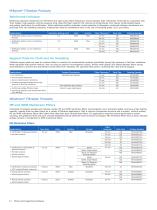
MF-Millipore™ Membrane Filters (continued) 1Monitor refills with thin absorbent pads for aerosol monitoring 2Matched weight filter pairs 3Monitor refills with thick absorbent pads for liquid monitoring 4Matched-weight monitor refills with thick absorbent pads for liquid monitoring 5Minimal fiber contamination. For asbestos monitoring applications 6Immobilon®-NC Transfer Membrane for Western blotting

 Open the catalog to page 13
Filters and  Supporting Hardware-14

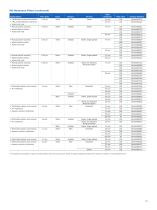
Reinforced cellulose membranes (or RW filters) are rigid screen filters featuring a mixed cellulose ester membrane reinforced by a polyester web. Their rigidity, high-capacity, and low pressure drop make RW filters ideal for the removal of contaminants from heavily contaminated liquids and gasses, particularly for prefiltration. While traditional prefilter materials contain asbestos or fiberglass, reinforced cellulose membranes are produced from non-shedding materials, making them ideal for prefiltration prior to the use of sterilizing-grade (<0.2 gm) filters.

 Open the catalog to page 14
Filters and  Supporting Hardware-15

+This application only applies to specific membrane filters within the product group. Please see specific application details for the product of interest on www.sigmaaldrich.com

 Open the catalog to page 15
Filters and  Supporting Hardware-16

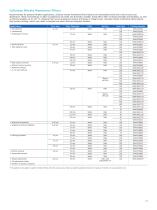
+This application only applies to specific membrane filters within the product group. Please see specific application details for the product of interest on www.sigmaal

 Open the catalog to page 16
Filters and  Supporting Hardware-17

Recommended for general filtration applications, cellulose nitrate membrane filters feature low extractable levels and a narrow pore size distribution. While nitrocellulose is often considered to be brittle and thermally instable, these filters offer increased strength and flexibility, as well as thermal stability up to 121 °C, allowing them to be autoclaved without shrinkage or integrity loss. Cellulose nitrate membrane filters feature high protein binding, which may result in sample loss when filtering biological samples. +This application only applies to specific membrane filters within the...

 Open the catalog to page 17
Filters and  Supporting Hardware-18

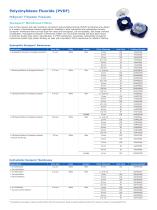
Polyvinylidene Fluoride (PVDF)Millipore® Filtration ProductsDurapore® Membrane Filters Due to their solvent and heat resistance, Durapore® polyvinylidene fluoride (PVDF) membranes are utilized in a variety of biomedical research applications. Available in both hydrophilic and hydrophobic formats, Durapore® membrane filters provide high flow rates and throughput, low extractables, and broad chemical compatibility. Hydrophilic Durapore® membranes exhibit very low protein binding and have been shown to bind less protein than nylon, nitrocellulose, or PTFE membranes. Conversely, hydrophobic Durapore®...

 Open the catalog to page 18
*Prices are pre-tax. They exclude delivery charges and customs duties and do not include additional charges for installation or activation options. Prices are indicative only and may vary by country, with changes to the cost of raw materials and exchange rates.