
- Catalogs
- MetaMedics
- For Deans, Vice-Deans & Academic Innovation Leaders - Health Sciences - Higher Education as You Knew It Is Dead

- Company
- Products
- Catalogs
- News & Trends
- Exhibitions
For Deans, Vice-Deans & Academic Innovation Leaders - Health Sciences - Higher Education as You Knew It Is Dead
For Deans, Vice-Deans & Academic Innovation Leaders - Health Sciences - Higher Education as You Knew It Is Dead
MetaMedicsVR presents a guide for deans, vice-deans, and academic innovation leaders in health sciences, addressing the impact of AI, particularly ChatGPT, on higher education. The document outlines strategies for adapting to this new era, drawing parallels with the e-learning revolution.
1. The Break
ChatGPT has altered the landscape of university education by diminishing the cognitive engagement traditionally fostered by assignments. Studies indicate a negative correlation between AI tool usage and critical thinking, particularly among younger users. The concept of 'cognitive debt' is introduced, highlighting the long-term impact of relying on AI for cognitive tasks.
2. The Precedent
The document compares the current AI shift to the e-learning transformation two decades ago. It emphasizes that blended learning, which combines online and in-person elements, proved most effective. The role of faculty evolved from information delivery to experience design and assessment.
3. AI Against AI
Active learning and AI-powered simulations are highlighted as methodologies that remain effective despite AI advancements. These approaches require students to engage in decision-making and practical applications, which AI cannot replicate. Evidence supports the effectiveness of active learning and simulations in improving student performance and satisfaction.
4. The New Toolkit
The guide provides an overview of the market for educational tools, categorizing them into virtual patients, immersive VR simulations, and general digital learning platforms. MetaMedicsVR positions itself as a comprehensive solution combining conversational AI and immersive VR.
5. Assessment After AI
The guide suggests shifting assessment focus from outputs that AI can generate to performances that require student enactment. This includes observed performances, real-time reasoning, and continuous assessment to ensure genuine competence.
6. Implementation
A practical roadmap is proposed, starting with reforming one course to demonstrate the model's effectiveness. The process involves selecting a course, integrating AI-resistant assessments, and expanding based on measured outcomes.
Next Steps
MetaMedicsVR offers to conduct a working session with faculties to apply the framework to their programs, focusing on redesigning assessments and enhancing educational practices.
Catalog excerpts
Higher education as you knew it is dead dead. Welcome to the post-ChatGPT era. How to use AI to fight AI in the classroom — a new era of university training, just like e-learning twenty years ago, but faster and deeper. What ChatGPT killed · The e-learning parallel · The methodologies that still work · The new toolkit · Assessment after AI · A practical roadmap. Education 4.0 Guide · A briefing for your next faculty meeting metamedicsvr.com · [email protected]
Open the catalog to page 1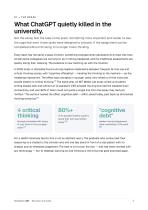
What ChatGPT quietly killed in the university. Not the essay. Not the take-home exam. Something more important and harder to see: the cognitive work those tasks were designed to provoke. If the assignment can be completed without thinking, it no longer trains thinking. Every dean has the same uneasy intuition: something changed when generative AI arrived, the most conservative colleagues are carrying on as if nothing happened, and the traditional assessments are quietly losing their meaning. The evidence is now catching up with the intuition. A 2025 study in Societies found a strong negative...
Open the catalog to page 2
We have lived through this before: elearning. learning Twenty years ago a new technology was going to "transform" or "destroy" the university, depending on who you asked. It did neither cleanly — and the way it actually settled is the best map we have for what comes next. When e-learning arrived, the loudest predictions were the wrong ones. The campus did not disappear, and the lecture did not survive untouched. What the evidence eventually showed was more nuanced and far more useful. The largest review of the era — a meta-analysis commissioned by the U.S. Department of Education across more...
Open the catalog to page 3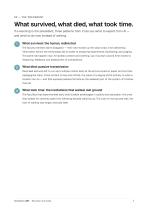
What survived, what died, what took time. If e-learning is the precedent, three patterns from it tell you what to expect from AI — and what to do now instead of waiting. 1 What survived: the human, redirected What died: passive transmission What took time: the institutions that waited, lost ground The faculty member didn't disappear — their role moved up the value chain, from delivering information (which the technology did at scale) to designing experiences, facilitating, and judging. The same will happen now: AI handles content and drafting; your faculty's scarce time moves to reasoning, feedback...
Open the catalog to page 4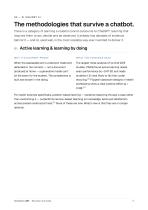
The methodologies that survive a chatbot. There is a category of learning a student cannot outsource to ChatGPT: learning that requires them to act, decide and be observed. It already has decades of evidence behind it — and AI, used well, is the most scalable way ever invented to deliver it. 01 Active learning & learning by doing WHAT THE E VID ENCE SAYS When the assessable act is a decision made and defended in the moment — not a document produced at home — a generative model can't sit the exam for the student. The competence is built and shown in the doing. The largest meta-analysis of its...
Open the catalog to page 5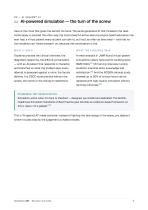
AI-powered simulation — the turn of the screw Here is the move that gives the section its name. The same generative AI that threatens the takehome essay is, pointed the other way, the most powerful active-learning engine health education has ever had: a virtual patient every student can talk to, out loud, as often as they need — and that no two students can "share answers" on, because the conversation is live. WHAT IT DO ES WHAT THE E VID ENCE SAYS Students practise the clinical interview, the diagnostic reasoning, the difficult conversation — with an AI patient that responds in character and...
Open the catalog to page 6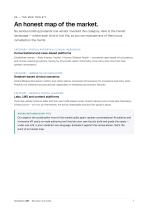
No serious briefing pretends one vendor invented this category. Here is the honest landscape — where each kind of tool fits, so you can evaluate any of them (ours included) on the merits. CATEGORY · VIRTUAL PATIENTS & CLINICAL REASONING Conversational and case-based platforms Established names — Body Interact, Aquifer, i-Human, Shadow Health — pioneered case-based virtual patients and clinical-reasoning practice. Strong for structured cases; historically more menu-and-click than free, spoken conversation. CATEGORY · IMMERSIVE VR SIMULATION Headset-based clinical scenarios Oxford Medical Simulation,...
Open the catalog to page 7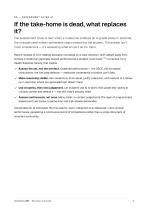
If the take-home is dead, what replaces it? The assessment crisis is real: when a model can produce an A-grade essay in seconds, the unsupervised written deliverable stops measuring the student. The answer isn't more AI detectors — it's assessing what AI can't do for them. Recent reviews of AI in medical education converge on a clear direction: shift weight away from outputs a model can generate, toward performances a student must enact.[11] In practice, for a Health Sciences faculty, that means: Assess the act, not the artefact. Observed performance — the OSCE, the simulated consultation, the...
Open the catalog to page 8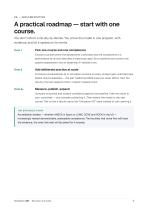
A practical roadmap — start with one course. You don't reform a faculty by decree. You prove the model in one program, with evidence, and let it spread on its merits. Term 1 Pick one course and one competence Choose a course where the assessment crisis bites and the competence is a performance (a clinical interview, a reasoning case). Set a baseline and convert one passive assessment into an observed, AI-resistant one. Add deliberate practice at scale Introduce conversational-AI or simulation practice so every student gets unlimited reps before they're assessed — the part traditional OSCE prep...
Open the catalog to page 9
Let's apply this to your faculty. faculty We'll run a 45-minute working session with your team where we apply this framework to your programs — which courses, which competences, which assessments to redesign first. A pedagogical conversation, not a sales pitch. Write to [email protected] Or book your session at metamedicsvr.com/resources/education-4-0-guide/ metamedicsvr.com
Open the catalog to page 10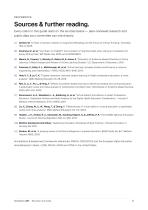
Sources & further reading. Every claim in this guide rests on the sources below — peer-reviewed research and public data your committee can cite directly. [1] Gerlich, M. "AI Tools in Society: Impacts on Cognitive Offloading and the Future of Critical Thinking." Societies, [2] Kosmyna, N., et al. "Your Brain on ChatGPT: Accumulation of Cognitive Debt when Using an AI Assistant for Essay Writing Task." MIT Media Lab, 2025. arXiv:2506.08872. [3] Means, B., Toyama, Y., Murphy, R., Bakia, M., & Jones, K. "Evaluation of Evidence-Based Practices in Online Learning: A Meta-Analysis and Review of Online...
Open the catalog to page 11All MetaMedics catalogs and technical brochures
- Training phantom
- General care phantom
- Online software
- Hospital software
- AI-assisted software
- Training software
- Simulation software
- Recording software
- Web-based software
- Monitoring simulator
- Real-time software
- Evaluation software
- Research software
- ECG simulator
- Anatomy software
- Virtual reality simulator
- Emergency software
- Virtual reality software
- Transcription software
- SaaS software