
- Catalogs
- MetaMedics
- For Directors of Clinical Education & Learning and Development (L&D) Hospitals 2026 Hospital Training Catalog

- Company
- Products
- Catalogs
- News & Trends
- Exhibitions
For Directors of Clinical Education & Learning and Development (L&D) Hospitals 2026 Hospital Training Catalog
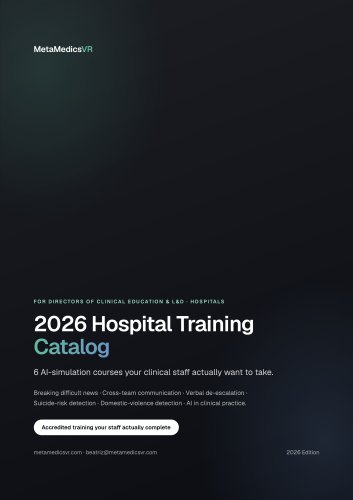
For Directors of Clinical Education & Learning and Development (L&D) Hospitals 2026 Hospital Training Catalog
This document outlines the 2026 Hospital Training Catalog by MetaMedicsVR, designed for directors of clinical education and learning & development in hospitals. It highlights six AI-simulation courses aimed at improving clinical staff training in critical communication and assessment skills.
Challenges with Traditional Training
Traditional training methods are often ineffective due to their passive nature, leading to low completion rates and poor skill transfer. The document emphasizes the need for interactive and practical training formats that can be measured and justified to leadership.
Benefits of Conversational-AI Simulation
Conversational-AI simulation offers a practical approach where staff engage in interactive scenarios with virtual patients. This method allows for unlimited practice, safe repetition, and competence assessment, leading to higher completion rates and measurable improvements.
Course Offerings
The catalog includes six accredited courses:
- Breaking Bad News: Utilizes the SPIKES protocol for delivering difficult news in oncology and critical care settings.
- Cross-Team Clinical Communication: Focuses on structured handovers and effective communication across hierarchies.
- Managing the Agitated Patient: Teaches verbal de-escalation techniques for high-tension situations.
- Suicide Risk Assessment & Prevention: Covers safe communication and referral protocols for suicide risk.
- Safeguarding & Gender-Based Violence Detection: Trains staff to recognize and respond to indicators of gender-based violence.
- New Health Technologies: Provides a framework for understanding and using AI in clinical training.
Implementation and Accreditation
The courses are designed to integrate seamlessly into existing training plans, with flexible scheduling and comprehensive documentation for accreditation and funding purposes. MetaMedicsVR assists with paperwork and identifies applicable funding routes.
Next Steps
Hospitals are encouraged to book a session with MetaMedicsVR to tailor the training plan to their specific needs and explore funding options.
Catalog excerpts
2026 Hospital Training Catalog 6 AI-simulation courses your clinical staff actually want to take. Breaking difficult news · Cross-team communication · Verbal de-escalation · Suicide-risk detection · Domestic-violence detection · AI in clinical practice. Accredited training your staff actually complete metamedicsvr.com · [email protected]
Open the catalog to page 1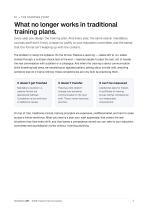
What no longer works in traditional training plans. Every year you design the training plan. And every year, the same scene: mandatory courses staff don't finish, a report to justify to your education committee, and the sense that the format isn't keeping up with the content. The problem is rarely the syllabus. It's the format. Passive e-learning — videos left to run, slides clicked through, a multiple-choice test at the end — teaches people to pass the test, not to handle the real conversation with a patient or a colleague. And when the training is about communication skills (breaking bad news,...
Open the catalog to page 2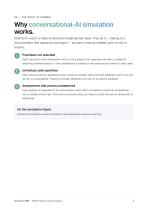
Why conversational-AI simulation works. Staff don't watch a video of someone breaking bad news. They do it — talking to a virtual patient that responds and reacts — as many times as needed, with no risk to anyone. 1 Unlimited, safe repetition Assessment that proves competence Staff take part in the conversation with a virtual patient that responds and reacts, instead of watching someone else do it. The competence is trained on the same ground where it's later used. Each scenario can be repeated as many times as needed, with automatic feedback every time and no risk to a real patient. Practice...
Open the catalog to page 3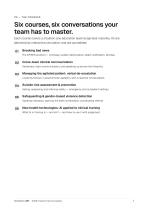
The SPIKES protocol — oncology, sudden deterioration, death notification, families. 02 Cross-team clinical communication Handovers, team communication, and speaking up across the hierarchy. 03 Managing the agitated patient: verbal de-escalation Lowering tension in psychomotor agitation, with a reactive virtual patient. 04 Suicide-risk assessment & prevention Asking, assessing, and referring safely — emergency and outpatient settings. 05 Safeguarding & gender-based violence detection Spotting indicators, opening the safe conversation, coordinating referral. 06 New health technologies: Al applied...
Open the catalog to page 4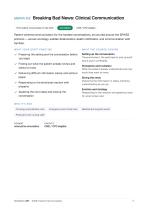
The hardest conversation of the shift CME / CPD eligible Patient-centred communication for the hardest conversations, structured around the SPIKES protocol — across oncology, sudden deterioration, death notification, and communication with families. WHAT THE COURSE COVERS The environment, the participants, and yourself (the S and P of SPIKES). What the patient already understands and how much they want to know. Delivering the information in steps, checking understanding as you go. Responding to the reaction and agreeing a plan for what comes next. WHAT YOUR STAFF PRACTISE ✓ Preparing the setting...
Open the catalog to page 5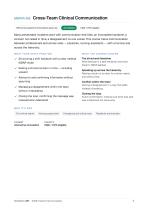
Where the patient's information gets lost CME / CPD eligible Many preventable incidents start with communication that fails: an incomplete handover, a concern not raised in time, a disagreement no one voices. This course trains communication between professionals and across roles — physician, nursing, assistants — with structure and WHAT THE COURSE COVERS What belongs in a safe handover and what doesn't; SBAR applied. Speaking up across the hierarchy Raising a doubt or an alert to a senior clearly and without fear. Conflict within the team Voicing a disagreement in a way that adds, instead of...
Open the catalog to page 6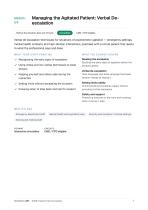
Before the situation gets out of hand WHAT THE COURSE COVERS Spotting the early signs of agitation before the situation peaks. Verbal de-escalation Tone, language, and body language that lower tension instead of raising it. Setting limits safely Communicating boundaries clearly without provoking further escalation. Protecting everyone in the room and knowing when to bring in help. WHAT YOUR STAFF PRACTISE ✓ Recognising the early signs of escalation ✓ Using verbal and non-verbal techniques to lower ✓ Keeping yourself and others safe during the interaction >/ Setting limits without escalating the...
Open the catalog to page 7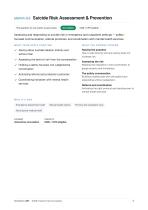
The question no one wants to get wrong CME / CPD eligible WHAT YOUR STAFF PRACTISE ✓ Asking about suicidal ideation directly and without fear ✓ Assessing the level of risk from the conversation v Holding a safety-focused, non-judgemental conversation ✓ Activating referral and protection protocols v Coordinating handover with mental health services WHAT THE COURSE COVERS Raising the question How to ask directly, and why asking does not increase risk. Reading the indicators in the conversation to gauge severity and immediacy. Building a safety plan with the patient and responding without judgement....
Open the catalog to page 8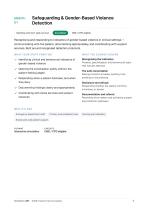
Safeguarding & Gender-Based Violence Detection Spotting what isn't said out loud Recognising and responding to indicators of gender-based violence in clinical settings — communicating with the patient, documenting appropriately, and coordinating with support services. Built around recognised detection protocols. WHAT YOU R STAFF PRACTIS E Identifying clinical and behavioural indicators of gender-based violence Opening the conversation safely, without the patient feeling judged Responding when a patient discloses, and when they deny Documenting findings clearly and appropriately Coordinating with...
Open the catalog to page 9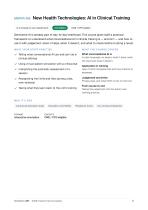
Al is already in your department Generative Al is already part of day-to-day healthcare. This course gives staff a practical framework to understand what conversational Al in clinical training is — and isn't — and how to use it with judgement: when it helps, when it doesn't, and what to check before trusting a result. WHAT YOUR STAFF PRACTISE ✓ Telling what conversational Al can and can't do in clinical settings ✓ Recognising the limits and risks (privacy, bias, over-reliance) ✓ Taking what they learn back to the unit's training WHAT THE COURSE COVERS In plain language, no jargon: what it does...
Open the catalog to page 10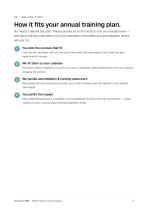
How it fits your annual training plan. No need to rebuild the plan. These courses slot into the structure you already have — and leave the documentation trail your education committee and accreditation review will ask for. 1 You pick the courses that fit We fit them to your calendar We handle accreditation & funding paperwork From the six, we select with you the ones that answer the real needs of your staff and your departments this year. Simulation doesn't depend on a room or an actor's schedule: staff practise when they can, without stopping the service. We prepare the documentation and point...
Open the catalog to page 11All MetaMedics catalogs and technical brochures
- Training phantom
- General care phantom
- Online software
- Hospital software
- AI-assisted software
- Training software
- Simulation software
- Recording software
- Web-based software
- Monitoring simulator
- Real-time software
- Evaluation software
- Research software
- ECG simulator
- Anatomy software
- Virtual reality simulator
- Emergency software
- Virtual reality software
- Transcription software
- SaaS software