


µStat-i 400

µStat-i 400
Metrohm DropSens offers the µStat-i 400 and µStat-i 400s, portable and wireless (Bi)Potentiostat/Galvanostat/Impedance Analyzers designed for laboratory and fieldwork. These instruments support a variety of electrochemical measurements including Voltammetric, Amperometric, Potentiometric, and Electrochemical Impedance Spectroscopy (EIS).
Key Features
- Frequency Range: 1 mHz to 1 MHz
- AC Amplitude Range: 1 mV to 0.350 V rms (1.0 V p-p)
- DC Voltage Range: -3.5V to 3.5V or OCP value
- Portable & Wireless: Ideal for in-situ EIS analysis
- Software: Advanced data presentation and export capabilities
Available Techniques
- Potentiostat: Includes various voltammetry and amperometry techniques such as LSV, CV, SWV, and more.
- Galvanostat: Techniques include LSP, CP, PD, and others.
- Mixed Techniques: Available in µStat-i 400, combining voltammetry and amperometry.
Specifications
- Power: Li-ion Battery (2300 mAh), USB, DC charger
- PC Interface: Wireless Connection / USB
- Operating Modes: BiPotentiostat/Galvanostat/Impedance Analyzer (µStat-i 400), Potentiostat/Galvanostat/Impedance Analyzer (µStat-i 400s)
- DC-Potential Range: ±4 V
- Current Ranges (Potentiostat): ±1 nA to ±10 mA (8 ranges)
- Maximum Measurable Current: ±40 mA
- Potential Ranges (Galvanostat): ±100 mV, ±1 V (2 ranges)
- Dimensions: 13.2 cm x 10.0 cm x 3.6 cm
- Weight: 540 g
Conclusion
The µStat-i 400 series provides a comprehensive solution for electrochemical analysis with robust features suitable for both laboratory and field applications. Its advanced software and versatile measurement capabilities make it a valuable tool for a wide range of applications.
Catalog excerpts

µStat-i 400 (Bi)potentiostat/Galvanostat/Impedance Analyzer (EIS) µStat-i 400s Potentiostat/Galvanostat/Impedance Analyzer (EIS) Metrohm DropSens provides you with a portable and wireless (Bi)Potentiostat/ Galvanostat/ Impedance Analyzer that can be used for Voltammetric, Amperometric, Potentiometric and Electrochemical Impedance Spectroscopy (EIS) measurements. A complete solution for laboratory and fieldwork. Potentiostatic impedance measurements allow defining resistive and capacitive properties in the analyzed system. From corrosion to detection of immunological binding events, EIS analysis offers a wide range of applications. Now you have two different instruments available: Potentiostat/Galvanostat, single channel impedance instrument µStat-i 400s Bipotentiostat/Galvanostat, dual channel impedance instrument µStat-i 400 Key EIS features Portable & wireless system for in-situ EIS analysis Compact and robust ideal for field work AC perturbation superpose to a fixed DC Voltage [-3.5V Powerful software for getting the most from your laboratory experiments Frequency scan Key Software Features In addition to all powerful functions of DropView 8400: Data presentation: Nyquist, Bode, Lissajous, Time Domain, Frequency Domain (FFT) and more Fit and Simulation, semicircle fit Graphical Equivalent Circuit Export measured data to ZView, EIS Analyzer or NOVA with one click
Open the catalog to page 1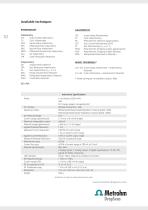
Available techniques POTENTIOSTAT Voltammetry LSV Linear Sweep Voltammetry CV Cyclic Voltammetry SWV Square Wave Voltammetry DPV Differential Pulse Voltammetry NPV Normal Pulse Voltammetry NDPV Differential Normal Pulse Voltammetry ACV AC Voltammetry LPR Linear Polarization Resistance Amperometry AD Amperometric Detection ZRA Zero Resistance Amperometry FA Fast Amperometry (tint < 0.1 s) PAD Pulsed Amperometric Detection MAD Multipulsed Amperometric Detection COUL Coulometric Detection MIXED TECHNIQUES * Linear Sweep Potentiometry Cyclic Potentiometry Potentiometric Detection (galvanostatic)...
Open the catalog to page 2All Metrohm catalogs and technical brochures
 OMNIS KARL FISCHER TITRATOR
4 Pages
 2029
20291 Page
 2026 Titrolyzer
8 Pages
 Mira P Handheld
8 Pages
 OMNIS Sample Robot
4 Pages
 930 Compact IC Flex
12 Pages
 899 Coulometer
8 Pages
 Accessories for 2.1008.1010
6 Pages
 OMNIS
OMNIS16 Pages
 Sample preparation
12 Pages
 Titrotherm
12 Pages
 855 Robotic Titrosampler
12 Pages
 888/890 Titrando
12 Pages
 904/905 and 906/907 Titrando
24 Pages
 OMNIS
OMNIS8 Pages
 PSTAT mini
8 Pages
 Professional Rancimat
20 Pages
 Dosing Package
4 Pages
 Dosing Interface
3 Pages
 Dosimat plus
4 Pages
 Amino acid analyzer
4 Pages
 Vision Air Software
12 Pages
 815 Robotic Soliprep
16 Pages
 KF Evaporator
4 Pages
 848/877 Titrino plus
8 Pages
 909 UV Digester
8 Pages
 NIRS XDS MasterLab Analyzer
4 Pages
 NIRS XDS MultiVial Analyzer
4 Pages
 NIRS XDS SmartProbe Analyzer
4 Pages
 921 NIRS Vial Heater
1 Page
 NIRS DS2500 Analyzer
4 Pages


Archived catalogs
 898 XYZ Sample Changer
8 Pages
 NIRS Analyzer Pro
8 Pages
 Industrial Process Analyzers
16 Pages


- Analysis software
- Sample preparation system
- Automatic sample processor
- Control software
- Laboratory testing system
- Laboratory sample preparation system
- Straight electrode
- Spectroscope
- Laboratory workstation
- Control analyser
- Data management software
- Temperature testing system
- Chromatography system
- Flow testing system
- Medical electrode
- Digital controller
- Laboratory peristaltic pump
- Environmental analysis tester
- Testing system with touchscreen
- Pressure testing system