
- Catalogs
- Mettler Toledo
- Automated Synthesis & Inline Analysis


Automated Synthesis & Inline Analysis
Automated Synthesis & Inline Analysis
Challenges in chemical development require innovative solutions across stages like molecule invention, reaction development, process creation, and material manufacturing. Each stage involves considerations of safety, scalability, and profitability.
Modern labs use automated systems for continuous experiments, enhancing safety and data accuracy. Inline analytics and real-time data collection improve understanding and decision-making.
Automated reactor platforms offer flexible configurations and seamless integration, allowing precise control and data recording, improving productivity and reducing training needs.
FTIR spectroscopy enables real-time monitoring of reactions, providing insights into kinetics and mechanisms, enhancing process development efficiency and safety.
Automated sampling systems like EasySampler provide continuous data collection, offering insights into reaction kinetics and impurity profiles, crucial for optimizing chemical processes.
Inline particle analysis ensures process consistency and optimizes product quality by tracking changes in particle size, shape, and count.
Reaction calorimetry identifies exothermic events and ensures scalable processes, helping predict and mitigate risks for safe chemical development.
Software tools synchronize experimental data, enabling efficient data analysis and knowledge sharing, supporting informed decision-making and enhancing workflow efficiency.
- Automatic data capture and preparation for regulatory compliance.
- Web-based interface for easy configuration and reduced manual data handling.
- Integration with various technologies for comprehensive data analysis.
- Titration: OneClick™ interface for minimal training and automatic recognition of accessories.
- Weighing: Innovations like Quantos™ for automated dosing and comprehensive balance portfolio for security and traceability.
- pH Measurement: Instruments with high accuracy and flexibility.
- Thermal Analysis: Products like DSC™, TGA™, and innovative techniques for high sensitivity results.
- Pipetting: RAININ pipettes with ergonomic designs to reduce errors and enhance performance.
- UV/VIS Spectroscopy: FastTrack™ technology for reliable performance and data management integration.
- Automated Chemistry: Tools and services for transforming bench scale chemistry into commercial processes.
- Physical Values: Instruments for measuring refractive index, density, and thermal data.
Catalog excerpts

Chemical Development Automated Synthesis & Inline Analysis From Molecule to Manufacturing
Open the catalog to page 1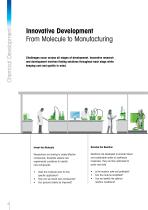
Chemical Development I Innovative Development From Molecule to ManufacturingChallenges occur across all stages of development. Innovative research and development involves finding solutions throughout each stage while keeping cost and quality in mind. Invent the Molecule Researchers are looking to create effective compounds. Scientists explore new experimental conditions to identify new compounds. • Does the molecule work for this specific application? • How can we invent new compounds? • Can personal safety be improved? Develop the Reaction Reactions are developed to provide robust and sustainable...
Open the catalog to page 2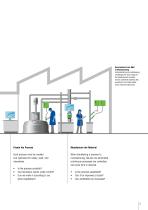
Development from R&D to Manufacturing Understanding and addressing challenges for each stage of the development process means scientists address key questions and make better, more informed decisions. Create the Process Each process must be created and optimized for safety, yield, and robustness. • Is the process scalable? • Are hazardous events under control? • Can we make it according to our plant capabilities? Manufacture the Material When transferring a process to manufacturing, failures are eliminated, continuous processes are controlled, and cycle time is reduced. • Is the process repeatable?...
Open the catalog to page 3
Chemical Development The Evolution of the Modern Laboratory With safe and unattended experiments 24 hours a day, precise controls, and continuous measurements, researchers quickly understand the effect of changing parameters and make better, more informed decisions. Knowledge and control in the modern lab lead to innovative development. Traditional Lab Techniques Data is not recorded Scientist must be present to sample Reactors are poorly controlled Personal safety risks Results, Offline Analysis Gaps in understanding lead to suboptimal performance start 4 Gaps or delays in results
Open the catalog to page 4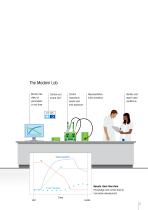
The Modern Lab Monitor the effect of parameters in real time Control hazardous events and limit exposure Representative, inline analytics Identify and report ideal conditions Results, Real-Time Data Knowledge and control lead to innovative development
Open the catalog to page 5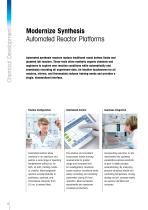
Chemical Development Modernize Synthesis Automated Reactor Platforms Automated synthesis reactors replace traditional round bottom flasks and jacketed lab reactors. These tools allow synthetic organic chemists and engineers to explore new reaction conditions while automatically and seamlessly recording all experiment data. An intuitive touchscreen for all reactors, stirrers, and thermostats reduces training needs and provides a single, standardized interface. Flexible Configuration Seamless Integration Automated reactors allow chemists to run reactions and explore a wide range of operating temperatures...
Open the catalog to page 6
By-Product Formation Round Bottom Flask EasyMax Time (h:mm) start dosing HCl Synthesis Beyond the Round Bottom Flask With EasyMax, OptiMax, and RX-10, experiments are easy to execute and deliver highly precise and repeatable data over a wide temperature range. Scientists are able to measure the impact that process variables have on the reaction. In this figure, the temperature trend for the manual system shows the erratic control, which raises the potential for inconsistency such as by-product formation. EasyMax provides extremely stable temperature control, reducing the need for repetition,...
Open the catalog to page 7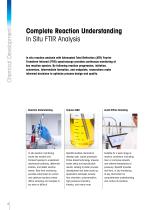
Chemical Development Complete Reaction Understanding In Situ FTIR Analysis In situ reaction analysis with Attenuated Total Reflection (ATR) Fourier Transform Infrared (FTIR) spectroscopy provides continuous monitoring of key reaction species. By following reaction progression, initiation, conversion, intermediate formation, and endpoints, researchers make informed decisions to optimize process design and quality. Reaction Understanding Avoid Offline Sampling In situ reaction monitoring tracks key reactive and transient species to understand mechanism pathway, determine kinetics, and detect reaction...
Open the catalog to page 8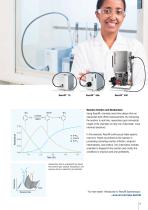
Reaction Kinetics and Mechanisms Using ReactIR, chemists avoid time delays that are associated with offline measurements. By measuring the reaction in real time, researchers gain immediate insight of the chemistry so they can make faster, more informed decisions. Catalyst DMSO In this example, ReactIR continuously takes spectra over time. Peaks are profiled as the reaction is proceeding indicating reaction initiation, endpoint, intermediates, and kinetics. This information enables scientists to fingerprint this reaction and modify the conditions to improve yield and profitability. Researchers...
Open the catalog to page 9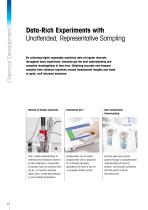
Chemical Development I Data-Rich Experiments with Unattended, Representative Sampling By collecting highly repeatable analytical data at regular intervals throughout each experiment, chemists get the best understanding and complete investigations in less time. Obtaining accurate and frequent samples from chemical reactions reveals fundamental insights and leads to quick, well informed decisions. Difficult to Sample Chemistry Gain Fundamental Understanding Gain a better understanding of chemistry from reactions where it is labor-intensive or impossible to sample, such as reactions that are air-...
Open the catalog to page 10
Data collected overnight via automated sampling Address Problems with Insightful Data Understanding reaction kinetics and the mechanism of products, by-products, and impurities over the course of a reaction is needed in chemical development. A major hurdle in reaction progress analysis is the lack of data from reactions that must run unattended overnight. The use of EasySampler solves the issue of information gaps and enables researchers with the ability to automatically collect, quench, and prepare HPLC-ready samples from chemical reactions 24/7. Learn how Novartis Identified the Root Cause...
Open the catalog to page 11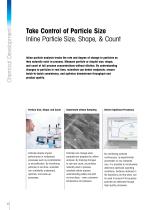
Chemical Development Take Control of Particle Size Inline Particle Size, Shape, & Count Inline particle analysis tracks the rate and degree of change to particles as they naturally exist in-process. Measure particle or droplet size, shape, and count at full process concentrations without dilution. By understanding changes to particles in real time, scientists can detect endpoints, ensure batch-to-batch consistency, and optimize downstream throughput and product quality. Particle Size, Shape, and Count Deliver Optimized Processes Particles directly impact performance in multiphase processes such...
Open the catalog to page 12All Mettler Toledo catalogs and technical brochures
 XPR Precision Balances
20 Pages
 GWP
GWP2 Pages
 Reaction Analysis and PAT tools
16 Pages
 InMotion™ Autosamplers
16 Pages
 Excellence Titrators
16 Pages
 FiveEasy Bench Instruments
8 Pages
 SevenExcellence™
20 Pages
 Flash DSC1
14 Pages
 MS Balance Line
24 Pages
 Excellence Plus XP
20 Pages
 XP Precision Balances
20 Pages
 Excellence Melting Point Systems
12 Pages


- Laboratory reagent
- Analysis software
- Visualization software
- Tablet computer software
- Tablet PC software
- Buffer solution reagent
- Control software
- Automatic balance
- Laboratory balance
- Electronic laboratory balance
- Temperature sensor
- Reporting software
- Benchtop laboratory balance
- Laboratory software
- Pipette tip
- Automated software
- Design software
- Traceability software
- Automatic laboratory balance