
- Catalogs
- Microbrush International
- Tru White Paper

Tru White Paper
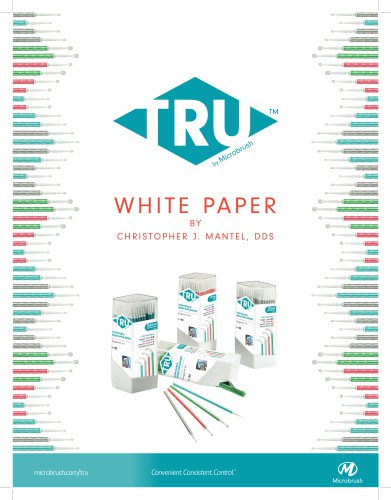
Tru White Paper
Introduction to TRU™ by Microbrush®
This white paper introduces TRU by Microbrush, a redesigned dental micro-applicator aimed at improving consistency, minimizing waste, maximizing ergonomics, and increasing clinical efficacy. The focus is on enhancing the applicator's performance, which has seen little innovation compared to other dental products.
Development of a Superior Micro-Applicator
Microbrush engaged in extensive feedback and testing to refine TRU, involving dental professionals in the process. The early prototypes showed promise, indicating the potential for TRU to become a superior dental applicator.
Advanced Flocking Technology
TRU by Microbrush features advanced flocking technology that eliminates the need for an intermediate glue layer, allowing for precise tip size and consistent holding volume. The applicator's tip is non-linting, non-absorbing, and non-dissolving in dental solutions, matching the size of dental prep burs.
Addressing Common Applicator Issues
The ultrafine size of TRU by Microbrush addresses common problems such as tip breakage, insufficient solution penetration, and inconsistent solution application. The applicator's ultrafine size is 0.5 mm in diameter, designed for small cavity preps and preventive resin restorations.
Accuracy and Waste Reduction
TRU's ultrafine size allows for precise application of solutions, reducing mess and waste. The applicators come in various sizes (ultrafine, superfine, fine, and regular) to match different preparation sizes and solution volumes, minimizing the need for repeated dipping into dental solutions.
Enhanced Access with Dual Bending Points
TRU by Microbrush features two bending points for improved access, especially in pediatric patients or those with limited mouth opening. The bending points are engineered to prevent unexpected bending, and the tip material is highly resilient to breakage.
Ergonomic Design
The applicator's total length is 12 cm, with an optional 2 cm breakoff for shorter use, facilitating access to posterior teeth and improving ergonomics to reduce body strain during procedures.
Conclusion
TRU by Microbrush represents a significant advancement in applicator technology, addressing previous shortcomings and enabling more efficient and effective dental practices while minimizing waste.
Catalog excerpts

WHITE PAPER BY CHRISTOPHER J. MANTEL, DDS SIZES AVAILABLE: Rcgul»2.0mn.** Convenient. Consistent. Control.™
Open the catalog to page 1
INTRODUCING TRU™ BY MICROBRUSH® The purpose of this white paper is to convey the benefits of TRU by Microbrush. During the redesign of a dental instrument as simple as an applicator, much thought was given on how to improve its efficacy. Applicators have changed very little compared with the advance of other dental products. TRU by Microbrush is designed to be a micro-applicator that will improve consistency, minimize waste, maximize ergonomics and increase clinical efficacy. D E V E L O P I N G A S U P E R I O R M I C R O - A P P L I C AT O R Microbrush sought feedback on a new product they...
Open the catalog to page 2
either too much or too little solution to the tooth. The ultrafine size of TRU by Microbrush solves each of these problems. The ultrafine size is 0.5 millimeters in diameter and 3 millimeters in length before it begins to increase in size. The prototype applicators underwent many revisions to perfect the size. Mainly, the parameters of size were used with small pit and fissure caries and preventive resin restorations in mind. A C C U R A C Y T H AT C U T S O U T T H E W A S T E The TRU by Microbrush ultrafine size can navigate the entire cavosurface of teeth prepared with one pass, gracefully...
Open the catalog to page 3
T WO BENDS ARE BET TER THAN ONE Dental applicators are bent at the tip to allow better access to the preparation. To allow the clinician greater access, TRU by Microbrush now has two bending points in the tip. The first bending point is five millimeters from the end, while the second and main bending point remains at 12 millimeters. The 5-millimeter bending point allows for better visibility when working with preparations less than five millimeters deep. The first bending point allows for better access in the mouths of pediatric patients and patients that have limited opening. Both bending points...
Open the catalog to page 4All Microbrush International catalogs and technical brochures
 Matrix system
2 Pages
 Dry Tips Flyer
2 Pages
 TRU Flyer
2 Pages