
- Catalogs
- Micropoint BioScience Inc.
- qLabs® Vet

- Products
- Catalogs
- News & Trends
- Exhibitions
qLabs® Vet

qLabs® Vet
- Before You Start: Users should thoroughly read the manual and package inserts before using the qLabs® Vet system.
- Intended Use: The system is designed for veterinary professionals to measure Prothrombin Time (PT) and Activated Partial Thromboplastin Time (APTT) in animals using fresh venous blood and citrated whole blood.
- Test Principle: The system detects a test strip insertion, heats it, and measures blood coagulation through electrical changes.
- Packaging: Unpack the device carefully, place it on a flat surface, and avoid direct sunlight and strong magnetic fields.
- The device includes a touchscreen, test strip guide, power button, and various ports for connectivity and charging.
- Details the materials needed for testing and the steps involved in setting up and performing tests.
- Care: Handle the device carefully, avoid liquid spills, and store it within specified temperature ranges.
- Environment: Operate within 10°C to 35°C and avoid electromagnetic interference.
- Patient Health: Consider patient health status when interpreting results.
- Testing: Follow procedures strictly and ensure samples are fresh and applied correctly.
- Battery: Use only the provided charger and avoid exposing the device to high temperatures.
- Ensure the device is fully charged before first use. Follow specific instructions for powering on and off, and managing sleep mode.
Operators must log out and re-enter their ID by pressing the logout icon. If the Operator ID is off, the logout icon is disabled, and the device goes directly to the main screen upon startup.
Pressing the power button briefly puts the device into sleep mode to save battery. The device can be reactivated by pressing the power button or inserting a test strip. If auto sleep is enabled, the device shuts down after a set idle time.
Holding the power button for 3 seconds prompts a shutdown message. The device also shuts down automatically when the battery is exhausted.
- Language: Users can select their preferred language from the settings menu.
- WIFI: Enables connection to a Data Management System for data transmission. The system searches for nearby hotspots and remembers the last connected hotspot.
- Bluetooth: Allows connection to eStation II and mobile apps for data transfer. The device can be made discoverable to other Bluetooth devices.
- Test Parameters: Users can set sample numbers, manage Codechip information, and adjust reference ranges and test units.
- System Parameters: Includes settings for date/time, beeper volume, screen rotation, brightness, sleep settings, and print/upload functions.
- Transport Mode: Extends battery storage period and resets system time upon activation.
- About the Device: Displays system information and version details.
- Operator ID: Allows management of operator accounts, including creating, deleting, and resetting passwords. The administrator account is required for these actions.
Users can reset their passwords by providing the current password, a new password, and confirming the new password. If a password is forgotten, the administrator must be contacted. Administrators who forget their passwords should contact the local distributor or Micropoint technicians. Users can only change passwords for their own accounts.
Sample Test Procedures
- Choosing Test Type: Users can select test types such as feline, canine, and others.
- Input Sample Number: Sample numbers can be input manually or automatically. The character length should be between 1-20.
- Insert Test Strip: Insert the test strip correctly as per the instructions.
- Input Test Strip Information: Enter the Codechip number manually or by scanning the barcode.
- Install Codechip: Insert the Codechip into the slot. Warnings are issued if the Codechip number is incorrect or expired.
- Heating and Sample Addition: The instrument heats up before prompting sample addition, which must be done within 10 minutes.
- Collecting and Performing the Test: Collect blood samples carefully to avoid hemolysis and apply them to the test strip. The system starts the test automatically.
- Test Results: Results are displayed and can be printed or uploaded. Alerts are given for results outside the normal range.
Quality Control
The qLabs® system includes onboard and liquid QC tests to ensure accuracy. The QC process involves inserting a test strip, inputting Codechip information, and performing the test. Results can be printed or uploaded.
Results Management
Users are prompted to upload data when storage reaches 80% capacity. Results can be queried by various criteria and cleared if necessary.
Maintenance
- Cleaning Frequency: Clean the meter after each patient and when visibly soiled. Routine cleaning should occur monthly.
- Cleaning Areas: Focus on the test strip port, display, housing, and button area.
- Moisture Precautions: Avoid liquid entry into the meter. Do not spray or immerse the meter in liquid.
- Recommended Solutions: Use wipes with quaternary ammonium compounds and isopropyl alcohol. Avoid other disinfectants.
To clean and disinfect the meter housing, use the recommended cloth and solutions, allowing a contact time of 2 minutes. Ensure the meter is turned off before cleaning. Pre-clean by removing debris with a clean cloth, then disinfect using a new cloth, wiping all surfaces including the LCD screen and button areas. Avoid liquid accumulation near openings and ensure no liquid enters the meter. Leave the meter wet for 2 minutes, then dry with a fresh cloth.
Battery Precautions
The qLabs® ElectroMeter contains a non-removable lithium battery. For replacement, contact your distributor. If unused for over a month, fully charge and activate transportation mode. Charge every 3 months if stored longer to prevent battery issues.
Servicing
All servicing must be performed by Micropoint Biotechnologies Co., Ltd. as there are no user-serviceable components.
Troubleshooting
For error codes, retest and contact your distributor if issues persist. Common errors include low battery, heating timeouts, and insufficient sample addition. Each error code has specific corrective actions.
Symbols and Specifications
Symbols indicate instructions, expiry dates, and other important information. Operating conditions include a temperature range of 10ºC to 35ºC and humidity of 10% to 90%. The product specifications detail the processor, display, memory, and power requirements.
Warranty
The meter has a two-year warranty against material defects. Misuse or tampering voids the warranty. For returns, obtain authorization from Micropoint Biotechnologies Co., Ltd.
Catalog excerpts
qLabs® Vet User’s Manual
Open the catalog to page 1
1. ntroduction I 1.1 Before You Start Before using qLabs® Vet, read the User's Manual as well as the package inserts for all relevant consumables carefully. 1.2 Intended Use The qLabs® Vet system, which consists of qLabs® Vet instrument and qLabs® Vet Test Strips, intended for quantitative determination of Prothrombin Time (PT) and Activated Partial Thromboplastin Time (APTT) in fresh venous blood and citrated whole blood. The qLabs® Vet system is only for veterinarian professional use in feline, canine and other animals. 1.3 Test Principle The qLabs® Vet automatically detects the insertion of...
Open the catalog to page 5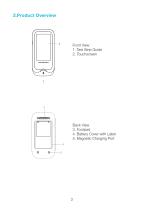
Front View 1. Test Strip Guide 2. Touchscreen Back View 3. Footpad 4. Battery Cover with Label 5. Magnetic Charging Port
Open the catalog to page 6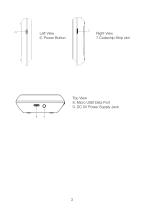
Left View 6. Power Button Right View 7.Codechip Strip slot Top View 8. Micro USB Data Port 9. DC 5V Power Supply Jack 8
Open the catalog to page 7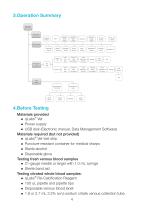
3. peration Summary O Operation Preparation Language Setting Bluetooth Switch Setting Sample No. Switch Setting Reference Range Setting Sleep Setting Upload/Print Setting Transport Mode APTT Units Setting Meter Setup Date/Time Setting Backlight Setting Screen Rotation Sample Test Insert Test Strip Input Test Strip Information Insert Codechip of Test Strip Beeper Setting Insert Test Strip Input Test Strip Information Insert Codechip of Test Strip Input QC Liquid Information Test Type Insert Codechip of QC Liquid Results Query Review Sample Test Result Delete Result Upload Result Review QC Test...
Open the catalog to page 8
5. recautions, Limitations and Warnings P The qLabs® Vet is for in vitro diagnostic use only. Some environmental factors and incorrect operation may cause the qLabs® Vet cannot work effectively or report accurate results. Please read the following warnings carefully before use and strictly follow them. As with all diagnostic tests, qLabs® Vet’s test results should be analyzed and interpreted by combining the condition, medical history, current and possible treatment of a specific animal. Any results exhibiting inconsistency with the clinical status should be repeated or supplemented with additional...
Open the catalog to page 9
netic radiation, as these may interfere with the proper operation of the instrument. 5.3 Patient health Status Current patient health status may cause inaccurate or unexpected test results. It is important to take certain health factors into consideration when interpreting the test results and deciding on a course of action for your patients. Failure to do so may lead to an incorrect interpretation of the test result. 5.4 Performing a Test ●● The qLabs® Vet should be placed on a level surface that is free of vibration. Testing on an uneven or unstable surface may cause inaccurate results. DO...
Open the catalog to page 10
●● The user must use the matching 5V special charger provided by Micropoint to charge. ●● Do not bring the meter close to a high-temperature heat source. ●● Do not allow the meter to be hit or exert heavy pressure on the meter. ●● If it is found that there is leakage from the battery cover on the back of the meter, direct skin contact should be avoided as much as possible. In case of accidental contact with skin due to battery leakage, please rinse with water. If your eyes come into contact with battery liquid, you should also seek medical care. ●● The battery should be disposed with the meter...
Open the catalog to page 11
6. ower ON/OFF P 6.1 Battery and Charging When turning on the meter for the first time after unpacking, please connect the adapter for power supply and turn off the transportation mode. You do not need to repeat this operation for subsequent reboot. Ensure the meter is fully charged before using for the first time. Approximately 3.5 hours to fully charge. When the screen displays E001, the adapter should be connected immediately for charging. If the battery charge display shows only one bar, it is recommended that the user connect the power adapter to charge as soon as possible. When the meter...
Open the catalog to page 12
Once Operator ID is On, the Log out icon in Main screen will be enabled and displayed in brown (see figure 1-2). To switch between the operators, please return to the screen for inputting the operator ID by pressing the Log out icon, and then re-enter the operator ID. 1-2 If Operator ID is Off, the Log out icon in Main screen will be disabled and grayed out (see figure 1-3), and the meter then directly enters the Main screen after it is turned on. 6.3 Sleep mode After a short press and release of the Power button, the screen will be off and enter sleep mode. The sleep mode is a low power mode...
Open the catalog to page 13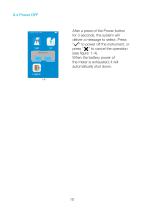
After a press of the Power button for 3 seconds, the system will deliver a message to select. Press " " to power off the instrument, or press " " to cancel the operation (see figure 1-4). When the battery power of the meter is exhausted, it will automatically shut down. 1-4
Open the catalog to page 14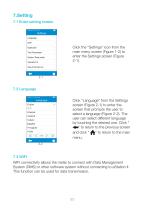
7. etting S 7.1 Enter setting screen Click the "Settings" icon from the main menu screen (Figure 1-2) to enter the Settings screen (Figure 2-1). 7.2 Language Click "Language" from the Settings screen (Figure 2-1) to enter the screen that prompts the user to select a language (Figure 2-2). The user can select different language by touching the desired one. Click " " to return to the previous screen and click " " to return to the main menu. 2-2 7.3 WIFI WIFI connectivity allows the meter to connect with Data Management System (DMS) or other software system without connecting to eStation II. This...
Open the catalog to page 15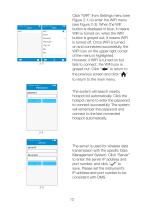
Click “WIFI” from Settings menu (see Figure 2-1) to enter the WIFI menu (see Figure 2-3). When the WIF button is displayed in blue, it means WIFI is turned on; when the WIFI button is grayed out, it means WIFI is turned off. Once WIFI is turned on and connected successfully, the WIFI icon on the upper right corner of the menu is highlighted. However, if WIFI is turned on but fails to connect, the WIFI icon is grayed out. Click “ ” to return to the previous screen and click “ ” to return to the main menu. The system will search nearby hotspot list automatically. Click the hotspot name to enter...
Open the catalog to page 16All Micropoint BioScience Inc. catalogs and technical brochures
 qLabs®ElectroMeter Plus
2 Pages
 qLabs® ElectroMeter (Q3)
2 Pages
 630-00291 Q-3 Pro Meter
59 Pages

- Detection kit
- Blood detection kit
- Plasma detection kit
- Infectious disease detection kit
- Respiratory disease assay kit
- Clinical detection kit
- COVID-19 assay kit
- Antigen detection kit
- IgG assay kit
- Fecal test kit
- Immunoassay analyzer
- Clinical diagnostic immunoassay analyzer
- Automated immunoassay analyzer
- Saliva assay kit
- POC analyzer
- Benchtop immunoassay analyzer
- Throat detection kit
- Nasal detection kit
- Urine test strip