
- Catalogs
- Modus Medical Devices
- Modus QA - Product Data Sheet - MRID3D

Modus QA - Product Data Sheet - MRID3D

Modus QA - Product Data Sheet - MRID3D
QUASAR™ MRID3D is an advanced measurement technique designed to assess MRI geometric distortion in 3D using harmonic analysis. This method is more efficient, lighter, and larger compared to traditional techniques.
Specifications
The system uses a 21 kg phantom with dimensions of 39.4 cm in diameter and 39.1 cm in length. It is made from acrylic and filled with susceptibility-matched mineral oil, which is non-reactive and maintains dimensional stability over time. The phantom is designed to be lightweight and easy to handle, with recessed handles and integrated feet for stability.
Procedures and Workflow
The system includes client-based image analysis software with a built-in DICOM receiver for efficient file transfer. The process from setup to results can be completed in as little as 10 minutes. The software automates control point detection and harmonic analysis, and it can separate distortions caused by magnetic field inhomogeneities from those caused by gradient non-linearities.
Geometric Accuracy and Standards
The phantom design adheres to NEMA/MITA MS-12 and IEC 62464-1 standards for high accuracy, even in high distortion scenarios. It minimizes perturbations to the magnetic fields, ensuring unbiased measurements.
Additional Capabilities
The system offers new QA capabilities, including rapid ferrous content detection, submillimeter laser alignment checks, and characterization of Z gradient non-linearity.
MRI Data Acquisition Recommendations
Recommended settings include a 3D T1 weighted fast gradient echo sequence with specific parameters for optimal results at different field strengths.
System Requirements
The software requires Windows 7 SP1 or higher, an Intel Core™ i7 processor or better, at least 8 GB of RAM, and a compatible graphics card.
Product Specifications
The phantom is made of acrylic with a density of 1.18 g/cm³ and filled with 5 liters of high T1 contrast paraffinic mineral oil. The internal hollow volume allows for a significant weight reduction compared to conventional phantoms.
Ordering Information
The system includes a software license, phantom, and user’s guide. Additional licenses and maintenance contracts are available.
Contact Information
For more information, contact Modus QA at their London, Ontario office.
Catalog excerpts

WORKFLOW EFFICIENCY GEOMETRIC ACCURACY Quickly setup, scan and quantify geometric distortion measurements in as little as 10 minutes with a lighter, larger and faster analysis system. Large FOV phantom design follows recommendations from NEMA/ MITA MS-12 and IEC 62464-1 for highest accuracy even when distortion is high and vendor correction is off. DIMENSIONAL STABILITY Integrated expansion tubes (patent pending) compensate for changes in liquid volume, caused by changes in temperature and pressure, ensuring the phantom is dimensionally stable. HARMONIC ANALYSIS Adapts analytical techniques that are routinely used in MRI B0 shimming and gradient coil design. QUASAR™ MRID3D is a lighter, larger and more efficient measurement technique that leverages harmonic analysis to quantify MRI geometric distortion in 3D. Harmonic analysis is a well-established mathematical tool used to solve electromagnetism problems with well-defined boundary conditions including MRI gradient coil design and B0 shimming. The QUASAR MRID3D Geometric Distortion Analysis System extends this approach by measuring distortions on the closed surface of a boundary phantom and then uses harmonic analysis to calculate the distortions inside. This permits the use of a lighter, larger, hollow boundary phantom. At 21 kg, the 39.4 cm diameter by 39.1 cm long phantom is half the weight of a water-filled grid phantom of the same volume. It includes recessed handles for safe carrying plus integrated 3 point contact feet and engraved landmarks for convenient OSHA compliant (under 50 lbs.) one person set-up. Fiducials in the acrylic phantom contain susceptibility matched mineral oil for fast high contrast 3D T1W scanning. Mineral oil is non-reactive and allows plastics to remain dimensionally stable over time unlike water which causes plastics to swell. The maintenance free phantom never has to be drained or refilled. The low dielectric constant mineral oil permits dielectric-resonance-free use at high field strengths. The system includes robust, mature, client-based image analysis software. The built-in DICOM receiver ensures efficient file transfer. There is no waiting for files to upload to the cloud thus avoiding associated IT issues. Control point detection and harmonic analysis are fully automated; from phantom setup to results in as little as 10 minutes. Software features include the
Open the catalog to page 1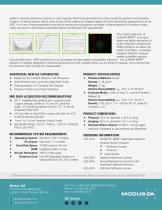
ability to separate distortions caused by main magnetic field inhomogeneities from those caused by gradient non-linearities. A region of interest selector allows users to focus their analysis on targeted regions for more demanding applications such as SRS. A rich set of data presentation tools allows trending and comparison amongst a diverse selection of phantom scans. Users can export customizable automated reports including full DVF spreadsheets. The modern approach of QUASAR MRID3D is a better, faster and lighter alternative for routine distortion assessment. GRID phantoms are either too small...
Open the catalog to page 2All Modus Medical Devices catalogs and technical brochures
 PRODUCT CATALOG 2022
13 Pages
 Modus QA - White Paper - MRID3D
28 Pages
 QUASAR™ Catphan Shaker
2 Pages
 QUASAR™ GRID3D
2 Pages
 QUASAR™ MRID3D
2 Pages
 QUASAR MRID3D
2 Pages
 QUASAR IsoCenter Cube
2 Pages
 QUASAR Penta-Guide
2 Pages
 QUASAR? eQA
2 Pages
 QUASAR ADQ
2 Pages


