
- Catalogs
- MSP, a Division of TSI
- Copley Catalog Inhaler Testing Brochure


- Company
- Products
- Catalogs
- News & Trends
- Exhibitions
Copley Catalog Inhaler Testing Brochure
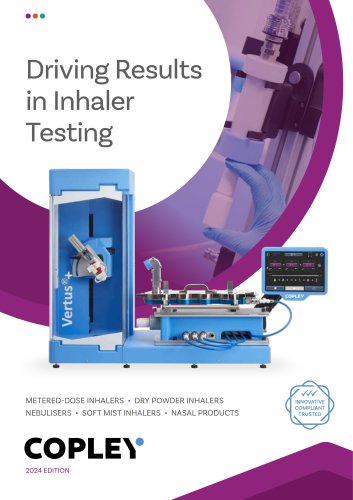
Copley Catalog Inhaler Testing Brochure
Copley Scientific, established in 1946, is a leading global manufacturer of inhaler test equipment, headquartered in Nottingham, UK. The company is renowned for its high-quality pharmaceutical testing equipment, designed and manufactured in the UK, and offers comprehensive product support and training.
Copley Scientific is committed to excellence, employing Quality by Design (QbD) principles and holding ISO 9001:2015 certification. Continuous improvement is a core focus, aiming to exceed industry expectations.
The document provides a comprehensive guide to testing various inhaler types, including metered-dose inhalers (MDIs), dry powder inhalers (DPIs), nebulisers, soft mist inhalers (SMIs), and nasal products. It covers the aerodynamic particle size distribution, delivered dose uniformity, and the use of realistic breathing profiles and models.
- Metered-Dose Inhalers (MDIs): Require coordination for optimal use, with options like breath-actuated MDIs and spacers to aid users.
- Dry Powder Inhalers (DPIs): Deliver medication in powder form, often requiring patient inhalation strength, with active DPIs available for improved dose accuracy.
- Nebulisers: Convert liquid medication into aerosol, requiring minimal patient coordination but can be cumbersome and costly.
- Soft Mist Inhalers (SMIs): Provide a higher fine particle fraction without using propellants, addressing issues of lung deposition and dose variability.
- Nasal Products: Include sprays, aerosols, and powders, offering multi-dose and unit-dose options for various applications.
The document outlines compliance with global regulatory standards and pharmacopoeias, including the European Pharmacopoeia, United States Pharmacopeia, Chinese Pharmacopoeia, and Japanese Pharmacopoeia. It also highlights the role of expert groups and international standards organizations.
Orally inhaled and nasal drug products (OINDPs) are increasingly used for local and systemic therapy, offering advantages over traditional oral and parenteral routes. They are used for a wide range of treatments, including diabetes, migraine, and vaccine delivery.
This document discusses the potential and current applications of nasal and inhalation drug delivery systems, highlighting their advantages, regulatory frameworks, and the role of various organizations in ensuring drug safety, quality, and efficacy.
Nasal and inhalation routes offer rapid drug absorption and direct targeting of the central nervous system, potentially treating conditions like Alzheimer's disease. These methods provide benefits such as fewer side effects, rapid onset, and non-invasive administration. Inhalation is particularly useful for treating lung diseases like asthma and COPD.
Regulatory bodies such as the EMA, FDA, and others in China and Japan oversee the safety and efficacy of inhaled and nasal products. The EMA provides guidelines on pharmaceutical quality and clinical documentation for these products. The FDA has issued guidelines for metered-dose inhalers and dry powder inhalers, focusing on quality and performance.
The ICH promotes harmonisation of drug regulation to ensure safety and efficacy. It has developed guidelines on pharmaceutical development, quality risk management, and manufacturing practices. The ICH Q10 guideline outlines a Pharmaceutical Quality System covering the entire product lifecycle.
Pharmacopoeias in the EU, USA, China, and Japan set standards for medicines. They provide guidelines for testing inhalation and nasal products, ensuring compliance with quality and performance standards.
Groups like the European Pharmaceutical Aerosol Group and the International Pharmaceutical Consortium on Regulation and Science work to establish best practices and standards for inhalation products.
- Drug Formulation: The active pharmaceutical ingredients (API) and excipients.
- Medical Device: The device that delivers the formulation to the patient, with standards defined by ISO.
- ISO 20072: Design verification for aerosol drug delivery devices.
- ISO 27427: Standards for nebulizing systems.
- EMA Guidelines: Focus on pharmaceutical quality and clinical documentation for inhalation and nasal products.
- FDA Guidance: Quality considerations for MDIs and DPIs, and guidelines for nasal sprays and inhalation solutions.
- European Pharmacopoeia: Includes dosage forms and aerodynamic assessment of fine particles.
- US Pharmacopeia: Covers general information and product quality tests for inhalation and nasal drug products.
- Chinese and Japanese Pharmacopoeias: Standards for dose uniformity and particle size distribution.
- EPAG: European group focused on inhaled and nasal drug products.
- IPAC-RS: US-based group involved in regulation and science of inhaled products.
- PQRI: Collaborative research organization involving FDA’s CDER.
- Delivered Dose Uniformity (DDU): Ensures consistent API dosage delivery. Tests are conducted to assess inter-batch and intra-dose consistency.
- Testing Apparatus: DUSA for MDIs and DPIs, with specific setups for different inhaler types.
- Automated Systems: Vertus III and III+ automate dose collection and waste management, enhancing testing efficiency.
- DecaVertus III: An automated system for high-throughput shake and fire testing.
- Dose Uniformity Sampling Apparatus (DUSA): Used for measuring delivered dose uniformity in nasal drug products.
- Nasal Spray Dose Collector (NSDC): Designed to enhance accuracy in nasal spray testing by minimizing sample loss.
- Waste Shot Collector (WSC2): Ensures consistent waste collection under controlled conditions.
The document outlines various systems and tools for testing nasal sprays and inhalers, focusing on Delivered Dose Uniformity (DDU). It highlights the NSDC manual test system for nasal sprays and the Vertus III for nasal aerosols, emphasizing automation and efficiency in testing processes. The DTS 100i automates internal rinsing for drug dissolution and recovery, enhancing testing capacity and reducing errors.
The document references guidelines from EMA, Ph. Eur., FDA, and USP for DDU testing of nasal aerosols and powders. It stresses the importance of meeting regulatory standards for accuracy and reliability in pharmaceutical testing.
A comprehensive range of services is offered, including product design, installation, training, and technical support, to optimize pharmaceutical testing.
Solutions are provided to improve the accuracy, sensitivity, and reproducibility of test data, considering environmental variability.
The document details automation tools like the DTS 100i and Vertus III, which improve testing efficiency and accuracy by reducing handling errors and increasing testing capacity.
Testing for nasal aerosols and powders is discussed, with emphasis on the importance of aerodynamic particle size distribution (APSD) for drug efficacy. Cascade impactors are highlighted as the preferred tool for measuring APSD due to their ability to capture the entire dose and provide API-specific measurements.
GMP regulations require proper qualification documentation and services, which are provided to ensure compliance with testing standards.
This document provides a detailed overview of the use and operation of cascade impactors for aerodynamic particle size distribution (APSD) testing in inhaler devices. It covers the principles of operation, types of cascade impactors, and their applications in quality control and in-vitro bioequivalence testing.
The cascade impactor is a precision instrument used to separate aerosol particles into size fractions. It consists of multiple stages arranged in a stack, each with nozzles that direct particles onto collection plates. The document describes various components such as the induction port, vacuum pump, and collection cups, highlighting the importance of maintaining a fixed volumetric flow rate for accurate particle sizing.
The document details different types of cascade impactors, including the Next Generation Impactor (NGI) and Andersen Cascade Impactor (ACI). The NGI is noted for its flexibility and precision, suitable for a wide range of flow rates and testing applications. The ACI, with a vertical layout, is well-established for APSD characterization and offers options for high flow rate testing.
Cascade impactors operate by directing airborne particles through nozzles onto collection plates, where they are separated by size. The document explains the process of recovering and analyzing particle mass using chemical methods like HPLC. It also introduces Inhalytix®, a software solution for automating APSD data analysis.
Regular maintenance, including mensuration, leak testing, and cleaning, is emphasized to ensure the accuracy and longevity of the impactors. The document provides guidelines for these practices and mentions available servicing options.
A range of accessories is available to enhance the functionality of cascade impactors, including rinsing caps, carrying racks, and storage cabinets. The document also discusses the NGI Cooler™ and various sample collection cups designed for specific testing needs.
Cascade impactors are critical tools in inhaler testing, providing precise and reproducible measurements of particle size distribution. The document underscores their importance in ensuring product quality and regulatory compliance.
- Flow Rate Range: Standard ACI operates at 28.3 L/min, with modified configurations available for 60 and 90 L/min.
- Particle Size Range: Varies with flow rate: 0.4 - 9.0 microns (28.3 L/min), 0.3 - 8.6 microns (60 L/min), 0.2 - 8.0 microns (90 L/min).
- Number of Stages: 8 stages for ACI.
- Materials: Aluminium, 316 Stainless Steel, or Titanium.
- The ACI uses impaction to separate particles by size across multiple stages, with each stage having specific cut-off diameters depending on the flow rate.
- Accessories include induction ports, quick clamps, preseparators, and collection plate racks, designed to enhance testing efficiency and accuracy.
- ACI is used for aerodynamic particle size distribution (APSD) testing of inhalers, crucial for ensuring drug delivery efficiency.
- Testing involves chemical analysis methods such as HPLC, UPLC, and IR.
- Multi-Stage Liquid Impinger (MSLI): Features four impaction stages and a final filter stage, with no inter-stage losses and moist collection stages to prevent particle bounce.
- Glass Twin Impinger (GTI): Used for routine quality control, operates at 60 L/min, and divides doses into respirable and non-respirable portions.
- Compliance with Ph.Eur., USP, ChP, and JP standards for various inhaler types, including MDIs, DPIs, and nasal products.
This section discusses the Inhaler Testing Workstation, which is recommended for establishing accurate and consistent inlet flow rates during testing. The Flow Rate Sensor (FRS) is highlighted for its precision in measuring flow rates as specified by pharmacopoeias.
Mouthpiece Adapters are essential for ensuring an airtight seal between the inhaler and the test apparatus. They are made from high-quality silicone rubber, and custom adapters are available upon request.
The Impactor Coater™ IC 200i standardizes the coating of impaction surfaces, improving efficiency and reducing variability. The Inhalytix® software automates the transformation of raw inhaler testing data into performance metrics, ensuring secure and compliant data processing.
GMP regulations require that pharmaceutical testing methods meet standards of accuracy and reliability. Copley provides qualification documentation and services to meet these requirements.
The document details the APSD testing for nebulisers and SMIs, emphasizing the importance of maintaining proper environmental conditions to ensure accurate measurements. The NGI Cooler™ is used to control the temperature during testing.
A comprehensive range of services is offered, including product design, installation, training, and technical support to optimize pharmaceutical testing processes.
The BRS 100i and BRS 200i models offer features like touchscreen interfaces, extensive data output options, and compliance with regulatory standards. They support various testing applications and provide user management features to ensure data compliance.
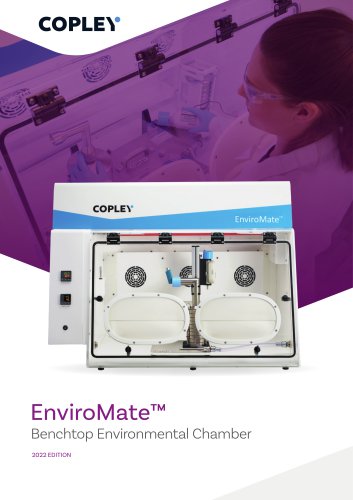
- EnviroMate™ is a compact, benchtop solution that ensures uniform temperature and humidity, minimizing electrostatic charge effects.
- It is energy-efficient and requires no routine maintenance, offering a cost-effective alternative to dedicated environmental control rooms.
- The system is compliant with Ph. Eur. and USP standards.
- Temperature Control Range: 17 - 35ºC with an accuracy of ±2ºC.
- Humidity Control Range: 15 - 85% RH with an accuracy of ±5% RH.
- Includes an electrostatic minimization system and various ancillary connector ports.
- Anti-Static Grounding Kit, Digital Static Meter, and Electrostatic Eliminator to manage electrostatic charge.
- NGI Cooler™ for nebuliser testing, maintaining precise temperature control to prevent evaporation-related issues.
- Inhaler Testing Workstation™ ITW for flexible and efficient handling of test apparatus.
- Glass Expansion Chambers for measuring drug particle deposition in nasal sprays.
This section lists various inhaler devices such as Turbuhaler, Diskhaler, Respimat, and others, along with accessories like mouthpiece adapters and support accessories. These accessories ensure proper positioning and organization during testing. Custom adapters are available for specific testing needs, and certificates of conformance are provided for materials used.
Custom nosepiece adapters are available for nasal devices to ensure a perfect fit with testing equipment. These adapters create airtight seals necessary for accurate testing of nasal drug delivery systems.
The Inhalytix software is designed for the analysis of aerodynamic particle size distribution (APSD) in inhaled and nasal drug products. It complies with USP and Ph.Eur. standards and supports various cascade impactors. The software offers a flexible, validated solution for data entry, analysis, and reporting, with features like user-configurable test methods and equipment inventory management.
The software provides a dashboard for system monitoring, supports custom impactor configurations, and allows for detailed test method creation. It facilitates the preparation, execution, and analysis of tests, ensuring data integrity and traceability.
Enhancing the clinical realism of in vitro tests can bridge the gap between quality control testing and in vivo performance. The document discusses the challenges of predicting pharmacokinetic and pharmacodynamic properties and the importance of robust IVIVCs for demonstrating bioequivalence and supporting Quality by Design (QbD) initiatives.
The FDA's draft guidance for Beclomethasone Dipropionate aerosol highlights novel in vitro testing approaches to improve clinical realism and IVIVCs. The document emphasizes the need for clinically relevant in vitro tests and in silico models to support the development of generic OINDPs.
- Demonstrating Bioequivalence (BE): The document outlines the regulatory guidance for demonstrating bioequivalence between test and reference formulations, highlighting the importance of understanding CQAs related to patient, device, and formulation.
- Improving IVIVCs: Methods to improve IVIVCs include using realistic breathing profiles and throat/nasal models to better simulate human conditions during testing. This section stresses the need for more representative testing conditions to enhance drug delivery assessments.
- DDU and APSD Testing: The document discusses the significance of dose uniformity (DDU) and aerodynamic particle size distribution (APSD) testing in ensuring batch consistency and predicting bioavailability. It also highlights the role of in vitro dissolution testing in drug development.
- Realistic Breathing Profiles: The use of breathing simulators to generate realistic profiles is recommended to improve the clinical relevance of DDU and APSD testing, particularly for passive devices like dry powder inhalers (DPIs).
- Realistic Throat and Nasal Models: The document describes the development of models that mimic human anatomy to provide more accurate assessments of drug delivery to the lungs and nasal passages.
- Ancillary Equipment: Various tools and adapters are discussed, such as mixing inlets and breathing simulators, which are essential for conducting representative testing of inhaled products.
- Alberta Idealised Throat (AIT) and Nasal Inlet (AINI): These models simulate drug deposition in the nasal and throat regions, aiding in the evaluation of drug absorption and unintended lung transit.
- Breathing Simulator BRS: Used for simulating patient breath profiles during testing.
- Cascade Impactors: Essential for APSD measurement, with various models available based on device type.
- Vacuum Pump and Critical Flow Controller TPK 100i: Ensure consistent flow conditions during testing.
- NGI Cooler and Flow Rate Sensor FRS: Maintain temperature control and measure flow rates accurately.
The document discusses the application of Abbreviated Impactor Measurement (AIM) in the Quality by Design (QbD) process for orally inhaled products (OIPs). AIM is highlighted as a rapid screening tool in research and development (R&D) and quality control (QC) applications, offering a more efficient alternative to full-resolution cascade impactor methods.
The document outlines the use of cascade impactors as the preferred method for measuring the aerodynamic particle size distribution (APSD) of OIPs. It introduces Efficient Data Analysis (EDA) as a method to determine product fitness using simpler metrics once a full APSD profile is established. The document also describes the use of AIM in QC and R&D, emphasizing its role in fast screening of new formulations and reducing reliance on clinical trials.
There is a focus on the development of generic OIPs as patents expire, leading to the reintroduction of original test methods in pharmacopoeias. The document stresses the importance of understanding the impact of poor patient technique on inhaler critical quality attributes (CQAs) to optimize inhaler designs.
Device mishandling and poor technique are identified as significant issues affecting inhaler performance. Solutions are offered to help developers understand and mitigate these impacts, thereby improving drug delivery robustness.
The document details various specialized test equipment for assessing the performance of orally inhaled and nasal drug products (OINDPs). It introduces different versions of abbreviated impactors, such as the Fast Screening Andersen (FSA) and Reduced NGI (rNGI), designed to speed up formulation screening and improve data comparability.
The Volume and Resistance Compensator (VRC) is introduced as a tool to match flow resistance and flow rate rise-time profiles between full-resolution and abbreviated impactors, ensuring comparable conditions for aerosol generation.
The document emphasizes the potential of AIM to streamline the testing process for OIPs, offering faster and more efficient methods for both R&D and QC applications. It highlights the importance of maintaining data comparability and improving inhaler design to enhance drug delivery.
The VRC is designed to manage volume and resistance in inhaler testing. Performance data is presented in terms of pressure over time, indicating its effectiveness in maintaining consistent conditions during testing.
The FDA and USP have issued guidance and monographs for active pharmaceutical ingredients (APIs) used in asthma and COPD treatments. These guidelines emphasize the importance of using specific test equipment and methods to ensure bioequivalence with reference drugs. Key performance metrics include Delivered Dose Uniformity (DDU) and Aerodynamic Particle Size Distribution (APSD).
APSD measurements are crucial for both aerosols and powders, using an Andersen Cascade Impactor (ACI) with specific modifications. The testing involves simulating patient inhalation conditions to ensure accurate drug delivery.
Specific apparatus and procedures are outlined for testing FP/Salmeterol aerosols and powders, including the use of induction ports, inlet cones, and preseparators. The equipment ensures precise measurement of DDU and APSD.
The draft monograph specifies the use of a special glass Sample Collection Apparatus for DDU testing. APSD measurement requires a modified induction port and optional inlet sleeve for compatibility with standard adapters.
The PES replicates patient exhalation into inhaler devices, allowing developers to assess the impact of misuse on drug delivery. It features adjustable air flow temperature and flow rate, with comprehensive qualification tools available.
Automation solutions, such as the Vertus III and DecaVertus III systems, enhance testing efficiency by reducing manual handling and variability. These systems support DDU and APSD testing, offering precise control over test parameters and improving data integrity.
The document outlines the importance of specific testing equipment and procedures in ensuring the efficacy and safety of inhaler products. Compliance with regulatory guidelines and the use of advanced automation systems are emphasized to achieve consistent and reliable results.
- The Vertus III+ includes an integrated analytical balance for measuring shot weight, aiding in the detection of misfiring and troubleshooting.
- Automation capabilities streamline the testing process, particularly for the Uniformity of Delivered Mass as required by Ph. Eur. monograph 0676.
- The system supports the extraction of flammable propellants or high potency drugs through an exhaust port.
- Shaking and firing parameters are fully controllable, including shake speed, angle, and duration, as well as fire force and angle.
- Airflow parameters are adjustable, ensuring precise control over testing conditions.
- The Vertus III+ offers a weight range of 0.01 mg to 200 g with a resolution of 0.01 mg.
- User interface includes a 10.1” color touchscreen, with extensive connectivity options such as Ethernet, USB, and RS-232.
- The system is compatible with MDIs, nasal aerosols, and nasal sprays, and supports various interface plates for different testing needs.
- Accessories include a priming and waste module, interface plates for MDIs and nasal sprays, and various adapters and holders for specific testing setups.
- Designed for high-throughput testing, the DecaVertus III automates firing-to-waste for up to ten MDIs per test run, enhancing repeatability and reducing analyst workload.
- Compliant with Ph. Eur., EMA, USP, FDA, ChP, and NMPA standards, and offers extensive reporting and data output options.
- The DUSA Shaker DTS 100i automates drug recovery from DUSA collection tubes, improving efficiency and reducing variability in dose uniformity testing.
- The Impactor Coater IC 200i addresses the need for consistent coating of impactor stages to prevent particle bounce during APSD sampling.
Catalog excerpts
Driving Results in Inhaler Testing METERED-DOSE INHALERS • DRY POWDER INHALERS NEBULISERS • SOFT MIST INHALERS • NASAL PRODUCTS
Open the catalog to page 1
Inhaler Testing About Us Driving Results for Over 75 Years Copley Scientific, founded in 1946 and headquartered in Nottingham, UK, remains a family-owned and managed company. With a rich history spanning nearly eight decades, we have solidified our position as the leading global manufacturer of inhaler test equipment. Additionally, we are well-recognised as a reliable provider of high quality test instrumentation for other pharmaceutical dosage forms, including tablets, capsules, creams, ointments and powders. We continue to work closely with industry groups and leading experts to bring relevant...
Open the catalog to page 2
The Copley Promise Innovative Novel solutions that maximise understanding and productivity Compliant Certified to the standards defined by global regulators and pharmacopoeias Trusted Quality products with accuracy, robustness and reliability built-in
Open the catalog to page 3
Inhaler Testing ISO 9001: 2015 Quality Management System 2 Orally Inhaled & Nasal Drug Products (OINDPs) Orally Inhaled Drug Products 7 Metered-Dose Inhalers (MDIs) 7 Dry Powder Inhalers (DPIs) 8 Soft Mist Inhalers (SMIs) 10 Nasal Drug Products 10 Organisations and their Roles 12 Regulatory Bodies in the UK, European Union, China, Japan and USA 12 International Regulation and Harmonisation 14 Drug Safety, Quality and Efficacy -The Pharmacopoeias 15 United States Pharmacopeia (USP) 15 Device Safety, Quality and Efficacy - International Standards Organisation (ISO) 16 European Pharmaceutical Aerosol...
Open the catalog to page 4
Morphology Cold Freon® Effect Spray Force Tester SFT 1000 256 Plume Temperature Tester PTT 1000 258 Special Applications Abbreviated Impactor Measurement (AIM) 261 Fast Screen Andersen (FSA) 263 Fast Screening Impactor (FSI) 266 Volume and Resistance Compensator VRC 268 Generic Drug Development 270 Fluticasone Propionate/Salmeterol Aerosols & Powders 271 Albuterol Inhalation Aerosols 274 Device Robustness/Inhaler Misuse 276 Patient Exhalation Simulator PES 276 Stage and Components Mensuration 312 Data Interpretation 313 Impactor Performance Restoration 314 In-House and On-Site Equipment Servicing...
Open the catalog to page 5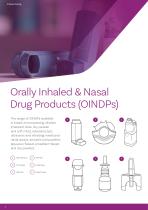
Inhaler Testing Orally Inhaled & Nasal Drug Products (OINDPs) The range of OINDPs available is broad, encompassing inhalers (metered-dose, dry powder and soft mist), nebulisers (jet, ultrasonic and vibrating mesh) and nasal sprays, aerosols and powders (aqueous-based, propellant-based and dry powder). Metered-Dose Soft Mist Nasal Spray Nasal Powder
Open the catalog to page 6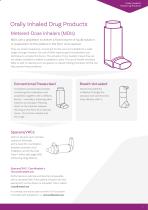
Orally Inhaled & Nasal Drug Products Orally Inhaled Drug Products Metered-Dose Inhalers (MDIs) MDIs use a propellant to deliver a fixed volume of liquid solution or suspension to the patient in the form of an aerosol. They are small, inexpensive, convenient for the user and suitable for a wide range of drugs. However, the use of MDIs requires good coordination and technique to actuate the device. The actuation force needed means they are not always suitable for elderly or paediatric users. The use of breath-actuated MDIs or add-on devices such as spacers or valved holding chambers (VHCs) can...
Open the catalog to page 7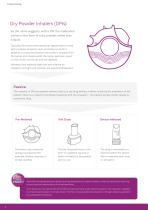
Inhaler Testing Dry Powder Inhalers (DPIs) As the name suggests, with a DPI the medication comes in the form of a dry powder, rather than a liquid. Typically, the active pharmaceutical ingredient(s) is mixed with a coarser excipient, such as lactose, to which it attaches. During aerosolisation the active is stripped from the carrier and inhaled whilst the carrier particles impact on the mouth and throat and are ingested. However, their relatively high cost and reliance on inhalation strength and duration are potential drawbacks. Passive The majority of DPIs are passive devices, that is to say...
Open the catalog to page 8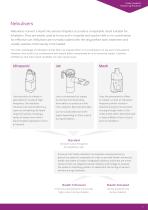
Orally Inhaled & Nasal Drug Products Nebulisers Nebulisers convert a liquid into aerosol droplets to produce a respirable cloud suitable for inhalation. They are widely used at home and in hospital and require little or no coordination for effective use. Nebulisers are normally loaded with the drug before each treatment and usually operate continuously once loaded. The main advantage of nebulisers is that their use requires little or no coordination on the part of the patient. However, they tend to be cumbersome and require either compressed air or an electrical supply. Expense, inefficiency...
Open the catalog to page 9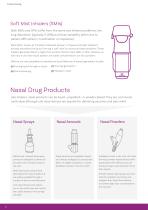
Inhaler Testing Soft Mist Inhalers (SMIs) Both MDIs and DPIs suffer from the same two inherent problems: low lung deposition (typically 5-20%) and dose variability (often due to patient difficulties in coordination or inspiration). SMIs (often known as “Inhalation Metered Sprays’’ or “Aqueous Droplet Inhalers”) actively aerosolise the liquid, forming a ‘soft mist’ to overcome these problems. These inhalers generally deliver a higher fine particle fraction than MDIs or DPIs. However, as with any multi-dose liquid system, microbial contamination can be a problem. SMIs do not use a propellant to...
Open the catalog to page 10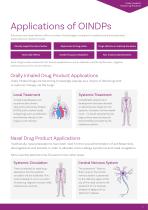
Orally Inhaled & Nasal Drug Products Applications of OINDPs Pulmonary and nasal delivery offers a number of advantages compared to traditional oral and parenteral (subcutaneous injection) routes: Directly targets the site of action Rapid onset of drug action Drugs effective in relatively low doses Fewer side effects Avoids first pass metabolism Non-invasive administration Such drugs include treatments for diverse applications such as diabetes, erectile dysfunction, migraine, osteoporosis and for vaccine delivery. Orally Inhaled Drug Product Applications Orally inhaled drugs are becoming increasingly...
Open the catalog to page 11
Inhaler Testing The ultimate responsibility for the safety, quality and efficacy of medicines and medical devices lies with the various national regulatory bodies designated to safeguard public health. At present, there are no worldwide standards that are specifically applicable to OINDPs. In the European Union, the responsibility for the regulation of medicines and medical devices lies with the European Medicines Agency (EMA) in the form of the Committee for Medicinal Products for Human Use (CHMP). The EMA was set up in 1995 to harmonise the work of existing national regulatory bodies in Europe....
Open the catalog to page 12All MSP, a Division of TSI catalogs and technical brochures
 Inhalytix®+ Copley Brochure
12 Pages
 EnviroMate™ Copley Brochure
5 Pages
- Laboratory agitator
- Sample preparation system
- General purpose laboratory shaker
- Benchtop laboratory agitator
- Digital laboratory agitator
- Climatic test cabinet
- Temperature test cabinet
- Benchtop sample preparation system
- Humidity test chamber
- Medical vacuum pump
- Laboratory test cabinet
- Monitoring simulator
- Medical device control panel
- Data analysis software
- Medical control system
- Temperature control system
- Laboratory control system
- Environmental test chamber
- Flow control panel