


- Products
- Catalogs
- News & Trends
- Exhibitions
AUDX

AUDX
The AuDX® screener is a portable OAE hearing screener used by pediatricians, audiologists, and school nurses. It provides quick and accurate results without requiring patient response or interpretation, offering a 'Pass/Refer' result. It operates on a rechargeable lithium battery or AC power and has over 25 years of experience in hearing product design and manufacturing. Technical support is available 24/7.
The screener uses otoacoustic emissions (OAE) to assess hearing by measuring responses from the cochlea's outer hair cells. It is suitable for all ages, from newborns to geriatrics. The device is easy to clean and durable, with an economical original unit for simple applications.
Hearing loss is a common birth disorder, affecting 3-4 out of every 1000 babies. The American Academy of Pediatrics and other organizations recommend screening infants using OAE or auditory brainstem response (ABR) to detect hearing loss early, ideally diagnosing by 3 months of age.
OAE screening is reimbursable under CPT code 92587, with an average reimbursement of $61.00. The cost of an AuDX Pro unit can be recouped in less than 8 weeks with regular use.
Regular hearing screening is recommended throughout childhood to detect significant hearing loss that may develop after the newborn period. The NIH's Healthy People 2010 initiative emphasizes increasing hearing examinations and reducing noise-induced hearing loss in children.
Otitis Media (OM) can cause temporary hearing loss during critical language development years. It accounts for millions of doctor visits annually, and persistent OM should be evaluated for hearing loss.
Biannual hearing screening is recommended for children with risk indicators such as family history, infections, or neonatal conditions.
1. OAE screening takes about 10 seconds per ear.
2. Any trained staff member can perform the test.
3. Minimal patient preparation is required.
4. A 'refer' result indicates potential issues like ear debris or hearing loss.
5. OAEs provide information on cochlear function, unlike tympanometry.
6. OAEs can track the resolution of middle ear fluid.
7. Patients with PE tubes can be screened, though results may vary.
The document includes details on probe tips and printer labels, emphasizing quality and value. Natus Medical Incorporated, the manufacturer, is a sponsor of Special Olympics and provides global sales and support.
Catalog excerpts

using Otoacoustic Emissions Early Hearing Detection & Intervention Programs, Pediatricians, Audiologists & School Nurses
Open the catalog to page 1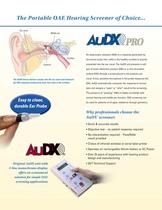
The Portable OAE Hearing Screener of Choice... Ear canal Middle ear An otoacoustic emission (OAE) is a response generated by Cochlea Eardrum structures (outer hair cells) in the healthy cochlea to sounds presented into the ear canal. The AuDX unit presents a soft pair of tones (distortion product OAE) or a click (transientevoked OAE) through a probe placed in the patient’s ear The AuDX device delivers sounds into the ear canal and measures the OAE response produced by outer hair cells in the cochlea. canal. A tiny, sensitive microphone in the probe measures the OAE. AuDX automatically compares...
Open the catalog to page 2
...for Newborn Hearing Screening Three to four babies out of every 1000 are born with hearing loss, making it the most frequently occurring birth disorder. The American Academy of Pediatrics 1, Joint Committee on Infant Hearing 2 and National Institutes of Health 3 recommend screening infants for hearing loss using either otoacoustic emissions (OAE) or auditory brainstem response (ABR). Either method alone or in combination is acceptable for detecting hearing loss. 1 merican Academy of Pediatrics (1999) Newborn and infant hearing loss: Detection and A intervention. Task Force on Newborn and Infant...
Open the catalog to page 3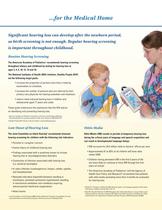
...for the Medical Home Significant hearing loss can develop after the newborn period, so birth screening is not enough. Regular hearing screening is important throughout childhood. Routine Hearing Screening The American Academy of Pediatrics1 recommends hearing screening throughout infancy and childhood by testing for hearing loss at ages 3, 4, 5, 10, 12, 15 and 18. T he National Institutes of Health (NIH) initiative, Healthy People 20102, set the following target goals: • ncrease the proportion of persons who have a hearing i examination on schedule; • ncrease the number of persons who are...
Open the catalog to page 4
...for Providers of World Class Care Frequently Asked Questions 1. How long does an OAE screening with an AuDX device take? Test time is very fast – about 10 seconds per ear if the patient is quiet and cooperative; slightly longer for “refer” results. 5. Why do I need OAEs if I have Tympanometry? T ympanometry is a powerful tool for assessing middle ear function. However, it provides no information about cochlear function or hearing. OAEs are affected by both hearing loss and middle ear dysfunction. For children with OME, for example, it is important 2. Who should administer the test? Since AuDX...
Open the catalog to page 5
Bio-logic supplies provide quality & value while ensuring optimal performance Pediatric Foam Tip —'".T^-^W"^ - '. Probe Tips •Patented Infant TreeTip® with graduated tip for secure fit for virtually all newborns • Smallest - Preemie TreeTip 3mm • Foam tip offers a better fit for varying shapes and sizes Printer Labels • Results from both ears Your Local Bio-logic Representative: Contact us for information on our complete line of Hearing Screening & Diagnostic Products Natus Medical Incorporated Global Sales & Support Special Olympics Natus Medical Incorporated is an Official Healthy Hearing Sponsor...
Open the catalog to page 6All Natus Medical catalogs and technical brochures
 Dantec® Clavis™ Handheld EMG
2 Pages
 Natus® EEG32U™ EEG Amplifier
2 Pages


Archived catalogs
 MiniMuffs®
2 Pages
 CFM Olympic Brainz Monitor
4 Pages
 NicoletOne vEEG System
2 Pages
 ICS® Impulse
2 Pages
 Madsen® Alpha OAE +
8 Pages
 Madsen® Alpha OAE
8 Pages
 THE AUDIOMETER
4 Pages
 AURICAL Aud
2 Pages
 MDrive
2 Pages
 NicoletOne
2 Pages
 Madsen® Accuscreen
8 Pages
 Aurical® Otocam 300
4 Pages
 THE TEST CHAMBER
4 Pages
 Otoscan®
8 Pages
 Bio-logic® AuDX PRO FLEX®
4 Pages
 MADSEN Capella²
4 Pages
 Otometrics® Madsen A450
8 Pages
 Aquamatic ll
2 Pages
 ALGO 5
4 Pages
 Olympic Circumstraint™
2 Pages
 Embla ® S4500
2 Pages
 NeuroCom®
4 Pages
 BiliCare ™ System
4 Pages
 neometrics
3 Pages
 Echo-Screen® III
4 Pages
 Smart Scale Model 50-51
2 Pages
 Warm Scale Model 23-28
2 Pages
 Smart Scale Model 60-65
2 Pages
 Warmette
2 Pages
 OraSwab
1 Page
 SugarPlum
2 Pages
 SunFish
1 Page
 TootSweet
2 Pages
 NeuroCom Smart EquiTest
4 Pages
 NeuroCom Balance Family
12 Pages
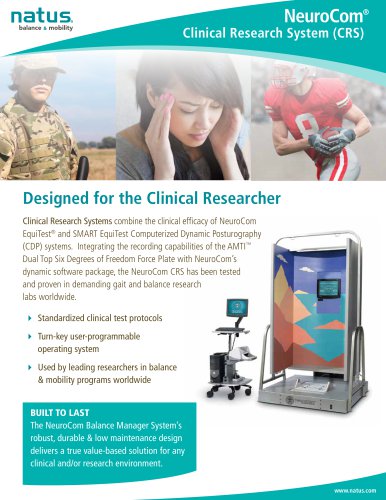 Clinical Research System
4 Pages
 NeuroCom inVision
4 Pages
 VersaLab APM & APM2
4 Pages
 VersaLab LE and SE
4 Pages
 Peloton ™ Screening Services
2 Pages
 audble
3 Pages
 ALGO Supplies
2 Pages
 Scout Sport
2 Pages
 Bio-logic AuDX Pro
2 Pages
 M.A.S.T.E.R II
3 Pages
 ENoG
ENoG2 Pages
 UltraPro S100
2 Pages
 Xltek ® ICU Monitor
4 Pages
 Bio-logic ® MASTER ® II
2 Pages
 Bio-logic ® Navigator ® Pro
3 Pages
 StethoDopTM
2 Pages
 Pocket-Dop II
2 Pages
 Pocket-Dop 3?
2 Pages
 ImexDop CT+?
2 Pages
 Nicolet? Elite
4 Pages
 FreeDop?
2 Pages
 Mini-Pasteurmatic
2 Pages
 Pasteurmatic 3000/3500
3 Pages
 neoBLUE radiometer
2 Pages
 OLYMPIC BILI-METER
2 Pages
 Biliband Datasheet
1 Page
 neoBLUE Family Brochure
2 Pages
 Echo-Screen Brochure
2 Pages
 ABaer
ABaer3 Pages
 ALGO 3i
2 Pages


- Positioning pillow
- Reusable electrode
- Monopolar electrode
- Surgical cushion
- Electrophysiological exploration electrode
- Air-filled cushion
- Medical electrode
- EEG electrode
- Electrophysiology amplifier
- EEG amplifier
- Vacuum cushion
- 32-channel electrophysiology amplifier
- Intracranial electrode
- Medical research electrophysiology amplifier
- 40-channel electrophysiology amplifier