
- Catalogs
- Natus Medical
- NeuroCom inVision


- Products
- Catalogs
- News & Trends
- Exhibitions
NeuroCom inVision

NeuroCom inVision
- VOR Assessment: The software includes protocols for Dynamic Visual Acuity (DVA) and Gaze Stabilization Test (GST) to identify and quantify VOR performance deficits.
- VOR Rehabilitation Training: Offers exercises that track head movement direction and duration, capture visual acuity accuracy, and set parameters for target head movement velocity.
- Clinical Significance: Provides insights into balance and vision problems, with case studies demonstrating its application in sports-related concussions.
- Additional Features: Includes a built-in metronome for exercises, customizable training parameters, and a patient summary report for at-home exercises.
Catalog excerpts

inVision Software Package Holding steady — the importance of stable vision Patients with balance problems often complain about problems with their vision, particularly blurring, jumpy vision or dizziness when moving or in busy environments such as the grocery store or shopping mall. Maintaining both visual clarity and balance is necessary to safely perform activities of daily living. This requires a stable gaze and a stable body while moving about, particularly when head movements are required. The complex process of assessing and rehabilitating the function of the Vestibulo-Ocular Reflex (VOR) can now be easily, reliably and objectively performed in clinic with NeuroCom’s inVision package. The world's first system for quantifying visual acuity & stable gaze Unique inVision protocols document the presence of VOR dysfunction Practical Reliable objective data help clinicians develop targeted treatment and monitor patient progress Specific Used by leading researchers in balance & mobility programs worldwide VOR Assessment Rigorous stimulus control, reliable DVA testing, and a new GST protocol come together to identify and quantify VOR performance deficits. NEW! VOR Rehabilitation Training Exercises Track direction of head movement and duration of training performance, capture accuracy of visual acuity at the point of retinal slip, and set parameters for target head movement velocity specific to the patient's GST results and customize to adjust at the clinician’s discretion. www.natus
Open the catalog to page 1
Evaluation of the vestibular system is an important part of the examination of balance problems, and it can be the most challenging. The Vestibulo-Ocular Reflex (VOR) is responsible for stabilizing the visual field during high velocity head movements. The challenge is to first isolate VOR performance and then to understand how it is contributing to the balance problem. Identifying problems within the gaze stabilization system and quantifying their effect upon function with the Dynamic Visual Acuity (DVA) and the Gaze Stabilization Test (GST) protocols can provide the key to resolving these interactions....
Open the catalog to page 2
Vestibular Rehabilitation Training of the VOR — NOW with Computerized Exercises* The patient is tested using the inVision DVA and GST protocols. The DVA and GST scores are used to determine the starting point for training. During VOR rehabilitation training exercises, the center target changes direction to record visual accuracy while the head moves at the target velocity. In training, the patient must move their head continuously for up to 2 minutes and call out the correct optotype direction. The operator can modify the training parameters by selecting the optotype size, target velocity and...
Open the catalog to page 3
inVision Software Vestibular Training Exercises with Postural Tasks Additional clinically significant information can be measured when performing VOR rehabilitation training while maintaining balance on a NeuroCom static or dynamic Force Plate. On a static balance system, the clinician can incorporate the use of rocker boards or foam on the Force Plate. On a dynamic balance system, the surround and support can be put into dynamic training responsive, variable, or random mode. To add greater complexity, integrating a "busy" background pattern will trigger patient symptoms. Additional features...
Open the catalog to page 4All Natus Medical catalogs and technical brochures
 Dantec® Clavis™ Handheld EMG
2 Pages
 Natus® EEG32U™ EEG Amplifier
2 Pages


Archived catalogs
 MiniMuffs®
2 Pages
 CFM Olympic Brainz Monitor
4 Pages
 NicoletOne vEEG System
2 Pages
 ICS® Impulse
2 Pages
 Madsen® Alpha OAE +
8 Pages
 Madsen® Alpha OAE
8 Pages
 THE AUDIOMETER
4 Pages
 AURICAL Aud
2 Pages
 MDrive
2 Pages
 NicoletOne
2 Pages
 Madsen® Accuscreen
8 Pages
 Aurical® Otocam 300
4 Pages
 THE TEST CHAMBER
4 Pages
 Otoscan®
8 Pages
 Bio-logic® AuDX PRO FLEX®
4 Pages
 MADSEN Capella²
4 Pages
 Otometrics® Madsen A450
8 Pages
 Aquamatic ll
2 Pages
 ALGO 5
4 Pages
 Olympic Circumstraint™
2 Pages
 Embla ® S4500
2 Pages
 NeuroCom®
4 Pages
 BiliCare ™ System
4 Pages
 neometrics
3 Pages
 Echo-Screen® III
4 Pages
 Smart Scale Model 50-51
2 Pages
 Warm Scale Model 23-28
2 Pages
 Smart Scale Model 60-65
2 Pages
 Warmette
2 Pages
 OraSwab
1 Page
 SugarPlum
2 Pages
 SunFish
1 Page
 TootSweet
2 Pages
 NeuroCom Smart EquiTest
4 Pages
 NeuroCom Balance Family
12 Pages
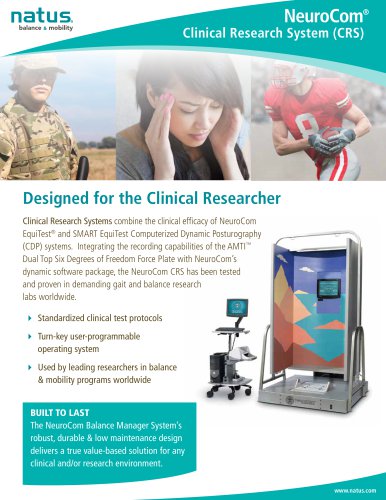 Clinical Research System
4 Pages
 VersaLab APM & APM2
4 Pages
 VersaLab LE and SE
4 Pages
 Peloton ™ Screening Services
2 Pages
 audble
3 Pages
 ALGO Supplies
2 Pages
 Scout Sport
2 Pages
 Bio-logic AuDX Pro
2 Pages
 M.A.S.T.E.R II
3 Pages
 ENoG
ENoG2 Pages
 UltraPro S100
2 Pages
 Xltek ® ICU Monitor
4 Pages
 Bio-logic ® MASTER ® II
2 Pages
 Bio-logic ® Navigator ® Pro
3 Pages
 StethoDopTM
2 Pages
 Pocket-Dop II
2 Pages
 Pocket-Dop 3?
2 Pages
 ImexDop CT+?
2 Pages
 Nicolet? Elite
4 Pages
 FreeDop?
2 Pages
 Mini-Pasteurmatic
2 Pages
 Pasteurmatic 3000/3500
3 Pages
 neoBLUE radiometer
2 Pages
 OLYMPIC BILI-METER
2 Pages
 Biliband Datasheet
1 Page
 neoBLUE Family Brochure
2 Pages
 AUDX
AUDX6 Pages
 Echo-Screen Brochure
2 Pages
 ABaer
ABaer3 Pages
 ALGO 3i
2 Pages


- Positioning pillow
- Reusable electrode
- Monopolar electrode
- Surgical cushion
- Electrophysiological exploration electrode
- Air-filled cushion
- Medical electrode
- EEG electrode
- Electrophysiology amplifier
- EEG amplifier
- Vacuum cushion
- 32-channel electrophysiology amplifier
- Intracranial electrode
- Medical research electrophysiology amplifier
- 40-channel electrophysiology amplifier