

EM / Optical Brochure

EM / Optical Brochure
NDI is a leader in optical measurement and electromagnetic (EM) tracking technology, providing solutions for medical device OEMs. Their technologies are integrated into nearly 90% of surgical navigation systems, offering GPS-like precision for medical instruments.
NDI's Polaris suite uses near-infrared light to track reflective markers on surgical instruments, providing sub-millimetre accuracy. This technology is used in neurosurgery, orthopaedic, and robotic surgeries, among others. The Polaris Vega unit offers real-time tracking, while the upcoming Polaris Lyra provides compact, targeted tracking.
The Aurora EM tracking system uses micro-sensors and an EM field generator to track instruments in confined areas without line-of-sight. This system is used in interventional cardiology, endoscopy, and ultrasound procedures. It provides real-time navigation by linking patient images with 3D space.
NDI offers various field generators, control units, and sensors for both optical and EM tracking. These components are designed for easy integration and high precision, with options for customization to meet specific OEM needs.
NDI combines optical and EM tracking technologies in a dual-modality solution, providing enhanced tool tracking visualization and accuracy by leveraging the strengths of both systems.
NDI emphasizes quality, performance, and innovation, adhering to multiple regulatory standards. They offer extensive customization and support, with a significant focus on R&D to address complex navigation challenges.
NDI provides global support with offices in Canada, the USA, Germany, and China.
Catalog excerpts

Medical Device Navigation with Optical and Electromagnetic Tracking Technology Navigate New Possibilities™
Open the catalog to page 1
Navigate New Possibilities with NDI NDI is the global authority and industry pioneer of optical measurement and electromagnetic (EM) tracking technology solutions. Backed by over 40 years of innovation and expertise, we’re the partner of choice for world’s top medical device OEMs, in some cases, for more than 25 straight years. In fact, nearly 90% of all surgical navigation systems on the market incorporate our technologies. Our optical and EM tracking technologies are trusted for their accuracy and reliability. They act like GPS navigation for OEM medical instruments, showing where an instrument...
Open the catalog to page 3
Electromagnetic Tracking Our Aurora® electromagnetic (EM) tracking solution uses micro-sensors in conjunction with an EM field generator to provide reliable positional data and tracking of OEM medical instruments within confined, difficult to view/access areas. Even if the sensor is not visible, continuous tracking is maintained. No line-of- sight is needed. Sensors can be embedded into rigid or flexible devices such as ultrasound probes, endoscopes, guidewires and catheters, even at the tip of a needle. The sensor serves as a localization point with the EM tracking volume. When integrated as...
Open the catalog to page 4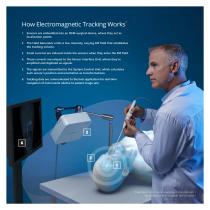
How Electromagnetic Tracking Works 1. Sensors are embedded into an OEM surgical device, where they act as localization points. 2. The Field Generator emits a low-intensity, varying EM field that establishes 3. Small currents are induced inside the sensors when they enter the EM field. 4. These currents are relayed to the Sensor Interface Unit, where they’re amplified and digitized as signals. 5. The signals are transmitted to the System Control Unit, which calculates each sensor’s position and orientation as transformations. 6. Tracking data are communicated to the host application for real-time...
Open the catalog to page 5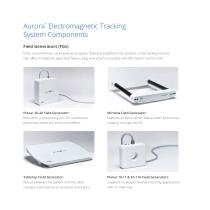
Aurora Electromagnetic Tracking System Components ® Field Generators (FGs) Emits a low-intensity, varying electromagnetic field and establishes the position of the tracking volume. NDI offers multiple FG types that feature plug-and-play functionality with the System Control Unit: Planar 20-20 Field Generator: Window Field Generator: placement within the physical workflow. Mounts to a positioning arm for unobtrusive Features an open center that enables fluoroscopy Tabletop Field Generator: Planar 10-11 & 10-11H Field Generators: includes a thin barrier to minimize distortions. with its small size....
Open the catalog to page 6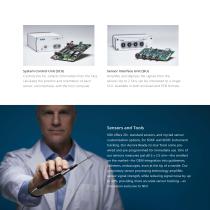
System Control Unit (SCU) Sensor Interface Unit (SIU) calculates the position and orientation of each sensors Up to 2 SIUs can be connected to a single Controls the FG, collects information from the SIUs, sensor, and interfaces with the host computer. Amplifies and digitizes the signals from the SCU. Available in both enclosed and PCB formats. Sensors and Tools NDI offers 20+ standard sensors, and myriad sensor customization options, for 5DOF and 6DOF instrument tracking. Our Aurora Ready-to-Use Tools come pre- wired and pre-programmed for immediate use. One of our sensors measures just ø0.3...
Open the catalog to page 7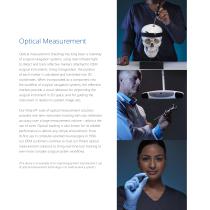
Optical Measurement Optical measurement (tracking) has long been a mainstay of surgical navigation systems, using near-infrared light to detect and track reflective markers attached to OEM surgical instruments. Using triangulation, the position of each marker is calculated and translated into 3D coordinates. When incorporated as a component into the workflow of surgical navigation systems, the reflective markers provide a visual reference for pinpointing the surgical instrument in 3D space, and for guiding the instrument in relation to patient image sets. Our Polaris® suite of optical measurement...
Open the catalog to page 8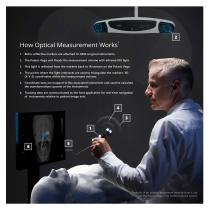
How Optical Measurement Works 1. Retro-reflective markers are attached to OEM surgical instruments. 2. The Polaris Vega unit floods the measurement volume with infrared (IR) light. 3. This light is reflected from the markers back to IR sensors on the Polaris Vega. 4. The points where the light intersects are used to triangulate the markers’ 3D (X-Y-Z) coordinates within the measurement volume. 5. Coordinate data are mapped to the associated instrument and used to calculate the transformations (poses) of the instruments. 6. Tracking data are communicated to the host application for real-time navigation...
Open the catalog to page 9
The Polaris Optical Measurement Product Suite ® Polaris Lyra (coming soon) NDI’s compact optical tracker has a wide measurement volume and short stand-off, for targeted tracking of individual body segments via smaller tools. Weighing less than a kilogram, and with a small footprint, the Polaris Lyra can be mounted almost anywhere, benefiting use in confined clinical suites. A volumetric accuracy to 0.20 mm RMS, frame rate of 60 Hz (standard), and low data latency, provide accurate and reliable OEM tool tracking and navigation. Ethernet connectivity (PoE+) and third-party equipment synchronization...
Open the catalog to page 10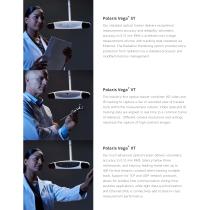
Polaris Vega ST Our standard optical tracker delivers exceptional measurement accuracy and reliability. Volumetric accuracy to 0.12 mm RMS is achieved over a large measurement volume, with tracking data streamed via Ethernet. The Radiation Hardening option provides extra protection from radiation via a shielded processor and modified memory management. Polaris Vega VT This industry-first optical tracker combines HD video and IR tracking to capture a live or recorded view of tracked tools within the measurement volume. Video data and IR tracking data are aligned in real time to a common frame...
Open the catalog to page 11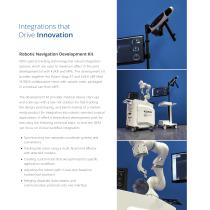
Integrations that Drive Innovation Robotic Navigation Development Kit NDI’s optical tracking technology has robust integration options, which are used to maximum effect in this joint development kit with KUKA and MPE. The development kit bundles together the Polaris Vega XT and KUKA LBR Med 14 R820 collaborative robot with sample code, packaged in a medical cart from MPE. The development kit provides medical device start-ups and scale-ups with a low-risk solution for fast-tracking the design, prototyping, and bench-testing of a market- ready product for integration into robotic-assisted surgical...
Open the catalog to page 12All NDI catalogs and technical brochures
 Polaris Vega VT
2 Pages
 Polaris Vega ST
2 Pages
 Aurora®
2 Pages

Archived catalogs
 SOFTWARE
1 Page
 DEVELOPER KIT
1 Page