
- Catalogs
- neoFroxx GmbH
- Albumin Fraction V (pH 7.0

Albumin Fraction V (pH 7.0
Albumin Fraction V (pH 7.0
Catalog excerpts
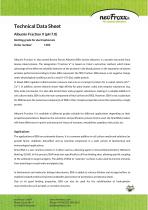
Technical Data SheetAlbumin Fraction V (pH 7.0)blotting grade for electrophoresis Order number: 1183 Albumin Fraction V, also named Bovine Serum Albumin (BSA, bovine albumin), is a protein extracted from bovine blood plasma. The designation "Fraction V" is based on Cohn's extraction method, which takes advantage of the different solubility behavior of the proteins in the blood plasma. In the separation of plasma proteins performed according to Cohn, BSA represents the fifth fraction. BSA shows a net negative charge under physiological conditions and is a small (~67 kDa), stable protein. In blood, BSA regulates colloid osmotic pressure and acts as a transport protein for 2-valent cations (Zn2+, Cu2+). In addition, bovine albumin shows high affinity for polar (water, salts) and nonpolar substances (e.g. fatty acids, hormones). It is also able to bind toxic and pyrogenic substances, making it a valuable additive in cell culture media. BSA is also the main component of fetal calf serum (FBS). However, BSA is not a substitute for FBS because the numerous components of FBS in their complex properties cannot be replaced by a single protein. Albumin Fraction V is available in different grades suitable for different applications depending on their properties/parameters. Based on the extraction and purification process that is used, the final BSA product will show differences in purity and amount of traces of enzymes, metabolites, peptides, fatty acids, etc. The applications of BSA are extremely diverse. It is a common additive in cell culture media and solutions (as growth factor, stabilizer, detoxifier) and an essential component in a wide variety of biochemical and immunological applications. Since BSA is a non-reactive protein, it is often used as a blocking agent in immunohistochemistry (Western blotting, ELISA). In this process, BSA binds non-specifically to all free binding sites, allowing specific coupling of the antibody to target antigens. The ability of BSA to "saturate" surfaces is also used to prevent enzymes from attaching to vessel walls and pipette tips. In biochemical and molecular biology laboratories, BSA is added to various dilution and storage buffers to stabilize isolated proteins/enzymes/antibodies (prevention of proteolysis and denaturation). Due to its good binding properties, BSA can also be used for the solubilization of hydrophobic macromolecules such as lipids, or sensitive enzymes. ^ neoFroxxGmbH www.neofroxx.com
Open the catalog to page 1
Furthermore, BSA is the most frequently used protein standard for the determination of unknown protein concentrations (Bradford assay, BCA assay, Lowry assay). Other uses for BSA include in vitro transport and binding studies and the use of BSA as a carrier in protein conjugates for the generation of antibodies against small peptides. The reason why BSA is used as the norm in so many applications and research areas is not just its properties. Because BSA is a by-product of the food industry, it is available in large quantities and is inexpensive. For blocking in immunological assays, usually...
Open the catalog to page 2