
- Catalogs
- NETZSCH Analyzing & Testing
- Accelerating Rate Calorimetry


Accelerating Rate Calorimetry
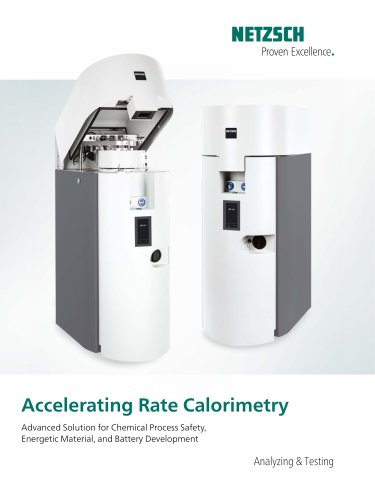
Accelerating Rate Calorimetry
Accelerating Rate Calorimetry (ARC) is essential for understanding thermal runaway in chemical processes, energetic materials, and battery development. It measures heat release and rate, crucial for preventing explosions due to temperature and pressure increases.
ARC operates under adiabatic conditions, simulating worst-case scenarios where heat cannot escape, leading to thermal runaway. ARC systems are robust and designed for safe operation under these conditions.
The ARC® 244 is a cost-effective solution for basic ARC testing, supporting modes like Heat-Wait-Search, Iso-Fixed, and Ramp mode. The ARC® 305 offers advanced technology for specialized testing, with features like a high tracking rate and larger sample vessel capacity.
The patented VariPhi® system enhances ARC testing by controlling thermal inertia, enabling accurate simulations of real-world conditions. It supports low Phi tests, crucial for industrial-scale processes.
Both ARC® 244 and ARC® 305 operate from room temperature to 500°C and handle pressures up to 150 bar. They offer various operation modes and optional features like stirring and injection.
ARC systems include intelligent software for easy setup and data analysis. Proteus® Thermal Analysis software allows comprehensive evaluation of results, including decomposition enthalpies and kinetic analysis.
ARC is used for thermal analysis of chemicals, process simulation, fire exposure studies, and more, particularly useful for analyzing energetic materials like ammonium nitrate.
The document discusses phase transitions and decomposition behavior of fertilizers, specifically ammonium nitrate, highlighting the importance of understanding solid-state phase transitions, melting at 166°C, and decomposition starting at 221°C for safety studies.
3-methyl-4-nitrophenol exhibits autocatalytic behavior when heated to decomposition temperatures. The Iso-Track or Iso-Fixed feature of calorimeter control software, along with the VariPhi® option, allows study under isothermal conditions, showing initial heat flux increase followed by decrease due to reactant consumption.
ARC®s operate in vented or open vessel mode, involving a computer-controlled valve allowing material flow to a drop-out pot. Reaction classification as a vapor system is based on pressure and temperature behavior.
TMR is crucial for identifying potential hazards during chemical processing and storage, measuring time between the start of a thermal runaway reaction and maximum reaction rate. Correcting TMR to a Φ-factor of 1 is emphasized for worst-case scenario prediction.
NETZSCH offers comprehensive support and expert service globally, focusing on thermal analysis and calorimetry. Their laboratories provide solutions for thermal analysis issues, offering high-precision measurement results and valuable interpretations. NETZSCH also provides training, maintenance, repair, and software updates for optimal instrument performance.
NETZSCH is a leading global technology company specializing in mechanical, plant, and instrument engineering, operating under three business units: Analyzing & Testing, Grinding & Dispersing, and Pumps & Systems. The company has a worldwide sales and service network, ensuring customer proximity and competent service since 1873.
Catalog excerpts
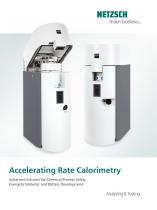
Accelerating Rate Calorimetry Advanced Solution for Chemical Process Safety, Energetic Material, and Battery Development Analyzing & Testing
Open the catalog to page 1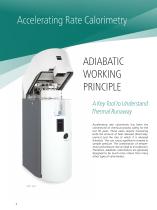
Accelerating Rate Calorimetry ADIABATIC WORKING PRINCIPLE A Key Tool to Understand Thermal Runaway Accelerating rate calorimetry has been the cornerstone of chemical process safety for the last 30 years. These cases require measuring both the amount of heat released (thermodynamics) and the rate at which it is released (kinetics). This can cause significant increase in sample pressure. The combination of temperature and pressure rise can lead to an explosion. Therefore, adiabatic calorimeters are generally designed to be much more robust than many other types of calorimeters.
Open the catalog to page 2
When looking at a thermal runaway as a part of a chemical process in a reactor, the reaction produces heat which increases the temperature of the reaction mixture and further increases the rate of reaction. There can come a point when the rate of heat release from the reaction exceeds the rate at which the heat can be lost to the surrounding environment – the point at which thermal runaway starts. Obviously, the worst case is when there is little or no ability for the heat to be lost to the environment. Any heat, even small amounts of heat, cause the temperature to rise and accelerates the reaction...
Open the catalog to page 3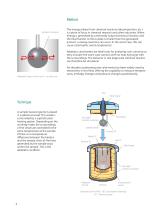
Sample Container The energy release from chemical reactions (decomposition, etc.) is a point of focus in chemical research and other industries. When energy is generated by a thermally induced chemical reaction and the heat transfer to the outside is smaller than the generated amount, runaway reactions can occur. In the worst case, this can cause catastrophic events (explosions). Adiabatic calorimeters are ideal tools for analyzing such scenarios as they simulate the worst case scenario with no heat exchange with the surroundings. The behavior in real large scale chemical reactors can therefore...
Open the catalog to page 4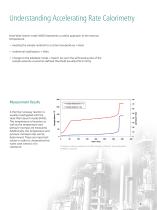
Heat-Wait-Search mode (HWS) represents a careful approach to the reaction temperature: ■ Heating the sample material to a certain temperature ^ Heat ■ sothermal stabilization ^ Wait ■ Change to the adiabatic mode ^ Search (as soon the self-heating rate of the sample extends a customer-defined threshold (usually 0.02 K/min)) A thermal runaway reaction is usually investigated with the Heat-Wait-Search mode (HWS). The temperature of reaction as well as the temperature and pressure increase are measured. Additionally, the temperature and pressure increase rates can be determined. These are important...
Open the catalog to page 5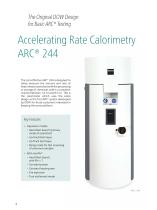
The Original DOW Design for Basic ARC® Testing The cost-effective ARC® 244 is designed to safely measure the amount and rate of heat release associated with the processing or storage of chemicals within a container volume between 1.0 ml and 8.5 ml. This is the calorimeter which uses the same design as the first ARC® system developed by DOW for those customers interested in keeping the same platform. • Operation modes: ■ Heat-Wait-Search (primary mode of operation) ■ Ramp mode for fast screening of unknown samples • Constant power • Constant heating rate
Open the catalog to page 6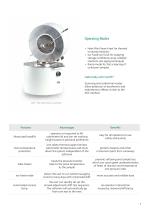
Operating Modes Heat-Wait-Search test for thermal runaway reactions Iso-Fixed/Iso-Track for studying storage conditions/auto-catalytic reactions (iso-aging technique) Ramp mode for fast screening of unknown samples Optionally with VariPhi® Scanning and isothermal modes allow detection of exothermic and endothermic effects; similar to the DSC method ARC® 244 Calorimeter Assembly Motorized headlift operator not required to lift calorimeter lid and can set working height based on personal preference easy for all operators to use safely and quickly Over-temperature protection one safety thermocouple...
Open the catalog to page 7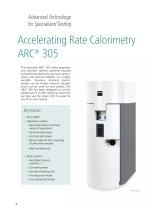
Advanced Technology for Specialized Testing The advanced ARC® 305 helps engineers and scientists identify potential hazards and tackle key elements of process optimization and thermal stability. As a highly versatile, miniature chemical reactor, sample can be stirred, material injected, and it can be used for vent studies. The ARC® 305 has been designed to use the traditional 10 ml ARC spherical vessel but can also use the larger 130 ml vessel for low Phi or vent testing. • Heat-Wait-Search (primary mode of operation) ■ Ramp mode for fast screening of unknown samples ■ High tracking rate ■ Constant...
Open the catalog to page 8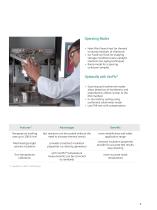
Operating Modes ■ Heat-Wait-Search test for thermal runaway reactions of chemicals ■ so-Fixed/Iso-Track for studying storage/conditions/auto-catalytic reactions (iso-aging technique) ■ Ramp mode for screening unknown samples ■ Scanning and isothermal modes allow detection of exothermic and endothermic effects; similar to the DSC method ■ n-situ battery cycling using isothermal calorimeter mode ■ _ow PHI-test with compensation Temperature tracking fast reactions can be tracked without the more reliable data and wider rate up to 200 K/min need to increase thermal inertia application range Machined...
Open the catalog to page 9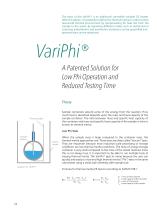
The basis of the VariPhi® is an additional controlled variable DC heater. With this option, it is possible to define the thermal inertia in order to allow real-world thermal environment by compensating for heat lost from the sample to the vessel. By operating different modes such as isothermal or scanning, endothermic and exothermic transitions can be quantified and pressure data can be measured. VariPhi® A Patented Solution for Low Phi Operation and Reduced Testing Time Theory Sample containers absorb some of the energy from the reaction. How much heat is absorbed depends upon the mass and heat...
Open the catalog to page 10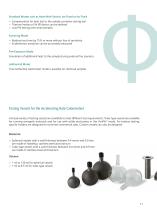
■ Compensation for heat lost to the sample container during test ■ Thermal inertia or Phi (0) factor can be defined ■ _ow Phi testing with small samples ■ Reduces test time by 75% or more without loss of sensitivity ■ Endothermic transition can be accurately measured Simulation of additional heat to the sample during external fire scenario. True isothermal calorimeter mode is possible on chemical samples. A broad variety of testing vessels are available to meet different test requirements. Tube-type vessels are available for running energetic materials and for use with solids and pastes in the...
Open the catalog to page 11All NETZSCH Analyzing & Testing catalogs and technical brochures
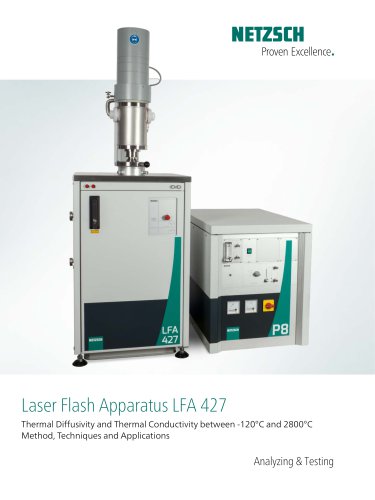 Laser Flash Apparatus LFA 427
24 Pages
Archived catalogs
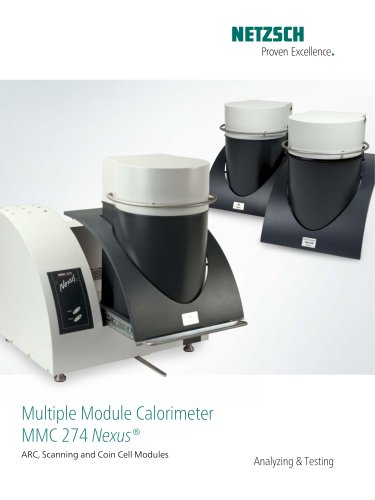 MMC 274 Nexus®
20 Pages
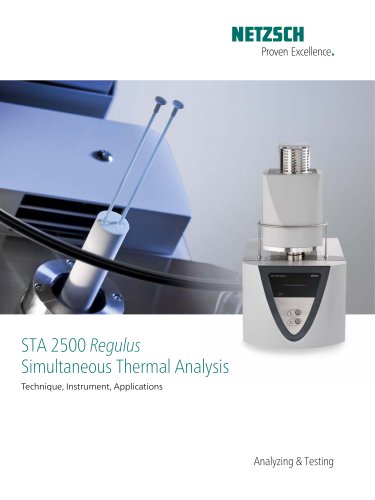 STA 2500 Regulus
12 Pages
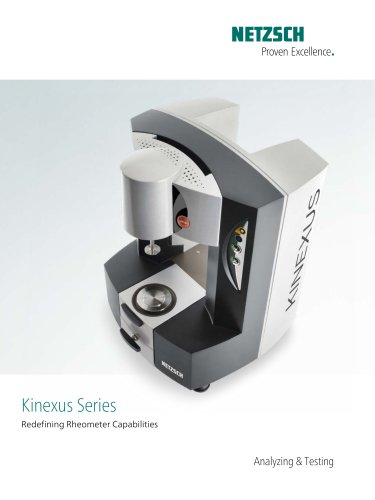 Kinexus series
16 Pages
- Windows software
- Automated software
- Software module
- Measurement software
- Import software
- Evaluation software
- Analysis software module
- Medical software module
- Design software module
- Software for the pharmaceutical industry
- Visualization software module
- Universal software
- Measurement software module
- Automatic calorimeter
- Thermal analyzer
- Laboratory calorimeter
- Differential scanning calorimeter