
- Catalogs
- NETZSCH Analyzing & Testing
- Differential Scanning Calorimetry – DSC 300 Caliris® Series


Differential Scanning Calorimetry – DSC 300 Caliris® Series
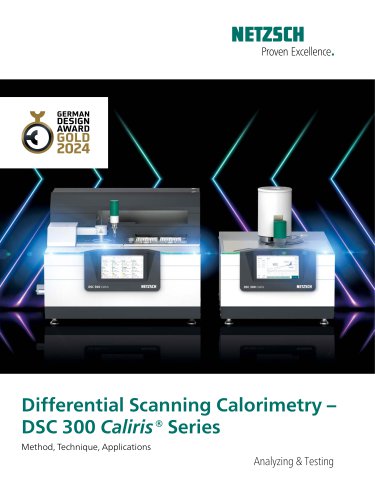
Differential Scanning Calorimetry – DSC 300 Caliris® Series
The DSC 300 Caliris® Series is a versatile Differential Scanning Calorimetry (DSC) instrument designed for material characterization, suitable for research, quality control, and material specification. It supports various analyses including material identification, process optimization, and failure analysis.
The DSC 300 Caliris® Series features a temperature range from -180°C to 750°C, a measuring range up to ±750 mW, and offers cooling options like LN₂ and compressed air. It has a modular design with interchangeable sensor-furnace modules and includes SmartMode for easy setup and AutoEvaluation for streamlined analysis. An Eco Mode reduces power consumption during idle periods.
The series includes three main modules: the H-Module for high temperatures, the P-Module for polymers, and the S-Module for standard measurements.
The DSC 300 Caliris® provides reliable measurements of caloric effects and complies with ISO 11357 and ASTM standards. It is designed for flexibility and future upgrades.
Proteus® software enhances functionality with AutoEvaluation for data analysis and Identify for material identification. It supports efficient workflow management and report generation.
The Eco Mode and hybrid cooling setup contribute to energy savings and reduced carbon footprint.
NETZSCH offers an Unlimited Warranty for comprehensive coverage and expert service.
Proteus® software includes SmartMode for routine tasks and ExpertMode for advanced users. Workspaces allow customization for efficient workflow. LabV® enhances automation and quality control.
Temperature-Modulated DSC separates reversible and non-reversible effects. Additional capabilities include a search engine for data management, peak separation, and 2D temperature calibration.
Specific heat capacity, glass transition temperatures, and crystallization processes are analyzed using DSC. The document discusses the implications for material processing and application.
Examples include the specific heat capacity of sapphire, glass transition temperatures of polymers, and the melting of aluminum. The curing of UV adhesives and crystallization of PE-HD are also examined.
The DSC 300 Caliris® series includes models like Supreme, Select, and Classic, with temperature ranges up to 750°C and heating/cooling rates from 0.001 to 500 K/min. It supports inert/oxidizing atmospheres and offers high enthalpy accuracy.
NETZSCH Group operates globally in Analyzing & Testing, Grinding & Dispersing, and Pumps & Systems, focusing on innovation in thermal analysis and related fields.
Catalog excerpts
Proven Excellence. Differential Scanning Calorimetry -DSC 300 Caliris® Series Method, Technique, Applications Analyzing & Testing
Open the catalog to page 1
DSC 300 Caliris® Series Whether you are working in research & development, quality control, contract testing or the specification of materials for applications, the way a material behaves under changing temperature and different atmospheres is a matter of importance. ■ Melting temperature and enthalpy ■ Crystallization temperature and enthalpy ■ Glass transition temperature ■ Curing, degree of cure ■ Specific heat capacity ■ Solid-liquid ratio (solid-fat content) ■ _iquid crystal transition
Open the catalog to page 2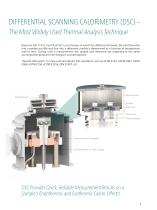
DIFFERENTIAL SCANNING CALORIMETRY (DSC) – The Most Widely Used Thermal Analysis Technique Based on ISO 11357, heat-flux DSC is a technique in which the difference between the heat flow rate into a sample crucible and that into a reference crucible is determined as a function of temperature and/or time. During such a measurement, the sample and reference are subjected to the same controlled temperature/time program and atmosphere. The DSC 300 Caliris® is in line with all relevant DSC standards, such as ASTM E793, ASTM E967, ASTM E968, ASTM E794, ASTM E1356, DIN 51007, etc. Silver furnace Sample...
Open the catalog to page 3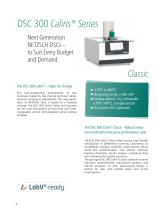
Next Generation NETZSCH DSCs -to Suit Every Budget and Demand Classic The DSC 300 Caliris® - Open for Change The ever-accelerating development of new materials, fueled by fast-moving technical trends, requires continuous adaptability. The new generation of NETZSCH DSCs is based on a modular concept. The DSC 300 Caliris® Select and Supreme are the only instruments of their kind with interchangeable and/or exchangeable sensor-furnace modules. ■ Cooling options: LN2, Intracooler (-70°C/-40°C), compressed air The DSC 300 Caliris® Classic - Robust instrument with attractive price-performance ratio...
Open the catalog to page 4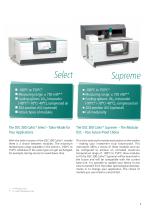
■ Cooling options: LN2, Intracooler (-90°C1/-70°C/-40°C), compressed air ■ Initial choice of modules ■ Cooling options: LN2, Intracooler (-90°C1/-70°C/-40°C), compressed air With the Select version of the DSC 300 Caliris®, initially there is a choice between modules. The maximum temperature range available in the Select is -180°C to 750°C. Modules of the same type can get exchanged, for example, during service to avoid down time. This is the only multi-module instrument on the market - making your investment truly future-proof. This instrument offers a choice of three modules and can be configured...
Open the catalog to page 5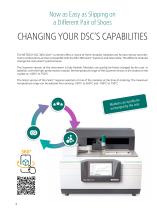
Now as Easy as Slipping on a Different Pair of Shoes CHANGING YOUR DSC’S CAPABILITIES The NETZSCH DSC 300 Caliris® currently offers a choice of three modules. Modules are furnace/sensor and electronic combinations and are compatible with the DSC 300 Caliris® Supreme and Select alike. The different modules change the instrument’s performance. The Supreme version of the instrument is fully flexible. Modules can quickly be freely changed by the user. In addition, with the high-performance module, the temperature range of the Supreme version is the widest on the market at -180°C to 750°C. The Select...
Open the catalog to page 6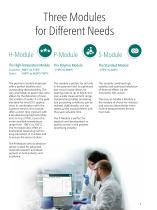
The High-Temperature Module The Polymer Module Supreme: -180°C to 750°C -170°C to 600°C The premium module impresses with a perfect baseline and outstanding reproducibility. The very small peak-to-peak noise ratio allows for the detection of even the smallest of peaks. It is the gold standard for most DSC applications. In combination with the Supreme version, this module offers a short time constant with a simultaneously high sensitivity and, on top of that, covers the entire available temperature range from -180°C to 750°C. The H-module also offers an illuminated measuring cell for easy placement...
Open the catalog to page 7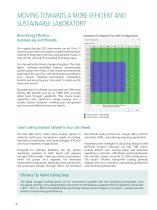
MOVING TOWARDS A MORE EFFICIENT AND SUSTAINABLE LABORATORY Boost Energy Efficiency – Automatically and Efficiently Example of a Setpoint Eco/Idle Configuration On a typical lab day, DSC instruments run for 10 to 12 hours but are often shut down outside working hours, leading to long warm-up times and delayed results; or they are left running, thus leading to energy waste. Our innovative Eco Mode changes the game. This intelligent, software-controlled feature automatically powers down the chiller in idle mode and seamlessly reactivates the gas flow and thermostat according to your custom schedule—eliminating...
Open the catalog to page 8
At NETZSCH, our commitment to quality extends well beyond the instruments themselves. We understand that your investment in advanced technology is a long-term one, and that's why we offer something truly unparalleled - our Unlimited Warranty. What Does Unlimited Warranty Mean? Unlike other warranties that may have hidden limitations, NETZSCH's Unlimited Warranty proves our dedication to your success. For as long as it is technically possible, we stand by our instruments and support you with: ■ Expert Service: Receive high-quality service directly from NETZSCH or our authorized dealers. ■ Predictable...
Open the catalog to page 9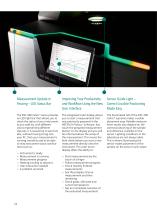
Measurement Update in Passing - LED Status Bar Improving Your Productivity and Workflow Using the New User Interface Sensor Guide Light -Correct Crucible Positioning Made Easy The DSC 300 Caliris® series provides an LED light bar that allows you to check the status of your instrument as you walk by, with different colors representing different statuses. It is reassuring to see from afar, without having to log into your PC, that your measurement is running smoothly and to be able to read instrument status notifications such as: ■ Measurement is running Measurement progress Heating/cooling to setpoint...
Open the catalog to page 10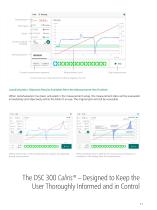
Temperature DSC signal Gases Current module installed Remaining time Current measurement segment Measurement curve Stop measurement Control over your measurements without logging into a PC AutoEvaluation: Objective Results Available After the Measurement Has Finished When AutoEvaluation has been activated in the measurement setup, the measurement data will be evaluated immediately and objectively within the blink of an eye. The original plot will still be accessible. Measurement plot, current temperature and gases are displayed during measurement. When AutoEvaluation is defined, the autonomous...
Open the catalog to page 11All NETZSCH Analyzing & Testing catalogs and technical brochures
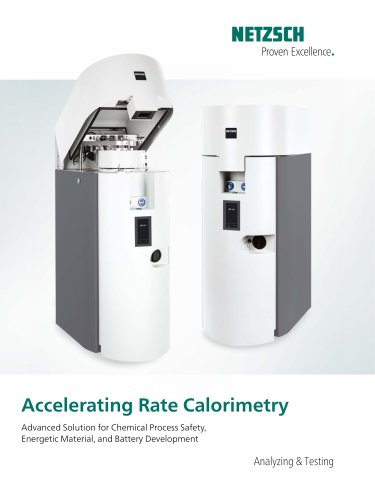 Accelerating Rate Calorimetry
20 Pages
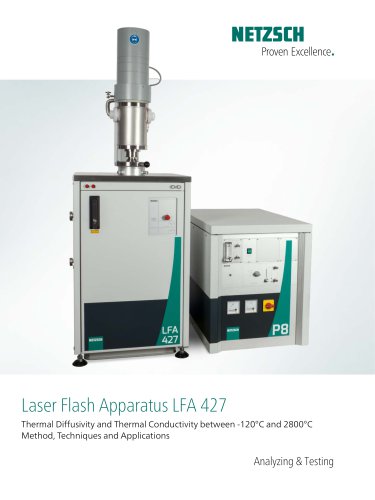 Laser Flash Apparatus LFA 427
24 Pages
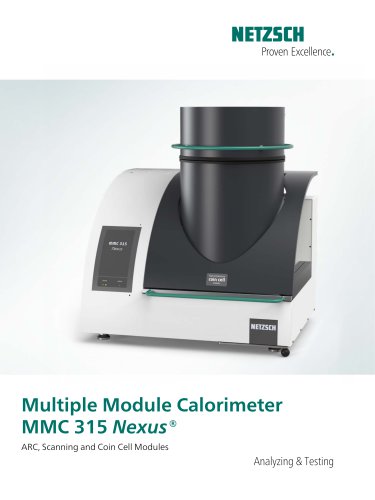
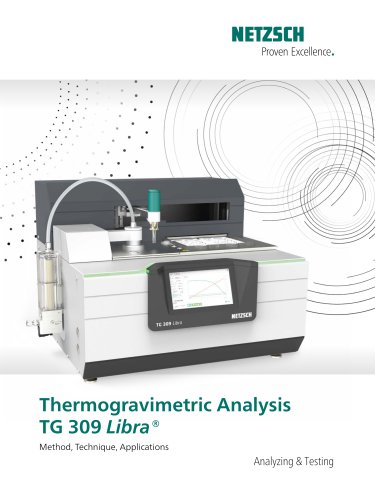
Archived catalogs
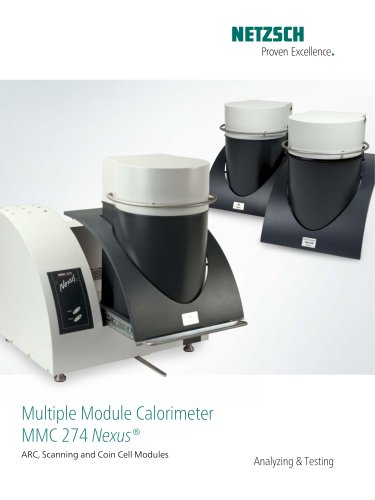 MMC 274 Nexus®
20 Pages
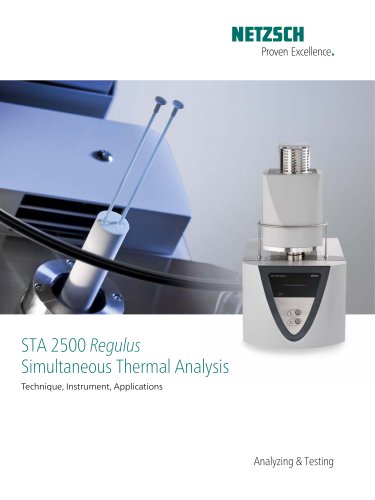 STA 2500 Regulus
12 Pages
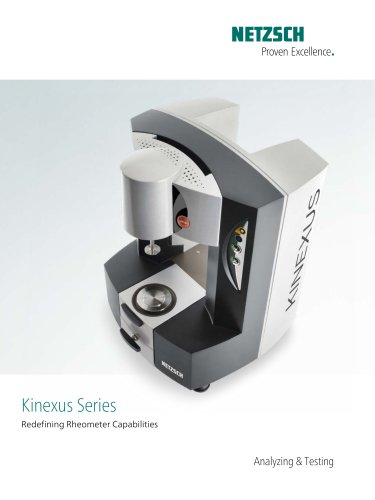 Kinexus series
16 Pages
- Analysis software
- Control software
- Windows software
- Automated software
- Software module
- Measurement software
- Import software
- Evaluation software
- Analysis software module
- Medical software module
- Design software module
- Software for the pharmaceutical industry
- Calorimeter
- Visualization software module
- Universal software
- Measurement software module
- Automatic calorimeter
- Thermal analyzer
- Laboratory calorimeter
- Differential scanning calorimeter