
- Catalogs
- NETZSCH Analyzing & Testing
- Laser Flash Apparatus LFA 427


Laser Flash Apparatus LFA 427
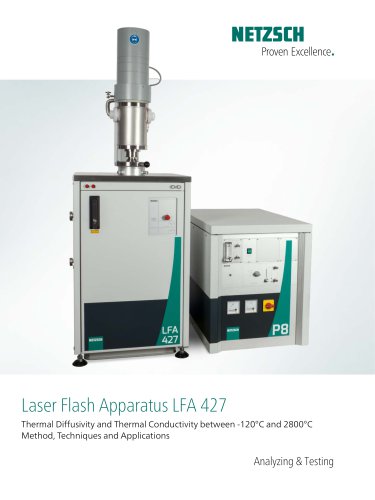
Laser Flash Apparatus LFA 427
The document provides an overview of the Laser Flash Apparatus (LFA) 427, used for measuring thermal diffusivity and conductivity from -120°C to 2800°C. It is particularly effective for analyzing conductive materials and ceramics.
The Laser Flash Method
This method involves heating a sample with a laser pulse and measuring the temperature change on the opposite face to determine thermal diffusivity and specific heat capacity. It is noted for its accuracy and non-destructive nature.
Principle of Operation
The sample is heated by a laser pulse in a furnace, and temperature changes are detected by an infrared sensor. The document provides the formula for calculating thermal conductivity.
Equipment Features
The LFA 427 features a vertical setup, double hoist for furnace interchangeability, optimized laser power, and patented pulse mapping for precise measurements.
Advanced Technology
Details include a laser system connected via fiber optics, a motor-driven hoist, and the ability to conduct tests under high vacuum conditions. It is equipped with thermocouples and pyrometers for high-temperature measurements.
Safety and Versatility
Safety features include an interlock system to prevent accidental laser firing. It offers interchangeable IR detectors and furnaces for various applications.
Sample Holders and Reference Materials
Various sample holders are available for different specimen types, and reference materials are provided for calibration.
Conclusion
The LFA 427 offers precise, reliable, and versatile thermal analysis capabilities for a wide range of materials and applications.
The document analyzes thermophysical properties of materials, focusing on thermal diffusivity, specific heat capacity, and thermal conductivity, using equipment like the LFA 427 and DSC 404 Pegasus.
Specifications
Specifications of the LFA 427 include its temperature range, heating rates, laser system, sensors, measuring range, and accuracy.
Procedures
Measurements were conducted using specific sample holders under controlled conditions, highlighting the LFA 427's adaptability.
Thermal Properties
- Pure Copper: Shows significant changes at around 1080°C due to phase transitions.
- Cast Iron: Exhibits peaks at the Curie transition and a phase transition at 1150°C.
- Ceramic Machine Tools: Emphasizes the importance of thermal diffusivity in design considerations.
- Boron Nitride: Notes differences in diffusivity based on direction due to its structure.
Recommendations
Suggests using specific sample holders and techniques for accurate data collection, emphasizing the importance of understanding material properties.
Service and Support
NETZSCH offers support and training services, including maintenance, repair, calibration, software updates, and technical support.
Conclusion
The document highlights the importance of precise measurement and analysis of thermophysical properties, positioning NETZSCH's equipment and services as essential tools for accurate results.
Catalog excerpts
Laser Flash Apparatus LFA 427 Thermal Diffusivity and Thermal Conductivity between -120°C and 2800°C Method, Techniques and Applications Analyzing & Testing
Open the catalog to page 1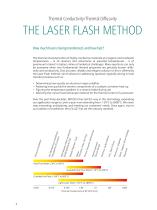
Thermal Conductivity/Thermal Diffusivity THE LASER FLASH METHOD How much heat is being transferred, and how fast? The thermal characterization of highly conductive materials at cryogenic and moderate temperatures – or of ceramics and refractories at elevated temperatures – is of paramount interest in today’s milieu of analytical challenges. Many questions can only be answered when two fundamental thermal properties are precisely known: diffusivity and conductivity. One accurate, reliable and elegant solution to this is offered by the Laser Flash method, which allows for addressing questions typically...
Open the catalog to page 2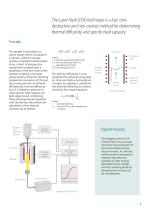
The Laser Flash (LFA) technique is a fast, nondestructive and non-contact method for determining thermal diffusivity and specific heat capacity. Principle The sample is mounted on a carrier system which is located in a furnace. After the sample reaches a predetermined temperature, a burst of energy emanating from a pulsed laser is absorbed on the front face of the sample, resulting in homogeneous heating. From the resulting temperature excursion of the rear face measured with an infrared (IR) detector, thermal diffusivity and, if a reference specimen is used, specific heat capacity are both determined....
Open the catalog to page 3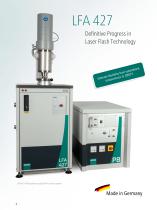
LFA 427 Definitive Progress in Laser Flash Technology n ambie b u s from ibility to 2800°C x e fl s ate Ultim mperature te LFA 427 with power supply P8 incl. laser system
Open the catalog to page 4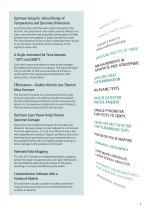
Optimum Setup for a Broad Range of Temperatures and Specimen Dimensions A vertical setup with the laser system located on the bottom, the specimen in the center and the detector on top is very sensitive and especially advantageous if high temperatures are applied or larger samples are used. The short distance to the surface of the specimen results in an increase in sensitivity and a reduction of the signal-to-noise ratio. A Single Instrument for Tests between -120°C and 2800°C Only the furnace and detector need to be changed. No additional footprint is necessary. The liquid nitrogen (LN2) controller...
Open the catalog to page 5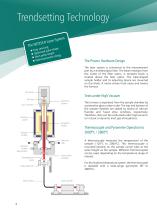
The Proven Hardware Design The laser system is connected to the measurement part by a shielded glass fiber. The beam emerges from the outlet of the fiber optics. A recipient block is located above the laser optics. The tube-shaped sample holder and its adjusting device are mounted on this block. A motor-driven hoist raises and lowers the furnace. Sample holder —[JJHit adjustment Tests under High Vacuum The furnace is separated from the sample chamber by a protective glass carbon tube. The top and bottom of the sample chamber are sealed by means of calcium fluoride and fused silica windows, respectively....
Open the catalog to page 6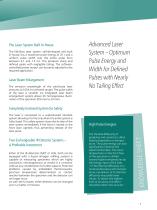
The Laser System Built In-House The Nd:Glass laser system, self-developed and built in-house, has a maximum pulse energy of 25 J and a uniform pulse width over the entire pulse form between 0.1 and 1.5 ms. This produces sharp and defined peaks with negligible tailing. The softwarecontrolled power output can be easily adjusted to the required application. Laser Beam Enlargement The emission wavelength of the solid-state laser amounts to 1054 nm (infrared range). The pulse width of the laser is variable. An integrated laser beam enlargement system allows for homogeneous illumination of the specimen...
Open the catalog to page 7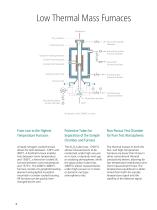
Low Thermal Mass Furnaces IR detector CaF2 window Gas outlet sample chamber Protective tube Evacuating system furnace chamber Graphite heating element Control thermocouple Gas outlet furnace chamber Sample thermocouple Sample carrier tube Protective gas furnace chamber Vacuum seal Protective gas sample chamber Evacuating system sample chamber Fused silica window Laser Protective Tubes for Separation of the Sample Chamber and Furnace Non-Porous Test Chamber for Pure Test Atmospheres A liquid-nitrogen-cooled furnace allows for tests between -120°C and 400°C. A Kanthal furnace enables tests between...
Open the catalog to page 8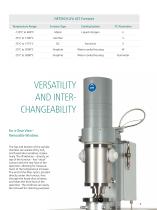
NETZSCH LFA 427 Furnaces Temperature Range Furnace Type Cooling System Liquid nitrogen Water-cooled housing Water-cooled housing VERSATILITY AND INTERCHANGEABILITY For a Clear View – Removable Windows The top and bottom of the sample chamber are sealed off by CaF2 and fused silica windows, respectively. The IR detector – directly on top of the furnace – has “visual“ contact with the rear face of the specimen, allowing for measurement of the temperature increase. The end of the fiber optics, located directly under the furnace, fires through the fused silica window and heats the front face of the...
Open the catalog to page 9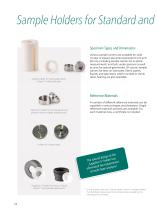
Sample Holders for Standard and Specimen Types and Dimensions Sample holder for testing specimens (“slags”) in the liquid state Various sample carriers are available for solid circular or square specimens between 6 mm and 20 mm, including sample carriers for in-plane measurements and tests under pressure as well as ones for special geometries. Of course, sample carriers for tests on laminates, fibers, pastes, liquids, and specimens which crumble or shrink upon heating are also available. Reference Materials “Platinum” holder for testing liquids and polymer melts at higher temperatures A number...
Open the catalog to page 10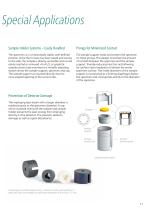
Special Applications Sample Holder Systems – Easily Handled Prongs for Minimized Contact The specimen is in a horizontally stable, well-defined position. Once the furnace has been raised and swung to the side, the sample is directly accessible and can be easily inserted or removed. An Al2O3 or graphite sample carrier tube mounted in a metallic adjusting socket carries the sample support, specimen and cap. The sample support is mounted directly into the cone-shaped opening of the carrier tube. The sample support holds and centers the specimen on three prongs. This design minimizes the amount of...
Open the catalog to page 11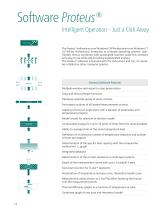
Software Proteus® Penetration (Eindringung) HEAT LOSS Intelligent Operation – Just a Click Away Heat Loss (Wärmeverlust) MODEL WIZARD Model Wizard Penetration (Eindringung) The Proteus® software runs on Windows® XP Professional or on Windows® 7 32-/64-bit Professional, Enterprise or Ultimate operating systems. Userfriendly menus combined with automated routines make this software very easy to use while still providing sophisticated analysis. The Proteus® software is licensed with the instrument and can, of course, be installed on other computer systems. PENETRATION Radiation (Interne Strahlung)...
Open the catalog to page 12All NETZSCH Analyzing & Testing catalogs and technical brochures
 Accelerating Rate Calorimetry
20 Pages
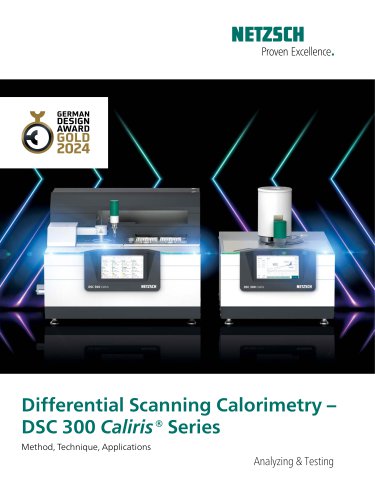
Archived catalogs
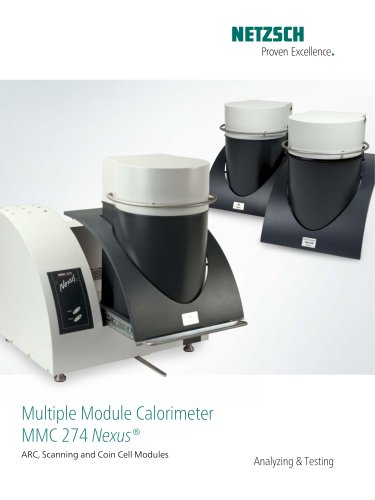 MMC 274 Nexus®
20 Pages
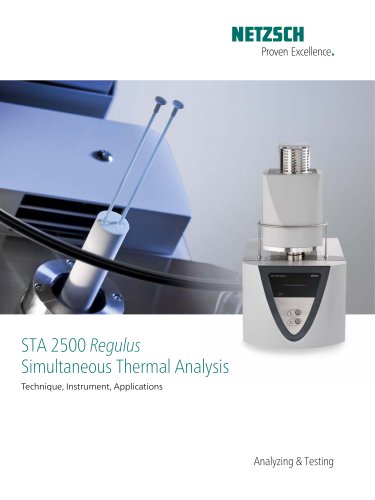 STA 2500 Regulus
12 Pages
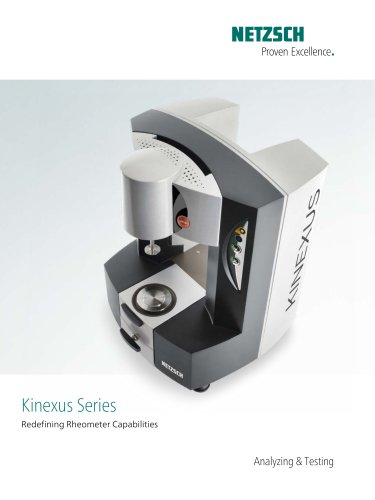 Kinexus series
16 Pages
- Analysis software
- Control software
- Windows software
- Automated software
- Software module
- Measurement software
- Import software
- Evaluation software
- Analysis software module
- Medical software module
- Design software module
- Software for the pharmaceutical industry
- Calorimeter
- Visualization software module
- Universal software
- Measurement software module
- Automatic calorimeter
- Thermal analyzer
- Laboratory calorimeter
- Differential scanning calorimeter