
- Catalogs
- NETZSCH Analyzing & Testing
- Multiple Module Calorimeter MMC 315 Nexus®


Multiple Module Calorimeter MMC 315 Nexus®
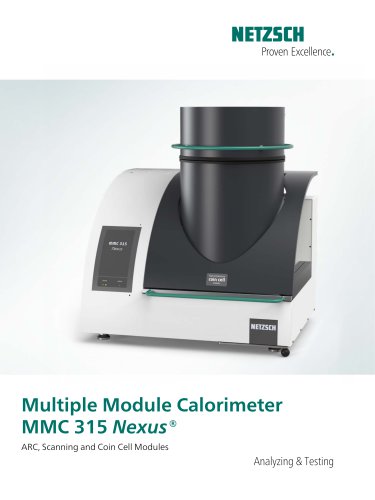
Multiple Module Calorimeter MMC 315 Nexus®
The NETZSCH Multiple Module Calorimeter MMC 315 Nexus® is a versatile instrument for analyzing energetic materials and batteries, suitable for R&D, universities, research centers, and quality control across various industries. It supports multiple analytical methods to enhance product and process understanding.
- Multiple testing modes: Scanning, Isothermal, and Adiabatic.
- Wide temperature and pressure ranges.
- Various sample containers available.
- Proteus® software for comprehensive data evaluation.
- ARC Module: Simulates worst-case scenarios under adiabatic conditions for process safety, thermal runaway, and storage studies.
- Scanning Module: Analyzes high-energy exo- and endothermal reactions in solids and liquids.
- Coin Cell Modules: Characterizes coin cells, including thermal behavior and performance analysis.
- Temperature range: Room temperature to 500°C.
- Pressure limit: 150 bar.
- Sample container volume: 0.5 to 8.5 ml.
- Modes of operation: Heat-Wait-Search, constant rate, and isothermal aging.
- VariPhi®: Compensates for heat loss, allowing accurate determination of reaction enthalpies and thermal inertia.
- Simulates fire exposure and additional heat scenarios.
Graphs and tables illustrate thermal behavior, self-heating rates, and kinetic parameters, aiding in understanding thermal dynamics and safety implications.
- Charge and Discharge Efficiency: Charge efficiency at 1C is 96.0%, discharge efficiency at 1C is 87.9%.
- Thermal Inertia: 1.480 with a delta T of 90.3 K and an ideal delta T of 133.7 K.
- Kinetic Parameters: Activation energy (E) is 151.039 kJ/mol, pre-exponential factor (A) is 15.152 log (1/s).
- Self-Decomposition Behavior: Investigated self-decomposition of DTBP in toluene, showing significant temperature rise and pressure increase.
- Heat-Wait-Search Test: Conducted on DTBP in toluene, highlighting the impact of different Φ-factors on self-heating rates.
- Safety in Chemical Processing: Understanding exothermic reactions is crucial for safe processing, storage, and transport of chemicals.
- Use of Scanning Module: Recommended for isothermal and constant temperature ramp tests, especially for small masses of highly energetic samples.
- Phase Transitions: Multiple endothermal and exothermal transitions observed in compounds like NH4NO3 and KNO3.
- Pressure and Temperature Correlations: Monitored pressure changes alongside temperature variations.
- Ammonium Nitrate Fuel Oil (ANFO): Used in mining and construction, with noted energy release during decomposition.
- Potassium Nitrate: Used in gunpowder synthesis and food preservation, with observed phase transitions.
- No special sample preparation required.
- Allows analysis of complete coin cells.
- Integrates heat generation data with battery data.
- Facilitates charging and discharging with a simple interface to a cycler device.
- Provides a representative thermal profile for complex materials.
- Enhances sensitivity and allows for highly reproducible measurements.
- Detects subtle thermal transitions.
- Two variations: High-Temperature (HT) and High-Sensitivity (HS).
- Temperature range: HT (RT to 300°C), HS (RT to 200°C).
- Temperature readability: 0.01 K.
- Limit of detection: HT (0.1 mW), HS (0.05 mW).
- Heat flow range: HT (± 4500 mW), HS (± 350 mW).
- Calibration using traditional melting standards and TrueJoule calibration for isothermal experiments.
- Connection to external battery testing systems is simplified.
The Coin Cell Module offers a unique approach to battery testing and material analysis, providing enhanced sensitivity, stability, and comprehensive data integration.
Discusses the use of the Nexus® system with an in-situ calibration cell for accurate power pulses and high measurement reliability.
Enables detailed study of the battery formation process, aiding in optimizing battery performance and lifespan.
Provides insights into the thermal behavior of new battery chemicals during cycling.
Allows analysis of larger sample sizes with exceptional sensitivity, crucial for detecting impurities in polymer samples.
Compares DSC and MMC results on (S)-(+)-Ibuprofen, enhancing material characterization.
NETZSCH-Gerätebau GmbH is a leading global technology company specializing in thermal analysis, calorimetry, and more, with 60 years of experience.
Catalog excerpts
Proven Excellence. Multiple Module Calorimeter MMC 315 Nexus® ARC, Scanning and Coin Cell Modules Analyzing & Testing
Open the catalog to page 1
Multiple Module Calorimeter Synergy of Proven Methods Scientists and engineers generally recognize that more product and process information can be obtained by multiple analytical methods rather than using a single technique. Different signals can be recorded, and superimposed sample effects can often be much better explained. The technique has to be reliable, fast and easy to use in everyday operations. The NETZSCH Multiple Module Calorimeter MMC 315 Nexus® is an instrument which can be operated with different modules for the investigation of energetic materials and batteries (coin cells). It...
Open the catalog to page 2
Advantages and Key Features of the MMC 315 Nexus® ARC Module -Process Safety Knowing the amount of energy released by a given chemical reaction is essential for ensuring safe and reliable processes. The ARC (Accelerating Rate Calorimetry) module allows you to study the worst-case scenarios at elevated temperatures without losing heat to the environment. ARC systems in accordance with ASTM E1981 have been widely used for decades to simulate the behavior of actual large-scale reactors. However, these instruments have a large footprint. In contrast, the MMC 315 Nexus® with ARC module has a space-saving...
Open the catalog to page 3
Thermal runaway scenarios can be understood by investigating the runaway reaction. Questions arise which can be answered by means of measurements under adiabatic conditions. For this purpose, the NETZSCH MMC 315 Nexus® can be configured with the ARC module, which can also be equipped with VariPhi®. The ARC Module Process Safety What is the thermal behavior of the material? n is l reactio en its a ic m e A ch y' wh 'runawa n rate is e b o t said uctio at prod t losses. own he han hea higher t What is the thermal hazard potential of the material? At what temperature does the reaction occur (onset)?...
Open the catalog to page 4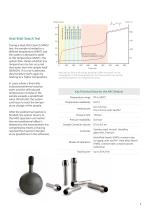
Initial heating Heat-Wait-Search Test During a Heat-Wait-Search (HWS) test, the sample is heated to a defined temperature (HEAT) and the system is allowed to settle at this temperature (WAIT). The system then checks whether any temperature rise has occurred that stems from the sample itself (SEARCH). If no rise is detected, the procedure starts again by heating to a higher temperature. In cases where a thermally induced exothermal reaction starts and the self-induced temperature increase of the sample exceeds a predefined value (threshold), the system continues to track the temperature change...
Open the catalog to page 5
The best way to understand worst case scenarios is to investigate runaway reactions under adiabatic conditions, which means no heat exchange occurs with the sample's environment. The ARC module is able to minimize heat loss from the sample container by maintaining the temperature of the surroundings equal to that of the sample temperature. A defined volume of a sample (ml scale) is placed in a tubeshaped or spherical container which is surrounded by a sophisticated heating system. If there is no temperature difference between the surrounding heaters and the sample, then all the heat generated...
Open the catalog to page 6
VariPhi® is an additional controlled variable DC heater which is in contact with the sample material (internal heater). It allows for the definition of thermal inertia for a real-world thermal environment by compensating for heat loss from the sample to the container. Since both the sample and the container are under adiabatic conditions, the heat generated by the sample causes not only an increase in its own temperature but also in that of the container. The sample container absorbs some of the energy from its own reaction depending upon its mass and heat capacity. On a small scale, the thermal...
Open the catalog to page 7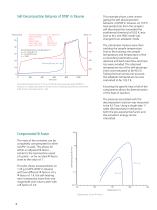
Heat flow /(mW/mg) Self-Decomposition Behavior of DTBP in0.10 Toluene Horizontal Step (110.21 °C - 200.51°C): Thermal Inertia: 1.480 delta T: 90.3 K delta T ideal: 133.7 K react. spec. heat: 280.675 J/g react. total. heat: 1611.075 J Kinetic Parameters, zero baseline, F1 A = 15.152 log (1/s) E = 151.039 kJ/mol n = 1.000 This example shows a test investigating the self-decomposition Area: 29.31 J/g behavior of DTBP in toluene. At 110°C, heat production from the sample's self-decomposition exceeded the exothermal threshold of 0.02 K/min. 156.7°C DueOnset: to this, the HWS mode was changed to an...
Open the catalog to page 8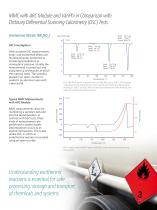
MMC with ARC Module and VariPhi in Comparison with Ordinary Differential Scanning Calorimetry (DSC) Tests Area: -76.7 J/g Peak: 172.3°C Onset: 169.0°C ↑ exo Area: -2.4 J/g Peak: 94.3°C Onset: 91.1°C -1 Heat flow /(mW/mg) With standard DSC measurements, endo- and exothermal effects are monitored under isothermal or increasing temperature at atmospheric pressure. Usually, the measurement is carried out and evaluated up to the point at which the material melts. The sample is placed in an open crucible or sealed in an aluminum pan with a pierced lid. Area: -23.3 J/g Peak: 65.3°C Onset: 53.2°C Area:...
Open the catalog to page 9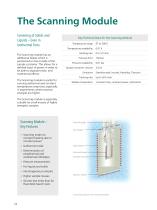
Key Technical Data for the Scanning Module Temperature range Temperature readability Heating rate Pressure limit Pressure readability Sample container volume Container Tracking rate Modes of operation Screening of Solids and Liquids - Even in Isothermal Tests The Scanning module has an additional heater which is positioned on the outside of the sample container. This allows for a defined input of power in order to be able to separate endo- and exothermal effects. The Scanning module is useful for running isothermal and constant temperature ramp tests, especially in experiments where reaction...
Open the catalog to page 10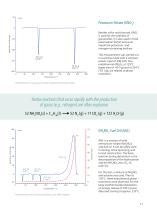
Heat flow Voltage Current Heat flow /(mW/mg) Besides sulfur and charcoal, KNO3 is used for the synthesis of gunpowder. It is also used in food preservation (E252) and as an important potassium- and nitrogen-containing fertilizer. This measurement was carried out in scanning mode with a constant power input of 200 mW. Two endothermal effects, at 129°C (peak area of -45 J/g) and at 334°C (-87 J/g), are related to phase transitions. Measurement on potassium nitrate using the Scanning module ↑ exo Heat flow /(mW/mg) Heat flow /(mW) Redox reactions that occur rapidly with the production of gases (e.g.,...
Open the catalog to page 11All NETZSCH Analyzing & Testing catalogs and technical brochures
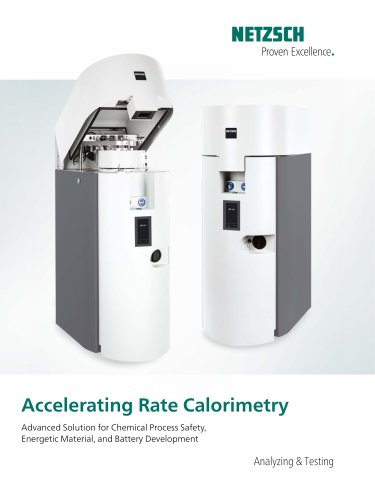 Accelerating Rate Calorimetry
20 Pages
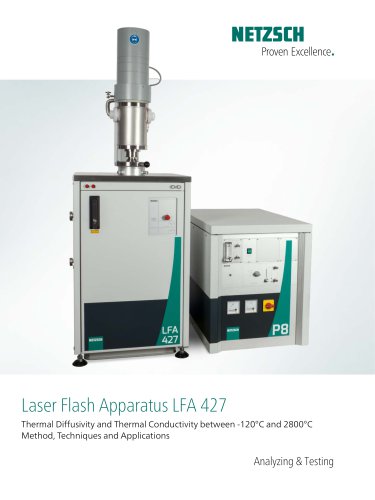 Laser Flash Apparatus LFA 427
24 Pages
Archived catalogs
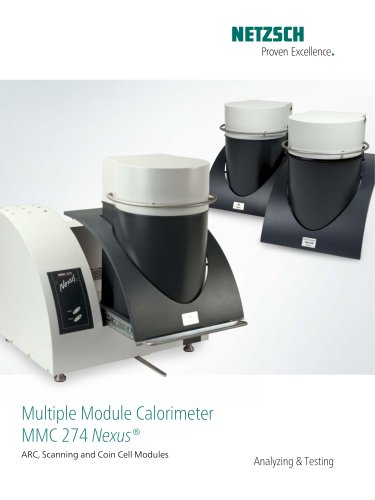 MMC 274 Nexus®
20 Pages
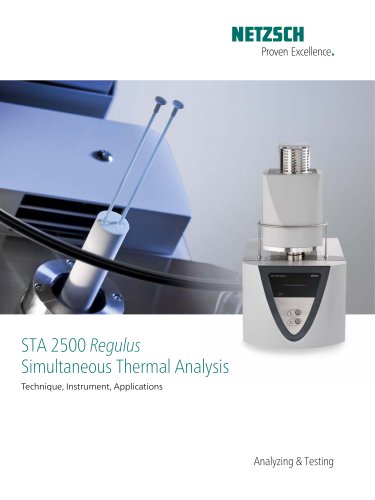 STA 2500 Regulus
12 Pages
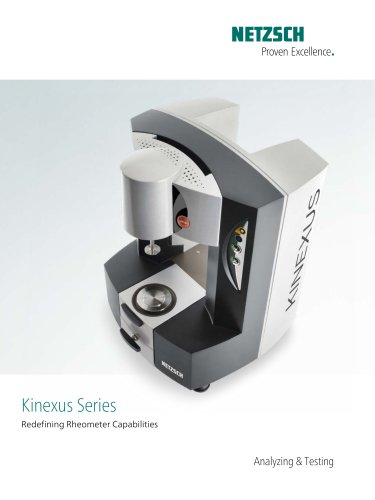 Kinexus series
16 Pages
- Analysis software
- Control software
- Windows software
- Automated software
- Software module
- Measurement software
- Import software
- Evaluation software
- Analysis software module
- Medical software module
- Design software module
- Software for the pharmaceutical industry
- Visualization software module
- Universal software
- Measurement software module
- Automatic calorimeter
- Thermal analyzer
- Laboratory calorimeter