
- Catalogs
- NETZSCH Analyzing & Testing
- Thermogravimetric Analysis TG 309 Libra®


Thermogravimetric Analysis TG 309 Libra®
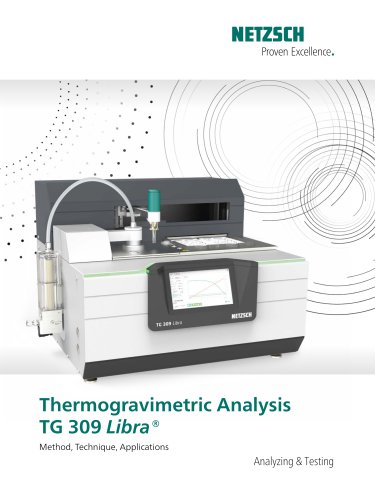
Thermogravimetric Analysis TG 309 Libra®
Thermogravimetric Analysis (TGA) is a precise analytical technique used to measure changes in the mass of a sample over time or temperature under controlled conditions. It is highly sensitive, capable of detecting weight changes down to fractions of a microgram, making it essential for determining physical and chemical properties of materials.
TGA is crucial in various industries such as pharmaceuticals, chemicals, and food for ensuring product quality and safety. It evaluates thermal stability, shelf-life, and degradation pathways, which are vital for quality control and regulatory compliance. TGA is also used for compositional analysis, material characterization, and understanding complex mixtures and transformations.
The technique is adaptable to a wide range of applications, from polymers to environmental science, making it indispensable for both industrial and academic research. It provides insights into material properties, aiding in quality control and research development.
The TG 309 Libra® series includes three instruments: Classic, Select, and Supreme, each tailored for different needs ranging from quality control to advanced research. These instruments comply with international standards for thermogravimetry.
The TG 309 Libra® features a vertical top-loading design with a micro-furnace for efficient heating and cooling. It includes a magnetic levitation system to minimize external interference and ensure accurate mass measurements. The design allows for easy sample handling and precise temperature detection.
The instrument supports multiple gas connections for easy switching and mixing, enhancing measurement efficiency. It also features an automatic sample changer (ASC) for handling up to 204 samples, improving laboratory workflow and efficiency.
The Proteus® software with SmartMode interface simplifies routine tasks, allowing for quick measurement setups. The BeFlat® feature eliminates the need for separate baseline corrections, streamlining the testing process.
The TG 309 Libra® series offers a comprehensive solution for thermogravimetric analysis, combining precision, versatility, and ease of use, making it a valuable tool for material analysis across various industries.
The document introduces two modes for conducting measurements: SmartMode and ExpertMode. SmartMode is designed for ease of use, allowing users to quickly start measurements with predefined procedures and user-defined methods. ExpertMode offers advanced settings for users who wish to delve deeper into the software's capabilities.
AutoCalibration simplifies the calibration process by automatically generating calibration curves and monitoring their validity. AutoEvaluation provides instant, objective evaluation of thermogravimetric analysis (TGA) measurements, identifying significant mass changes and peak temperatures.
The c-DTA® signal is used to reveal caloric effects during TGA measurements, providing insights into endothermic and exothermic reactions. This is particularly useful for characterizing sample properties and enhancing temperature calibration accuracy.
Identify is a software tool for material identification and quality control, utilizing a database of over 1300 entries. It allows for comparison with individual measurements or classes of data, aiding in accurate material identification.
The TG 309 Libra® features an LED status bar and a color touch display for easy monitoring and control of measurements. The Eco Mode reduces energy consumption by automatically managing the instrument's operational state, contributing to sustainability efforts in the laboratory.
- Temperature Resolution: 0.001 K
- Temperature Accuracy: ± 0.3 K (after calibration by c-DTA®, indium)
- Temperature Calibration: c-DTA®, also for detection of endo- and exothermal effects; Curie standards
- Temperature Stability: Peak-to-peak: 0.03 K, RMS: 0.005 K
- Temperature Precision: 0.15 K
- Vacuum-tightness: 1 mbar << 10-1 mbar
- Integrated MFC: 4-fold MFC available, 3-fold MFC optional
- Evolved Gas Analysis: 192+12-position ASC available, 20-position ASC optional
- Display: Color touch display
- Warranty: Unlimited warranty
NETZSCH-Gerätebau GmbH, located in Selb, Germany, is part of the NETZSCH Group, a leading global technology company specializing in mechanical, plant, and instrument engineering. The company operates under Erich NETZSCH B.V. & Co. Holding KG and consists of three business units: Analyzing & Testing, Grinding & Dispersing, and Pumps & Systems. These units are tailored to specific industries and products, supported by a worldwide sales and service network since 1873.
NETZSCH specializes in Thermal Analysis, Calorimetry (adiabatic & reaction), Thermophysical Properties determination, Rheology, and Fire Testing. With 60 years of experience, a broad product line, and comprehensive service offerings, NETZSCH aims to meet and exceed customer expectations.
Catalog excerpts
Proven Excellence Thermograv i metri c TG 309 Libra® Method, Technique, Applications Analyzing & Testing
Open the catalog to page 1
TG 309 Libra® UNLOCKING THE POWER OF THERMOGRAVIMETRY Thermogravimetry has the ability for differentiation between individual components based on their distinct thermal behavior. By analyzing weight-loss profiles, users can deduce the composition of complex samples, enabling deeper understanding of their structure and properties. Revealing the Mysteries of Complex Mixtures and Material Transformations Thermogravimetry (TG) is renowned for its precision and sensitivity. By subjecting a sample to controlled temperature increments while continuously measuring its weight change, TGA can detect even...
Open the catalog to page 2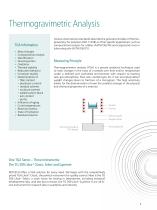
■ Compositional analysis Identification ■ Reduction behavior Corrosion studies ■ added carbon black ■ Influence of aging Curie temperatures Reaction kinetics State of hydration Residual solvents Various international standards describe the general principles of thermogravimetry for polymers (ISO 1 1358) or other specific applications, such as compositional analysis for rubber (ASTM D6370) and evaporation loss in lubricating oils (ASTM D6375). Measuring Principle Thermogravimetric analysis (TGA) is a precise analytical technique used to track changes in the mass of a sample over time and/or temperature...
Open the catalog to page 3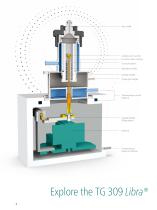
Sample and crucible Furnace water cooling Furnace heater Radiation shield Sample holder Purge gas sample Thermostatic control balance Sample holder lifting device Protective gas balance chamber
Open the catalog to page 4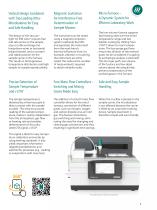
Vertical Design Combined with Top-Loading UltraMicrobalance for Easy and Safe Handling The design of the vacuum-tight TG 309 Libra® ensures free and safe access to the sample, easy crucible exchange (no hang-down wires or horizontal balance beam), and a constant and stable position for the sample carrier in the furnace. This results in homogeneous temperature distribution and high sample-to-sample reproducibility. Magnetic Levitation for Interference-Free Determination of Sample Masses The instrument can be raised using a magnetic levitation system (optional) that lifts and separates the instrument...
Open the catalog to page 5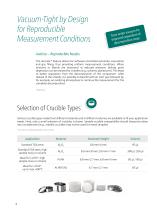
Vacuum-Tight by Design for Reproducible Measurement Conditions or cuum f a v r e d f n Tests u separation o d e improv osition steps p decom AutoVac – Reproducible Results The AutoVac* feature allows for software-controlled automatic evacuation and gas filling, thus providing uniform measurement conditions. When mixtures or blends are measured at reduced pressure, boiling point depression can be realized for volatiles (e.g., solvents, plasticizers). This leads to better separation from the decomposition of the component. After release of the volatile, it is possible to backfill with an inert...
Open the catalog to page 6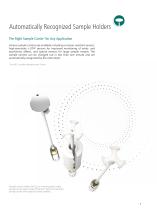
Automatically Recognized Sample Holders The Right Sample Carrier1 for Any Application Various sample carriers are available including corrosion-resistant sensors, high-sensitivity c-DTA® sensors for improved monitoring of endo- and exothermic effects, and special sensors for large sample masses. The sample carriers can be changed out in less than one minute and are automatically recognized by the instrument. 1 Sample carriers made of Al2O3 for corrosive gases (right), sample carrier type P made of Platinel® (left) and standard sample carrier with radiation shield (middle).
Open the catalog to page 7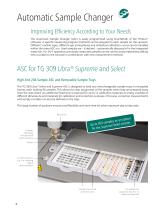
Automatic Sample Changer Improving Efficiency According to Your Needs The Automatic Sample Changer (ASC) is easily programmed using SmartMode of the Proteus® software. A specific measuring program (method) can be assigned to each sample on the carousel. Different crucible types, different gas atmospheres and individual calibration curves can be handled within the same ASC run. Used samples are – if desired – automatically disposed of in the integrated waste bin. For 24/7 operation, previously measured samples can be continuously replaced by adding new crucibles to the carousel in combination...
Open the catalog to page 8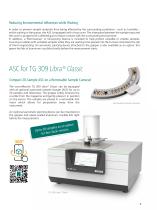
Reducing Environmental Influences while Waiting In order to prevent sample materials from being affected by the surrounding conditions – such as humidity – whilst waiting in the queue, the ASC is equipped with a tray cover. The interspace between the sample trays and the cover is purged with a defined gas to reduce contact with the surrounding environment. In addition, a “RemoveCap“ or lid-piercing feature is included to help protect unstable or volatile samples. Covering crucibles with unstable samples while they are waiting to be placed into the furnace minimizes the risk of them evaporating....
Open the catalog to page 9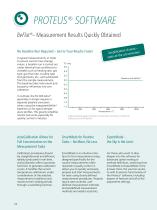
BeFlat®– Measurement Results Quickly Obtained 40 No Baseline Run Required – Get to Your Results Faster In typical measurements, in order to ensure correct mass change values, a baseline run is carried out under identical test conditions for variables such as heating rate, gas type, gas flow rate, crucible type and geometry, etc., and subtracted from the sample measurement. The baseline takes instrument and buoyancy influences into consideration. 0.6 0.4 0.2 Baseline with BeFlat® Stable baseline (green) thanks to automatic correction of external influences via TGA-BeFlat® 100 SmartMode TG curve...
Open the catalog to page 10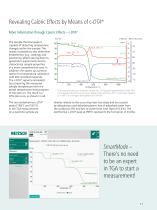
Revealing Caloric Effects by Means of c-DTA® 100 More Information through Caloric Effects – c-DTA® c-DTA /K DTG /(%/min) The sample thermocouple is capable of detecting temperature changes within the sample. This makes it possible to also determine endothermic (e.g., melting) and exothermic effects during thermogravimetric experiments and to characterize sample properties in a more comprehensive way. In addition, this opens up a precise option for temperature calibration with DSC standard materials. The c-DTA® signal is calculated by comparing the measured sample temperature with the preset temperature-time...
Open the catalog to page 11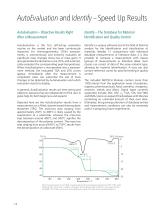
AutoEvaluation and Identify – Speed Up Results AutoEvaluation – Objective Results Right After a Measurement Identify – The Database for Material Identification and Quality Control AutoEvaluation is the first self-acting evaluation routine on the market and has been continuously improved. For thermogravimetry (TGA) measurements, it autonomously and instantly evaluates all significant mass changes (mass loss or mass gain). It also generates the derivative curve, DTG, and automatically evaluates the corresponding peak temperatures. When AutoEvaluation is incorporated into a measurement method, the...
Open the catalog to page 12All NETZSCH Analyzing & Testing catalogs and technical brochures
 Accelerating Rate Calorimetry
20 Pages
 Laser Flash Apparatus LFA 427
24 Pages
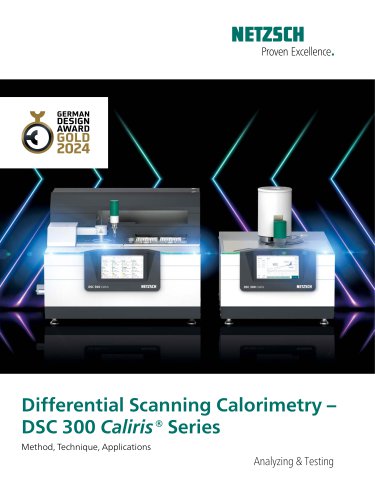
Archived catalogs
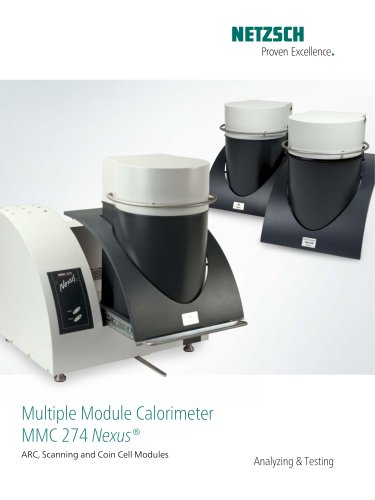 MMC 274 Nexus®
20 Pages
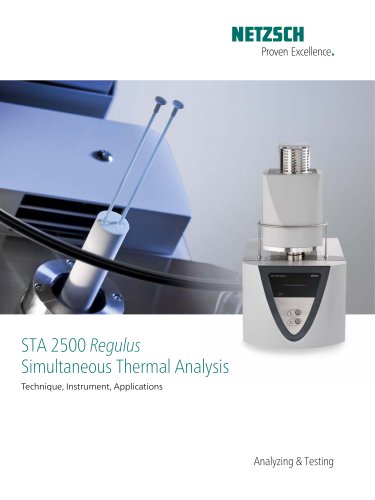 STA 2500 Regulus
12 Pages
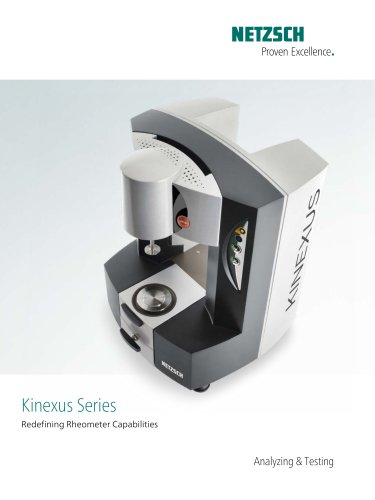 Kinexus series
16 Pages
- Analysis software
- Control software
- Windows software
- Automated software
- Software module
- Measurement software
- Import software
- Evaluation software
- Analysis software module
- Medical software module
- Design software module
- Software for the pharmaceutical industry
- Calorimeter
- Visualization software module
- Universal software
- Measurement software module
- Automatic calorimeter
- Thermal analyzer
- Laboratory calorimeter
- Differential scanning calorimeter