
- Catalogs
- Neurocare Group
- Transcranial Magnetic Stimulation TMS Effectiveness in studies

Transcranial Magnetic Stimulation TMS Effectiveness in studies
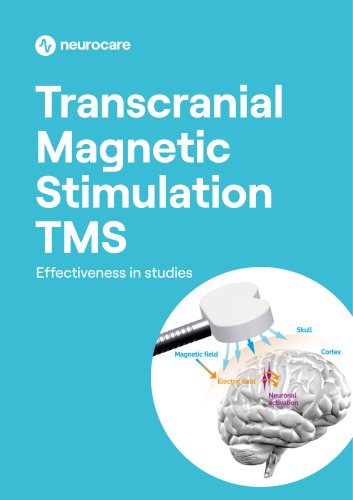
Transcranial Magnetic Stimulation TMS Effectiveness in studies
Repetitive Transcranial Magnetic Stimulation (rTMS) is a non-invasive treatment for neurological and psychiatric disorders. The document reviews research from 2014 to 2018, confirming rTMS's effectiveness for neuropathic pain, depression, and post-stroke motor recovery. It is likely effective for motor impairment, Parkinson’s disease, multiple sclerosis, PTSD, and aphasia.
Depression
rTMS combined with psychotherapy shows high response and remission rates in major depressive disorder, especially in treatment-resistant cases. High-frequency stimulation over the left DLPFC significantly improves depression scores.
Obsessive Compulsive Disorder (OCD)
Low-frequency rTMS over the right DLPFC reduces OCD symptoms, with improvements maintained at a 3-month follow-up.
Anxiety
High-frequency rTMS of the right DLPFC improves anxiety and depression scores in generalized anxiety disorder, offering an alternative for non-responsive patients to pharmacotherapies.
Post-Traumatic Stress Disorder (PTSD)
Bilateral and unilateral right high-frequency rTMS reduces PTSD symptoms, with faster improvements from bilateral stimulation.
Pain
rTMS over the primary motor cortex (M1) provides relief in malignant neuropathic pain, with effects lasting up to 15 days post-treatment. Early treatment is encouraged for chronic neuropathic pain.
Stroke - Motor Disorders and Aphasia
rTMS aids motor recovery and treats nonfluent aphasia post-stroke.
Multiple Sclerosis
rTMS shows potential in reducing lower limb spasticity in multiple sclerosis patients.
Conclusion
rTMS is a promising therapeutic tool for various disorders, with evidence supporting its efficacy and safety. Tailored protocols are emphasized to maximize treatment outcomes.
This document presents studies on the efficacy and safety of rTMS in neurological conditions like stroke recovery, aphasia, and multiple sclerosis.
Study 1: Motor Recovery in Subacute Stroke Patients
Objective: Evaluate daily high-frequency rTMS (HF-rTMS) in motor recovery of subacute stroke patients.
Methodology: Double-blind, placebo-controlled study with 41 patients (20 active, 21 placebo) combined with rehabilitation.
Results: Significant improvement in hand and arm scores in the active group. No serious adverse events.
Conclusion: Daily HF-rTMS is tolerable and enhances motor recovery.
Study 2: Combined Low-Frequency rTMS and Virtual Reality Training
Objective: Assess combined low-frequency rTMS and VR training on upper limb function in stroke patients.
Methodology: Double-blind, placebo-controlled trial with 108 patients (55 active, 53 placebo) post-stroke, combined with VR training.
Results: Significant improvements in WMFT, MBI, and SF-36 scores in the active group.
Conclusion: LF-rTMS with intensive rehabilitation, including VR training, improves upper limb function and quality of life.
Study 3: rTMS on Language Performance in Nonfluent Aphasia
Objective: Evaluate rTMS on language performance in stroke patients with nonfluent aphasia.
Methodology: Randomized, placebo-controlled study with 56 patients (33 LF rTMS, 23 placebo) combined with speech therapy.
Results: Significant improvement in CCAT scores in the active group.
Conclusion: Inhibitory rTMS achieves a persistent effect on language performance.
Study 4: Spasticity Management in Multiple Sclerosis
Objective: Compare HF-rTMS and iTBS on spasticity and symptoms in secondary progressive multiple sclerosis.
Methodology: Randomized, placebo-controlled study with 34 patients (12 HF-rTMS, 12 iTBS, 10 placebo) combined with physical therapy.
Results: Significant reduction in spasticity with HF-rTMS and iTBS. HF-rTMS also reduced pain and fatigue.
Conclusion: Both HF-rTMS and iTBS effectively reduce spasticity, with HF-rTMS also reducing pain and fatigue.
Training and Resources
The neurocare academy offers training in TMS and other neuromodulation techniques, providing online courses and practical workshops worldwide.
Contact Information
neurocare group AG
Email: [email protected]
Phone: +49 (3677) 68 979-0
Website: www.neurocaregroup.com
Catalog excerpts
Transcranial Magnetic Stimulation TMS Effectiveness in studies
Open the catalog to page 1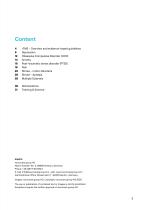
rTMS - Overview and evidence-based guidelines Depression Obsessive Compulsive Disorder (OCD) Anxiety Post-traumatic stress disorder (PTSD) Pain Stroke - motor disorders Stroke - Aphasia Multiple Sclerosis Abbreviations Training & Science Imprint neurocare group AG Albert-Einstein-Str. 3, 98693 Ilmenau, Germany Phone: +48 (3677) 68 979 0 E-mail: [email protected] • web: www.neurocaregroup.com Administrative Office: Rindermarkt 7 • 80331 Munich • Germany Images: neurocare group AG, Copyright: neurocare group AG 2020 The use or publication of contained text or images is strictly prohibited....
Open the catalog to page 3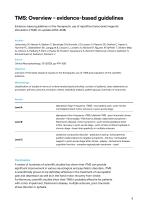
TMS: Overview - evidence-based guidelines Evidence-based guidelines on the therapeutic use of repetitive transcranial magnetic stimulation (rTMS): An update (2014–2018). Authors Lefaucheur JP, Aleman A, Baeken C, Benninger DH, Brunelin J, Di Lazzaro V, Filipovic SR, Grefkes C, Hasan A, Hummel FC, Jääskeläinen SK, Langguth B, Leocani L, Londero A, Nardone R, Nguyen JP, Nyffeler T, Oliveira-Maia AJ, Oliviero A, Padberg F, Palm U, Paulus W, Poulet E, Quartarone A, Rachid F, Rektorová I, Rossi S, Sahlsten H, Schecklmann M, Szekely D, Ziemann U Source Clinical Neurophysiology, 131 (2020), pp 474–528...
Open the catalog to page 5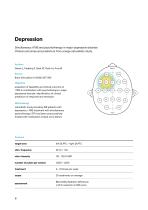
Depression Simultaneous rTMS and psychotherapy in major depressive disorder: Clinical outcomes and predictors from a large naturalistic study. Authors Donse L, Padberg F, Sack AT, Rush AJ, Arns M Objective evaluation of feasibility and clinical outcome of rTMS in combination with psychotherapy in major depressive disorder. Identification of clinical predictors of response and remission naturalistic study including 196 patients with depression, rTMS treatment with simultaneous psychotherapy. 97% had been unsuccessfully treated with medication at least once before. Protocol target area left DLPFC...
Open the catalog to page 6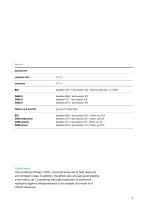
Results assessment response rate baseline 31.3 / Last session 14.1 / 55.9 % reduction, p < 0.001 DASS D DASS A DASS S baseline 28.6 / last session 12.1 baseline 13.7 / last session 5.6 baseline 22.4 / last session 10.1 BDI DASS depression DASS anxiety DASS stress baseline 29.4 / last session 8.0 / follow-up 13.8 baseline 27.0 / last session 6.5 / follow-up 11.8 baseline 14.1 / last session 4.0 / follow-up 7.2 baseline 22.3 / last session 7.3 / follow-up 12.5 Conclusions The combined therapy rTMS + psychotherapy led to high response and remission rates. In addition, the effect also showed good...
Open the catalog to page 7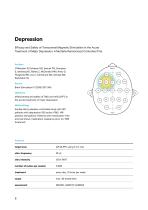
Depression Efficacy and Safety of Transcranial Magnetic Stimulation in the Acute Treatment of Major Depression: A Multisite Randomized Controlled Trial. Authors O’Reardon JP, Solvason HB, Janicak PG, Sampson S, Isenberg KE, Nahas Z, McDonald WM, Avery D, Fitzgerald PB, Loo C, Demitrack MA, George MS, Sackheim HA Objective effectiveness and safety of TMS over left DLPFC in the acute treatment of major depression Methodology double-blind, placebo-controlled study with 301 patients with depression (155 active rTMS, 146 placebo stimulation). Patients were medication-free and had shown medication...
Open the catalog to page 8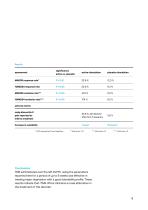
Results assessment significance active vs. placebo active stimulation placebo stimulation MADRS response rate* MADRS remission rate** scalp discomfort/ pain reported as mild to moderate 35.8 %; diminished after first 5 sessions adverse events * 50 % improvement from baselinee. Conclusions TMS administered over the left DLPFC using the parameters reported here for a period of up to 6 weeks was effective in treating major depression with a good tolerability profile. These results indicate that rTMS offers clinicians a novel alternative in the treatment of this disorder.
Open the catalog to page 9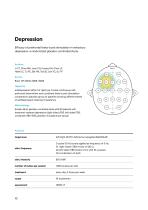
Depression Efficacy of prefrontal theta-burst stimulation in refractory depression: a randomized placebo-controlled study. Authors Li CT, Chen MH, Juan CH, Huang HH, Chen LF, Hsieh JC, Tu PC, Bai YM, Tsai SJ, Lee YC, Su TP Objective antidepressant effect of right pre-frontal continuous, leftprefrontal intermittent and combined theta-burst stimulation compared to placebo group of patients showing different levels of antidepressant treatment resistance Methodology double-blind, placebo-controlled study with 60 patients with treatment-resistant depression (right-sided cTBS, left-sided iTBS, combined...
Open the catalog to page 10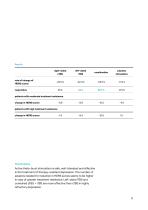
rate of change of HDRS scores right-sided cTBS left-sided iTBS placebo stimulation patients with moderate treatment resistance change in HDRS scores patients with high treatment resistance change in HDRS scores Conclusions Active theta-burst stimulation is safe, well-tolerated and effective in the treatment of therapy-resistant depression. The number of sessions needed for reduction in HDRS scores seems to be higher in case of greater treatment resistance. Left-sided iTBS and combined cTBS + iTBS are more effective than cTBS in highly refractory depression.
Open the catalog to page 11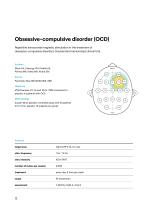
Obsessive-compulsive disorder (OCD) Repetitive transcranial magnetic stimulation in the treatment of obsessive-compulsive disorders: Double blind randomized clinical trial. Authors Elbeh KA, Elserogy YM, Khalifa HE, Ahmed MA, Hafez MH, Khedr EM Objective effectiveness of 1 Hz and 10 Hz rTMS compared to placebo in patients with OCD Methodology double-blind, placebo-controlled study with 45 patients (1 Hz, 10 Hz, placebo: 15 subjects per group) target area right DLPFC (5 cm rule) stim. frequency stim. intensity number of pulses per session every day, 5 time per week Y-BOCS, HAM-A, CGI-S
Open the catalog to page 12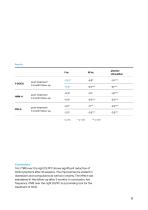
post-treatment 3 month follow-up post-treatment 3 month follow-up post-treatment 3 month follow-up placebo stimulation Conclusions 1 Hz rTMS over the right DLPFC shows significant reduction of OCD symptoms after 10 sessions. The improvement is evident in obsessions and compulsions as well as in anxiety. The effect was maintained in the follow-up after 3 months. In conclusion, low frequency rTMS over the right DLPFC is a promising tool for the treatment of OCD.
Open the catalog to page 13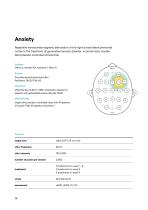
Anxiety Repetitive transcranial magnetic stimulation of the right dorsal lateral prefrontal cortex in the treatment of generalized anxiety disorder: A randomized, doubleblind placebo controlled clinical trial. Authors Dilkov D, Hawken ER, Kaludiev E, Milev R Prog Neuropsychopharmacol Biol Psychiatry 78 (2017) 61–65 Objective effectiveness of 20 Hz rTMS compared to placebo in patients with generalized anxiety disorder (GAD) Methodology single-blind, placebo-controlled study with 40 patients (15 active rTMS, 25 placebo stimulation) target area right DLPFC (5 cm rule) stim. frequency stim. intensity...
Open the catalog to page 14All Neurocare Group catalogs and technical brochures
 ActTrust
2 Pages
 THERA PRAX® MOBILE
2 Pages
 DC-STIMULATOR MC
2 Pages
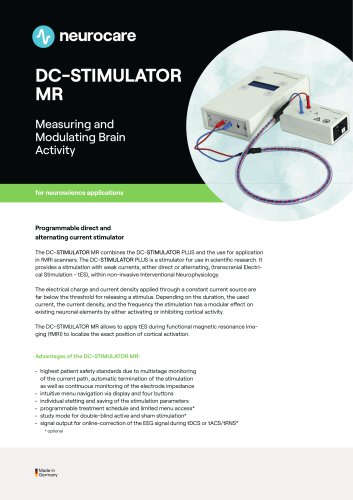 DC-STIMULATOR MR
2 Pages
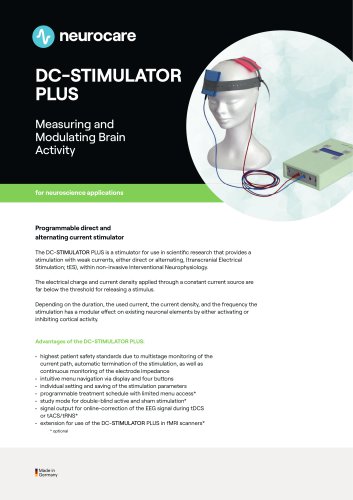 DC-STIMULATOR PLUS
2 Pages
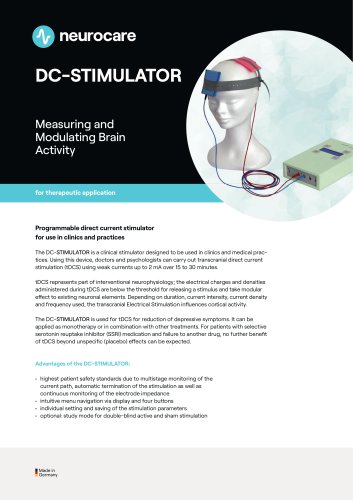 DC STIMULATOR
2 Pages
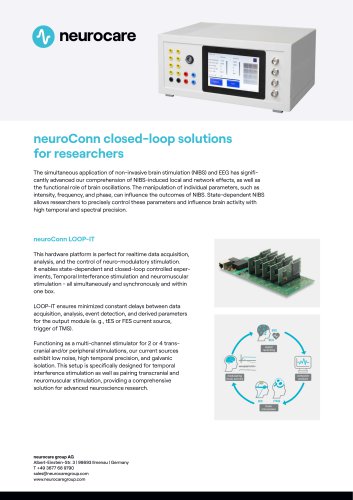 LOOP-IT
2 Pages
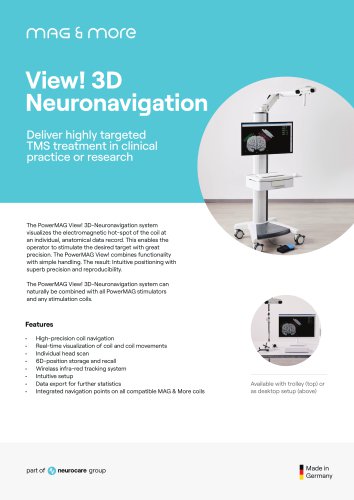 View! 3D Neuronavigation
2 Pages
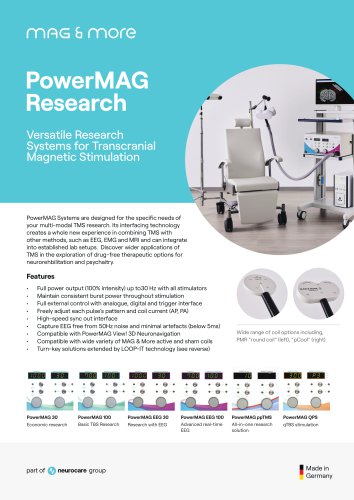 PowerMAG Research
2 Pages
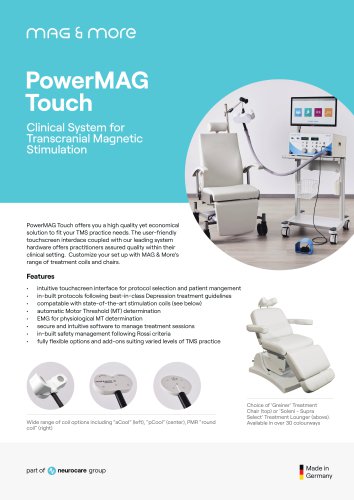 PowerMAG Touch
2 Pages
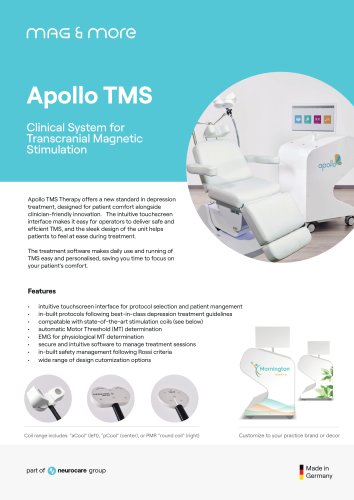 Apollo TMS
2 Pages
- Analysis software
- Monitoring software
- Recording software
- Treatment chair
- Electric treatment chair
- 3-section treatment chair
- Actigraphy system
- Neurocare Group transcranial stimulator
- Treatment chair on casters
- Height-adjustable treatment chair
- EEG system
- Magnetic transcranial magnetic stimulator
- Transcranial magnetic stimulator
- Treatment chair with armrests
- Wearable activity monitor
- Nervous system software
- Treatment chair with footrest
- Brain software
- Watch-type activity monitor
- TMS + rTMS transcranial magnetic stimulator