
- Catalogs
- Neurocare Group
- Transcranial Magnetic Stimulation TMS

Transcranial Magnetic Stimulation TMS
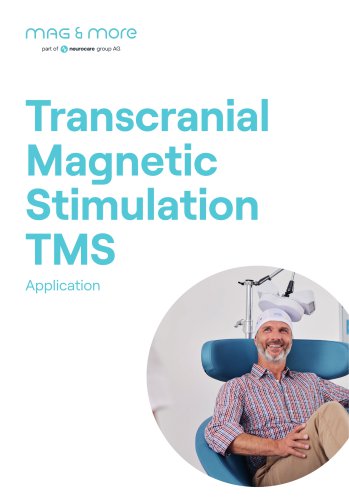
Transcranial Magnetic Stimulation TMS
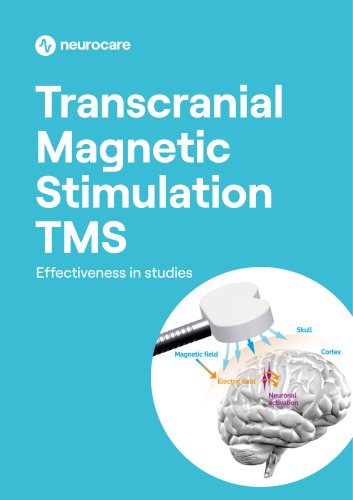
Transcranial Magnetic Stimulation (TMS) is a non-invasive therapy used for psychiatric and neurological conditions. It involves using a magnetic coil to adjust brain activity, which can be excitatory or inhibitory. TMS is known for minimal side effects and is suitable for outpatient treatment.
Applications of TMS
- Psychiatry: Effective for patients unresponsive to antidepressants, with a 66% response rate and 56% remission rate when combined with psychotherapy.
- Neurology and Rehabilitation: Assists in pain management and recovery of motor, speech, and cognitive functions, especially when combined with conventional therapies.
Specific Conditions Treated with TMS
- Depression: Increases activity in the left dorsolateral prefrontal cortex (DLPFC), beneficial for patients not responding to medication.
- Post-Traumatic Stress Disorder (PTSD): Reduces symptoms like anxiety and depression, improving quality of life.
- Obsessive-Compulsive Disorder (OCD): Induces long-term changes in brain activity, aiding chronic OCD patients.
- Neuropathic Pain: Alleviates pain and associated symptoms, enhancing lifestyle and sleep quality.
- Motor Disorders Post-Stroke: Facilitates new neural network formation, aiding recovery in post-acute and chronic stages.
- Multiple Sclerosis (MS): Reduces fatigue and pain, improving confidence in treatment efficacy.
Safety and Side Effects
TMS is non-convulsive, painless, and does not require anesthesia, making it a safe option with very few side effects.
Conclusion
TMS offers a promising alternative to traditional treatments for various conditions, with potential for faster and longer-lasting outcomes. Its non-invasive nature and minimal side effects make it a viable option for many patients.
Catalog excerpts
nriAG & more part of 2) neurocare group AG Transcranial Magnetic Stimulation TMS
Open the catalog to page 1
part of Q neirocare group AG Digital therapeutic techniques can help patients with a range of psychiatric disorders and neurorehabilitation problems like recovery from stroke and chronic pain. By measuring and modulating brain activity, neuromodulation has the potential to offer faster and longer-lasting outcomes than standard treatments, all with no to very minimal side-effects. MAG & More offers a range of TMS solutions to help you achieve better results in your therapeutic practice. We can support you with technology, equipment, advanced training, and further information. We also offer specific...
Open the catalog to page 2
4 What is TMS (Transcranial Magnetic Stimulation) 10 Post-Traumatic Stress Disorder 14 Motoric Disorders of the hand after a stroke 16 Safety and side effects 20 Apollo TMS Therapy System Imprint MAG & More GmbH • Machtlfinger Str. 13 • 81379 Munich • Germany +4 (89) 99829 2345 • [email protected] • www.magandmore.com Images: MAG & More GmbH, neurocare group AG, Copyright: neurocare group AG 2021 The use or publication of contained texts or pictures is strictly prohibited. Exceptions require the written approval of neurocare group AG.
Open the catalog to page 3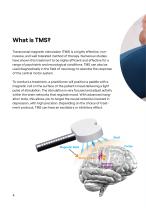
What is TMS? Transcranial magnetic stimulation (TMS) is a highly effective, noninvasive, and well tolerated method of therapy. Numerous studies have shown this treatment to be highly efficient and effective for a range of psychiatric and neurological conditions. TMS can also be used diagnostically in the field of neurology to examine the response of the central motor system. To conduct a treatment, a practitioner will position a paddle with a magnetic coil on the surface of the patient’s head delivering a light pulse of stimulation. The stimulation is very focused and adjust activity within the...
Open the catalog to page 4
advantages of other forms of treatments: • non-invasive, very few side effects • painless and safe • non-convulsive (not spasm inducing) • outpatient or inpatient treatment is possible • no anaesthesia or sedation required • specifically stimulates selected regions of the brain • t olerated well by patients
Open the catalog to page 5
part of O neurocare group AG
Open the catalog to page 6
TMS in Psychiatry TMS can help patients who have not responded to antidepressant medications or who struggle with its associated side effects. For those patients, TMS is a welcome, highly effective alternative. The effects of stimulation begin to show after a few treatments. Combining TMS with psychotherapy further improves the effectiveness of the treatment. Studies have shown a response rate of 66 % and remission rates of 56 %*. In many patients, the success has been sustainable in the long term. * Donse L. et al., 2017 TMS in neurology, rehabilitation and pain therapy TMS shows clear analgesic...
Open the catalog to page 7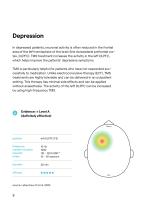
In depressed patients, neuronal activity is often reduced in the frontal area of the left hemisphere of the brain (the dorsolateral prefrontal cortex, DLPFC). TMS treatment increases the activity in the left DLPFC, which helps improve the patients' depressive symptoms. TMS is particularly helpful for patients who have not responded successfully to medication. Unlike electroconvulsive therapy (ECT), TMS treatments are highly tolerable and can be delivered in an outpatient setting. This therapy has minimal side effects and can be applied without anaesthesia. The activity of the left DLPFC can be...
Open the catalog to page 8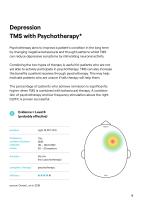
Depression TMS with Psychotherapy* Psychotherapy aims to improve a patient’s condition in the long term by changing negative behavioural and thought patterns whilst TMS can reduce depressive symptoms by stimulating neuronal activity. Combining the two types of therapy is useful for patients who are not yet able to actively participate in psychotherapy. TMS can also increase the benefits a patient receives through psychotherapy. This may help motivate patients who are unsure if talk therapy will help them. The percentage of patients who achieve remission is significantly higher when TMS is combined...
Open the catalog to page 9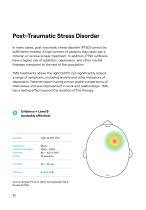
In many cases, post-traumatic stress disorder (PTSD) cannot be sufficiently treated. A high number of patients may never see a clinician or receive proper treatment. In addition, PTSD sufferers have a higher risk of addiction, depression, and other mental illnesses compared to the rest of the population. TMS treatments above the right DLPFC can significantly reduce a range of symptoms, including anxiety and other indicators of depression. Patients report having a more positive experience of themselves and see improvement in work and relationships. TMS has a lasting effect beyond the duration...
Open the catalog to page 10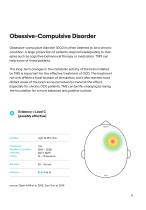
Obsessive-compulsive disorder (OCD) is often deemed to be a chronic condition. A large proportion of patients respond inadequately to therapies such as cognitive-behavioural therapy or medication. TMS can help some of these patients. The long-term changes in the metabolic activity of the brain initiated by TMS is important for the effective treatment of OCD. The treatment not only affects a focal location of stimulation, but it also reaches more distant areas of the brain as neural networks transmit the effect. Especially for chronic OCD patients, TMS can be life-changing by laying the foundation...
Open the catalog to page 11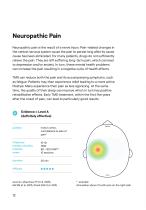
Neuropathic pain is the result of a nerve injury. Pain-related changes in the central nervous system cause the pain to persist long after its cause cause has been eliminated. For many patients, drugs do not sufficiently relieve the pain. They are left suffering long-term pain, which can lead to depression and/or anxiety. In turn, these mental health problems can increase the pain resulting in a negative cycle of health effects. TMS can reduce both the pain and its accompanying symptoms, such as fatigue. Patients may then experience relief leading to a more active lifestyle. Many experience their...
Open the catalog to page 12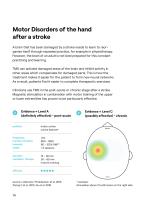
Motor Disorders of the hand after a stroke A brain that has been damaged by a stroke needs to learn to reorganise itself through repeated practice, for example in physiotherapy. However, the brain of an adult is not best prepared for this constant practicing and learning. TMS can activate damaged areas of the brain and inhibit activity in other areas which compensate for damaged parts. This is how the treatment makes it easier for the patient to form new neural networks. As a result, patients find it easier to complete therapeutic exercises. Clinicians use TMS in the post-acute or chronic stage...
Open the catalog to page 14All Neurocare Group catalogs and technical brochures
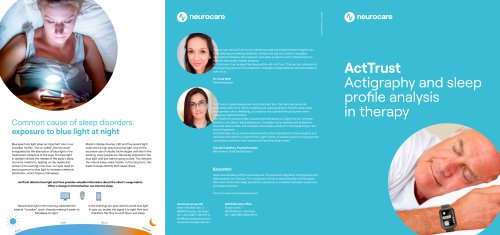 ActTrust
2 Pages
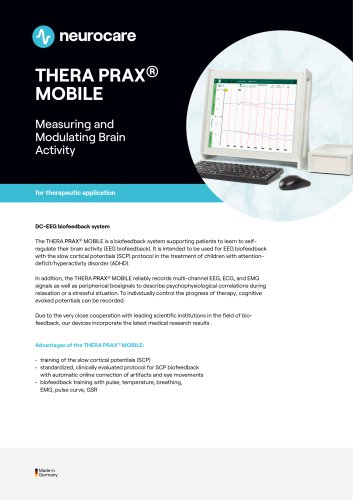 THERA PRAX® MOBILE
2 Pages
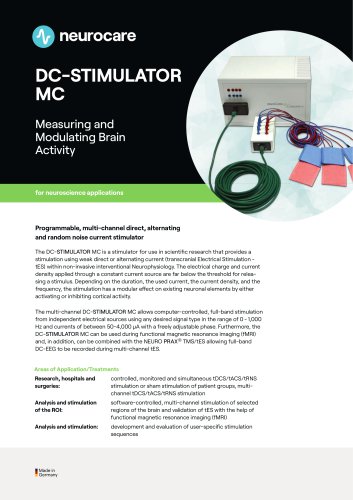 DC-STIMULATOR MC
2 Pages
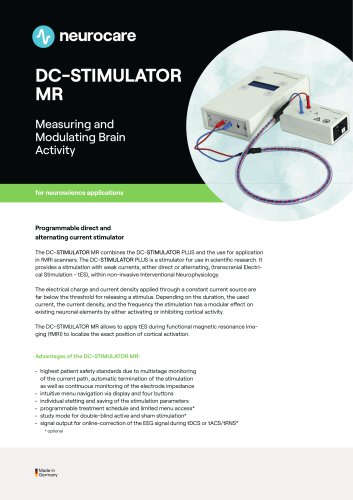 DC-STIMULATOR MR
2 Pages
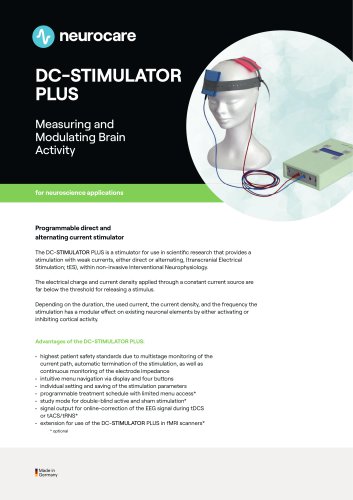 DC-STIMULATOR PLUS
2 Pages
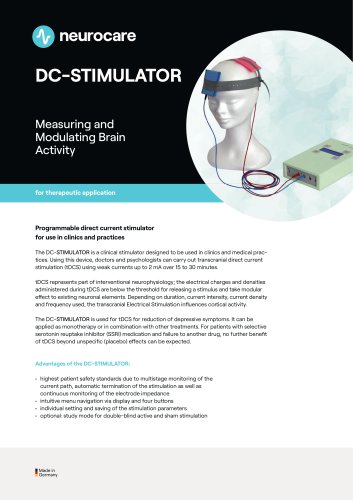 DC STIMULATOR
2 Pages
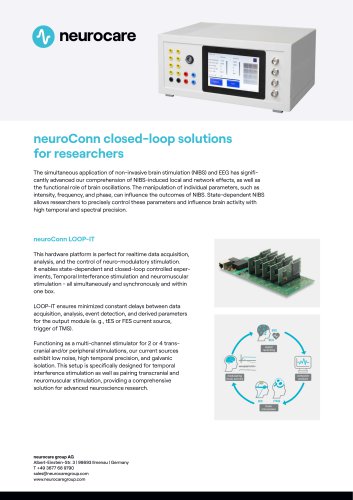 LOOP-IT
2 Pages
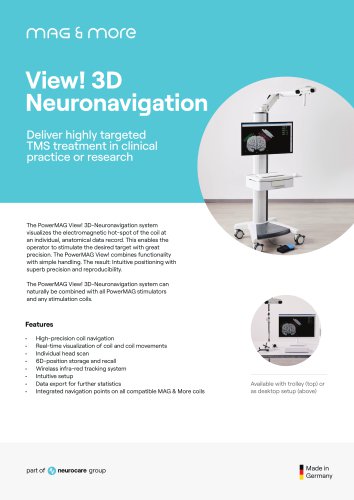 View! 3D Neuronavigation
2 Pages
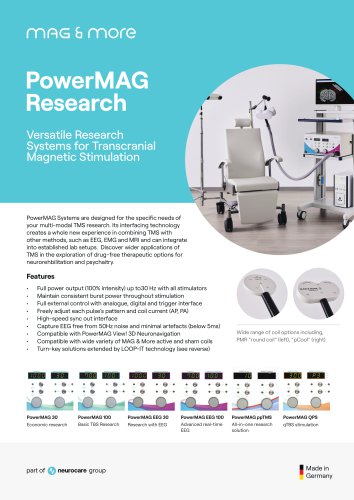 PowerMAG Research
2 Pages
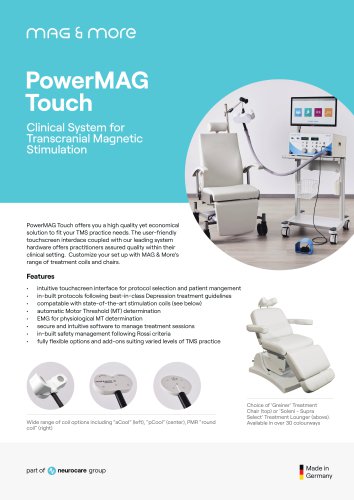 PowerMAG Touch
2 Pages
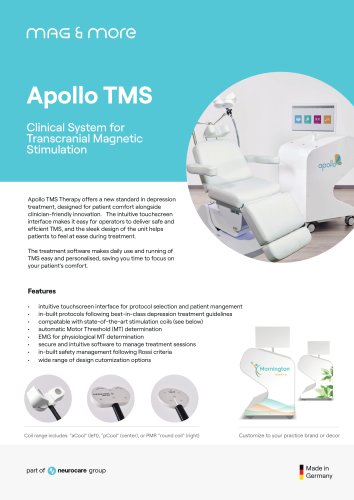 Apollo TMS
2 Pages
- Analysis software
- Monitoring software
- Recording software
- Treatment chair
- Electric treatment chair
- 3-section treatment chair
- Actigraphy system
- Neurocare Group transcranial stimulator
- Treatment chair on casters
- Height-adjustable treatment chair
- EEG system
- Magnetic transcranial magnetic stimulator
- Transcranial magnetic stimulator
- Treatment chair with armrests
- Wearable activity monitor
- Nervous system software
- Treatment chair with footrest
- Brain software
- Watch-type activity monitor
- TMS + rTMS transcranial magnetic stimulator