
- Catalogs
- Neuronetics
- NeuroStar TMS Therapy System Prescribing Information

NeuroStar TMS Therapy System Prescribing Information
NeuroStar TMS Therapy System Prescribing Information
The NeuroStar TMS Therapy System is a computerized device designed to treat Major Depressive Disorder (MDD) in adults unresponsive to antidepressants. It uses magnetic fields to induce electrical currents in the brain, potentially alleviating depression symptoms.
Prescribed by licensed physicians, the system is used in hospitals and clinics for adults with MDD who have not improved with prior treatments.
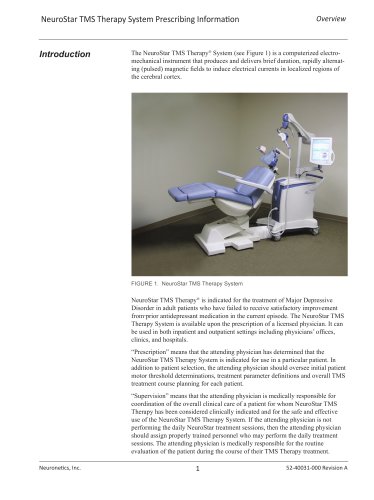
Available in single or multiple mobile console configurations, the system includes a treatment coil, head support, chair, and data management system.
Based on Faraday’s Law, it produces a magnetic field inducing an electrical current in the brain, with a peak strength of approximately 0.5 Tesla.
Clinical trials have shown the system's efficacy and safety, with significant benefits in remission rates compared to sham treatments and confirmed efficacy in real-world settings.
Contraindicated for patients with conductive or ferromagnetic metals near the treatment coil and those with implanted stimulators. Not recommended for patients with psychoses or psychiatric emergencies.
Patients should be monitored for worsening depression or suicidality. Caution is advised for patients with implants controlled by physiological signals.
The NeuroStar TMS Therapy System offers a non-invasive treatment option for MDD, with proven efficacy in trials. Careful patient selection and monitoring are essential for safety and effectiveness.
Patients with implants or metallic objects outside a 30 cm radius from the coil can receive therapy, but the coil must not be placed within 30 cm of these objects.
The risk of seizure is approximately 1 in 30,000 treatments. Caution is advised for patients with a history of seizures.
Safety and effectiveness have not been established for certain populations, including those with specific psychiatric or neurological conditions.
The system should not be used near flammable anesthetics or water. Proper patient positioning is crucial to avoid injuries.
Common adverse events include mild and transient application site pain and headaches. No cognitive or auditory function changes were observed.
The system must be operated by a licensed physician or trained professional, capable of managing seizures.
The system requires specific single-use supplies for each treatment session to ensure hygiene and effectiveness.
Connections must comply with IEC or ISO standards, and local laws may override these standards.
Patient data is securely stored, with access controlled by operator credentials. Data transferred via TMS TrakStar is protected by encryption.
Access requires a unique operator ID/password, ensuring only authorized personnel can operate the system.
Catalog excerpts

Volume 1: General Information NeuroStar TMS Therapy System Prescribing Information The NeuroStar TMS Therapy® System (see Figure 1) is a computerized electromechanical instrument that produces and delivers brief duration, rapidly alternating (pulsed) magnetic fields to induce electrical currents in localized regions of the cerebral cortex. Figure 1. NeuroStar TMS Therapy System NeuroStar TMS Therapy® is indicated for the treatment of Major Depressive Disorder in adult patients who have failed to receive satisfactory improvement from prior antidepressant medication in the current episode. The NeuroStar TMS Therapy System is available upon the prescription of a licensed physician. It can be used in both inpatient and outpatient settings including physicians’ offices, clinics, and hospitals. “Prescription” means that the attending physician has determined that the NeuroStar TMS Therapy System is indicated for use in a particular patient. In addition to patient selection, the attending physician should oversee initial patient motor threshold determinations, treatment parameter definitions and overall TMS treatment course planning for each patient. “Supervision” means that the attending physician is medically responsible for coordination of the overall clinical care of a patient for whom NeuroStar TMS Therapy has been considered clinically indicated and for the safe and effective use of the NeuroStar TMS Therapy System. If the attending physician is not performing the daily NeuroStar treatment sessions, then the attending physician should assign properly trained personnel who may perform the daily treatment sessions. The attending physician is medically responsible for the routine evaluation of the patient during the course of their TMS Therapy treatment. Neuronetics, Inc.
Open the catalog to page 1
NeuroStar TMS Therapy System Prescribing Information The NeuroStar TMS Therapy System is offered in the following configurations: ●● Single mobile console configuration: mobile console, treatment coil, head support system, treatment chair, and TMS TrakStar practice data management system. Multiple mobile consoles/TMS TrakStar system configurations to address the needs of facilities with large patient populations. Since the NeuroStar TMS Therapy System produces a time varying magnetic field, its intended effect derives fundamentally from Faraday’s Law, which asserts that a time-varying magnetic...
Open the catalog to page 2
NeuroStar TMS Therapy System Prescribing Information In clinical trials, medication adequacy was determined using the Antidepressant Treatment History Form (ATHF), or similar validated method (Study 19-50001), which identified those medications given at or above the minimal effective dose and duration as defined in the product labeling. Failure of benefit was defined as no more than a minimal clinical response to the antidepressant medication as assessed by the clinician. In cases where patients were untreated or insufficiently treated in the current episode, the medication history from the most...
Open the catalog to page 3
NeuroStar TMS Therapy System Prescribing Information TMS: 5.0%, P=0. 0173) was observed in the ITT study population (N=197). An adjusted odds ratio of achieving remission with active TMS was 4.05 (95% confidence interval (CI), 1.28-12.83) as compared to sham TMS. The baseline to endpoint change score outcome using the HAMD24 also favored active TMS to sham treatment (-2.11, 95% CI: -4.30, 0.08; P=0.0588). Baseline to endpoint outcomes for patients treated with active TMS were statistically significant as compared to sham treatment as measured using the MADRS (P=0.0136), CGI-S (P=0.0181) and the...
Open the catalog to page 4
NeuroStar TMS Therapy System Prescribing Information Study 19-50001 evaluated the durability of acute benefit with NeuroStar TMS Therapy during 12 month follow up in patients maintained on antidepressant medication and/or with periodic TMS reintroduction for symptom worsening (Neuronetics data on file). Overall, 36.2% of patients required re-treatment with TMS over 12 months. Amongst remitters, 29.5% of patients experienced relapse through 12 months. The NeuroStar TMS Therapy System is contraindicated for use in some situations as identified below and further described in Section 7 of the User...
Open the catalog to page 5
NeuroStar TMS Therapy System Prescribing Information All operators must consider the following warnings before proceeding to treatment. NeuroStar TMS Therapy has not been evaluated in patients with psychoses or with psychiatric emergencies where a rapid clinical response is needed, such as marked physical deterioration, catatonia, or immediate suicide risk. Use of NeuroStar TMS Therapy in the treatment of these patients is not recommended since rapid onset of effect in these high-risk populations has not been established. Following acute treatment with NeuroStar TMS Therapy, patients will need...
Open the catalog to page 6
NeuroStar TMS Therapy System Prescribing Information Implants Not Controlled by Physiologic Signals Patients who have implanted devices or metallic objects located in areas outside the 30 cm distance from the treatment coil may receive NeuroStar TMS Therapy. However, care must be taken by the NeuroStar TMS Therapy System operator to ensure that the treatment coil is never placed within 30 cm of these implants. Otherwise, serious injury could result. (Examples of these devices include staples and implanted insulin pumps.) Wearable or Removable Devices or Objects If patients have removable devices...
Open the catalog to page 7
NeuroStar TMS Therapy System Prescribing Information manual supplement). Treatment with stimulation parameters that lie outside of these guidelines is not recommended. TMS should be applied to the left dorsolateral prefrontal cortex using the coil placement methods described in the User Manual. Failure to follow these procedures may increase the risk of seizure. Be alert for signs of an imminent seizure and terminate the treatment session if those signs appear. If a medication that may alter seizure threshold has been taken since the last treatment session, the motor threshold determination should...
Open the catalog to page 8