

NeuroSENSE ®

NeuroSENSE ®
The NeuroSENSE monitor by NeuroWave Systems Inc. is a bilateral hemisphere monitor for anesthesia, utilizing WAVCNS technology for EEG quantification. It is available in markets recognizing the CE mark and in Canada.
EEG signals have been used since the 1930s for monitoring anesthetic effects. Reliable quantification became feasible in the 1990s with bispectral analysis and indexes like the Bispectral Index.
The University of British Columbia highlighted the need for a deterministic EEG analysis approach for closed-loop anesthesia systems to avoid delays and inaccuracies from interpretative feedback sensors.
WAVCNS uses wavelet analysis to track EEG changes in real-time, focusing on gamma frequencies. It compares EEG segments to reference PDFs to produce a bounded index reflecting cortical activity, allowing rapid detection of patient state changes.
The scale ranges from 0 to 100, with 40-60 optimal for anesthesia maintenance. Levels below 40 indicate deep anesthesia, while levels above 60 suggest increased awareness risk. It correlates highly with the BIS index in clinical studies.
WAVCNS provides a delay-free response due to deterministic computation, beneficial during rapid state changes like anesthesia induction.
WAVCNS technology offers a reliable, real-time method for monitoring brain activity during anesthesia, enhancing patient safety and optimizing drug delivery.
WAVCNS outperforms the BIS index in induction and emergence phases, providing delay-free per-second quantification. A study showed 95% of patients lost consciousness under a WAVCNS level of 72, with higher prediction probabilities than BIS.
WAVCNS exhibits consistent transient behavior during cortical changes, unlike the BIS index, allowing for more accurate pharmacodynamic modeling and closed-loop anesthesia delivery.
The NeuroSENSE monitor offers bilateral monitoring, automated artifact detection, and user-accessible case data, designed for electrically hostile environments, providing a robust platform for cortical monitoring during anesthesia.
WAVCNS technology offers a deterministic approach to EEG quantification, characterized by linear and time-invariant transitory behavior, representing a technological advancement in brain function monitoring during anesthesia.
Catalog excerpts

NeuroSENSE® Monitor with WAVCNS Cortical Quantifier: A Deterministic Approach to EEG Analysis by Stéphane Bibian and Tatjana Zikov NeuroWave Systems Inc., Cleveland Heights, OH, USA ABSTRACT – Brain function monitoring has been shown to provide additional insight for the assessment and optimization of the anesthetic drugs administration. Since 2003, NeuroWave Systems Inc. has been developing the NeuroSENSE®, a bilateral hemisphere monitor of patient’s brain activity for the anesthesia specialty. The NeuroSENSE incorporates the WAVCNS technology for automated EEG quantification. The WAVCNS (Wavelet-based Anesthetic Value for Central Nervous System) utilizes wavelet analysis of the normalized EEG signal in the gamma frequency band. This EEG quantifier was intentionally developed for future use in closed-loop anesthesia delivery systems. As such, the WAVCNS method employs a deterministic algorithm, which yields a delay-free, linear and time-invariant quantifier of cortical activity. The WAVCNS algorithm has been fully disclosed in [26]. This white paper provides interested readers with more information about the WAVCNS technology, the NeuroSENSE monitor and its use. ith the discovery of the effect of cyclopropane on brainwaves in the late 1930’s came the realization that electroencephalogram (EEG) signals could be used effectively to monitor the effect of anesthetic drugs. Since then, unlocking the hidden message behind the EEG waveforms has been the subject of intense research. Progress in the use of EEG to quantify anesthetic drug effect happened rapidly, with the first EEG-based closedloop delivery system developed and tested in the early 1950’s by Bickford and his colleagues. Yet, due to a simplistic burst suppression detection mechanism, the burgeoning technology did not expand beyond the Mayo Clinic and remained a technological curiosity. For the following 20 years, researchers used different time series analysis techniques to determine anesthetic depth. But none of these techniques could be used reliably across patients and anesthetic drug regimen to provide a viable quantifier. NeuroSENSE is available for sale in markets where CE mark is recognized and
Open the catalog to page 1
In the mid-1970’s, progress in computing science enabled researchers to use the spectral analysis in order to extract frequency information from the EEG signal. This opened a new era for the use of EEG in anesthesia, which culminated with the development of the Spectral Edge Frequency and Median Edge Frequency indexes. Yet, once again, repeatability of these measures was limited between patients and across anesthetic regimen. It is only in the early 1990’s that changes in both time and frequency content of the EEG signals were found to be complementary. For instance, with increasing drug concentration,...
Open the catalog to page 2
UBC group thus concluded that a better suited cortical quantifier should be based on a deterministic, instead of interpretative, approach to EEG analysis, where multiple features and their combination into a composite index should be avoided. In this context, a deterministic approach refers to a method of computation that always produces the same result for a given EEG segment. Therefore, for a given EEG segment, the output of a deterministic computation method is fully predictable. The WAVCNS Cortical Quantifier The major finding of the UBC group was that the wavelet information associated with...
Open the catalog to page 3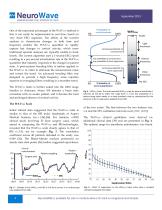
One of the important advantages of the WAVCNS method is that it can easily be implemented in real time, based on very short EEG segments. The ability of the wavelet analysis to characterize changes in both time and frequency enables the WAVCNS quantifier to rapidly capture fast changes in cortical activity, which more traditional spectral analyses are typically unable to track timely. The current algorithm uses a 1-second EEG epoch resulting in a per-second actualization rate of the WAVCNS quantifier that instantly responds to the changes in patient state. A post-analysis trending filter is further...
Open the catalog to page 4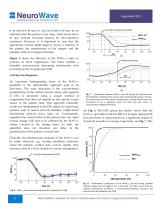
to be between 40 and 60. Any level below 40 may be an indication that the patient is too deep, while levels above 60 may indicate increased chances for intra-operative awareness. However, it is important to note that the appropriate cortical depth target is always a function of the patient, the requirements of the surgery and the intensity of the next surgical stimulus. Figure 5 shows the behavior of the WAVCNS index in presence of burst suppression. The index exhibits a desirable, monotonously decreasing characteristic with increasing levels of suppression [40]. Patient Reacting TIME [s] (b)...
Open the catalog to page 5
result is a direct consequence of a delay-free per-second quantification of the cortical state. in, e.g., pharmacodynamic (PD) modeling or closed-loop anesthesia delivery. With an aim to further explore the rapid quantification of the cortical state during induction, the UBC group conducted a study designed to assess the performance of the WAVCNS for determining whether a patient has lost consciousness after a standard bolus-based propofol induction. It was found that 95% of patients had lost consciousness under a WAVCNS level of 72 [50]. The PK prediction probabilities were 0.975 for the WAV...
Open the catalog to page 6
identification data. This suggests that the equilibration time constant between the plasma concentration of propofol and the physiological effect is much faster than initially anticipated [52]. In addition to PD modeling, the WAVCNS quantifier is also a good candidate for use within a closed-loop framework. The fact that its dynamic behavior is linear and timeinvariant (unlike other depth-of-anesthesia monitors such as BIS and M-Entropy [23]) allows for development of reliable control designs with optimal performance [20],[21]. This also allows for characterization of the uncertainty due to inter-patient...
Open the catalog to page 7
and with good signal quality, the level of agreement between the WAVCNS indexes for the left and right cerebral hemispheres is typically within ±8 units with a negligible bias [41], in comparison to ±15 units for the BIS index. Furthermore, if we consider only sustained differences in anesthetic depth (at least 30s in duration), only 2.22% of WAVCNS readings suggested different depths as compared to 8.03% for BIS. In [51], we have assessed the bilateral reproducibility of the WAVCNS and BIS (v.3.4) specifically during anesthesia induction in 57 patients. The 95% limits of agreement, as defined...
Open the catalog to page 8All NeuroWave catalogs and technical brochures
 NeuroSENSE® NS-701 Monitor
8 Pages
- Patient monitor
- Disposable electrode
- Compact patient monitor
- Electrophysiological exploration electrode
- Patient monitor with touchscreen
- Tabletop patient monitor
- EEG electrode
- Module
- Anesthesia patient monitor
- Telemonitoring module
- Easy-to-use patient monitor
- Patient monitor on casters
- USB module
- EEG patient monitor
- EMG patient monitor
- EEG module
- EMG module