

KEMIS

KEMIS
Kemis® is a minimally invasive, non-endoscopic surgical technique for carpal tunnel release surgery. It combines the safety of open release procedures with the clinical advantages of endoscopic surgery.
Instrument Design
The Kemis® knife features an ergonomic design to minimize the risk of injury to anatomical parts during insertion. The blade is integrated into the knife design to prevent damage to surrounding tissues, ensuring a secure cut of the ligament while preserving the palmar aponeurosis.
Technique Advantages
This technique is simple, reliable, and has a minimal learning curve with reproducible results. It allows immediate visualization of the ligament and distal division of the median nerve, with visual monitoring of anatomical variations. The blade avoids contact with surrounding anatomical parts, reducing the risk of unintentional injury.
Cost-Effectiveness
The Kemis® knife is cost-optimized, single-use, and sterile, eliminating the need for an endoscopy platform or additional equipment. It allows for quick implementation and reduces operating time to 5-10 minutes.
Environmental Impact
The single-use design reduces the need for multiple sterilizations, optimizing the carbon footprint. The lightweight knife (19.5g) also reduces recycling costs.
Postoperative Care
The procedure involves a short 1-2 cm incision, with no damage to the heel of the hand. Recovery time is similar to endoscopic surgery, approximately 21 days.
Surgical Technique
Step 1: Anatomical Landmarks
Incision is made to expose the distal part of the transverse carpal ligament and the thenar eminence. Two lines are drawn to mark the incision location.
Step 2: Exposure of the Transverse Carpal Ligament
The palmar aponeurosis is exposed and incised, and the subfascial adipose tissue is lifted to expose the distal lip of the ligament.
Step 3: Cutting the Transverse Carpal Ligament
The Kemis® knife is placed on the distal lip of the ligament, and regular pressure is applied to cut the ligament.
Step 4: Cautions and Closing
Careful insertion of the knife is required, and the incision is closed with stitches. An adhesive dressing is applied, and finger movement is encouraged.
References
The document cites various studies and articles supporting the technique and its benefits.
Catalog excerpts

KEMIS ® CARPA L TUNNEL RELE ASE SURGER Y Minimally invasive, non-endoscopic surgical technique Cutting of the transverse carpal ligament via retrograde route
Open the catalog to page 1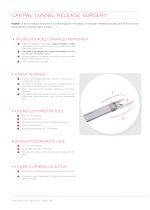
CARPAL TUNNEL RELEASE SURGERY Kemis® is an innovative instrument combining both the safety of the open release procedure and the clinical advantages of endoscopic surgery (1,2). AN ERGONOMICALL ENHANCED INSTRUMENT Y Ergonomic shape of the distal part, upper1 and lower 2 curves designed for reducing risks of lesion of the anatomical parts when inserting the knife. The blade is an integral part of the knife design3 and does not damage surrounding tissues. Secured cutting of the ligament reducing the risks of median nerve and flexor tendons lesion. Palmar aponeurosis preserved. A SAFER TECHNIQUE...
Open the catalog to page 2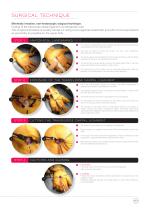
SURGICAL TECHNIQUE Minimally invasive, non-endoscopic surgical technique. Cutting of the transverse carpal ligament via retrograde route. This surgical procedure is usually carried out using a loco-regional anaesthetic and with a tourniquet placed as proximally as possible on the upper limb. STEP 1 The incision is performed so as to expose the distal part of the transverse carpal ligament and the thenar eminence. Two lines are drawn to mark the incision (1-2 cm). Their intersection determines its exact location. The first line goes from the distal fold of the thenar eminence, with the thumb extended,...
Open the catalog to page 3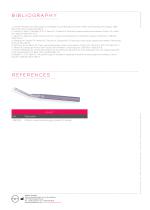
1. Lee WP, Strickland JW. Safe carpal tunnel release via a limited palmar incision. Plastic and Reconstructive Surgery. 1998 Feb;101(2):418–24–discussion425–6. 2. Cellocco P, Rossi C, Boustany El S, Di Tanna GL, Costanzo G. Minimally invasive carpal tunnel release. Orthop. Clin. North Am. 2009 Oct;40(4):441–8–vii. 3. Jebson PJ, Agee JM. Carpal tunnel syndrome: unusual contraindications to endoscopic release. Arthroscopy. 1996 Dec; 12(6):749–51. 4. Vasiliadis HS, Xenakis TA, Mitsionis G, Paschos N, Georgoulis A. Endoscopic versus open carpal tunnel release. Arthroscopy. 2010 Jan;26(1):26–33. 5....
Open the catalog to page 4All Newclip Technics catalogs and technical brochures
 INITIAL C™
12 Pages
 PERIACTIV
3 Pages
 ACTIVMOTION LIGAMENTO
4 Pages
 ALIANS PROXIMAL HUMERUS
8 Pages
 ALIANS CLAVICLE
8 Pages
 Initial F™ - Lapidus kit
14 Pages
 Single Use kit
12 Pages
 ACTIVMOTION SIZE 2
4 Pages
 NATIV
NATIV2 Pages
 ATLANTIC OW
6 Pages
 ATLANTIC CW
6 Pages
 FOOTMOTION PLATING SYSTEM
8 Pages
 FLATFOOT
2 Pages
 ACTIVMOTION
8 Pages
 Activ Ankle
8 Pages
 FO OT M OT I O N
8 Pages
 ALIANS ULNA
8 Pages
 SURGICAL TECHNIQUE
2 Pages
 ALIANS MIDSHAFT
8 Pages
 ALIANS DISTAL RADIUS
8 Pages
 FOREFOOT
8 Pages
 INITIAL R
8 Pages
 ALIANS ELBOW
8 Pages


- Bone plate
- Compression plate
- Metallic compression plate
- Locking compression plate
- Orthopedic surgery instrument kit
- Distal compression plate
- Compression bone screw
- Metallic compression bone screw
- Proximal compression plate
- Forearm compression plate
- Lateral compression plate
- Medial compression plate
- Tibia compression plate
- Humerus compression plate
- Radius compression plate
- Cannulated compression bone screw
- Arthrodesis plate
- Non-locking compression plate
- Sterile instrument kit
- Metallic arthrodesis plate