
- Catalogs
- Nexxt Spine
- NEXXT MATRIXX® TLIF / TLIF Oblique Interbodies

NEXXT MATRIXX® TLIF / TLIF Oblique Interbodies

NEXXT MATRIXX® TLIF / TLIF Oblique Interbodies
Exposure of Operative Level(s): Affected levels are identified using fluoroscopy and palpation, with instruments used to access the operative site and ensure adequate tissue retraction.
Discectomy: A complete discectomy is performed using instruments like pituitaries and curettes. Distraction may be necessary if there is significant disc space collapse.
Distraction: Techniques such as pedicle screw distraction and paddle distractors are employed to aid decompression and implant insertion.
Decompression: Osteotomes and rongeurs remove sections of the lamina and facet to create a bony window for disc space access.
Endplate Preparation: An annulotomy is performed, and disc material is removed to expose bleeding bone, optimizing implant contact.
Implant Size Selection: Trials determine the appropriate implant size based on intervertebral space dimensions, with fluoroscopy confirming fit.
Implant Preparation and Insertion: The implant is prepared and inserted using alignment keys and threaded shaft components, with graft material packed into the implant's cavity.
Insert and Rotate Technique: This optional technique allows for less neural retraction by rotating the implant in-situ to restore disc height and lordosis.
Implant Removal: The implant is removed using an inserter or removal instrument, with distraction re-applied if necessary.
Device Description: Nexxt Matrixx® implants are titanium alloy spacers with a roughened surface and geometric lattices, available in various sizes and configurations for spinal stabilization.
Indications: Devices are indicated for lumbar intervertebral fusion at one or two contiguous levels in patients with degenerative disc disease or degenerative scoliosis.
Contraindications: Include infection, pregnancy, metabolic disorders, and other conditions that may interfere with spinal surgery or implant effectiveness.
Warnings and Precautions: Mixing dissimilar metals is discouraged, and only experienced surgeons should perform the implantation.
Specifications and Usage Guidelines: Nexxt Matrixx® implants provide temporary stabilization for spinal fusion and are single-use only. Proper handling and storage are crucial.
Considerations for Implantation: Success depends on selecting the appropriate size, shape, and design. Supplemental internal fixation is necessary as the device is not intended to be the sole means of spinal support.
Risks and Precautions: Potential risks include device component breakage, loss of fixation, non-union, vertebral fracture, and possible neurologic, vascular, or visceral injury.
Product Numbers and Descriptions: The document lists various product numbers for Nexxt Matrixx® TLIF and TLIF Oblique implants, detailing dimensions and configurations.
Catalog excerpts

Surgical Technique Guide 70-042, Rev. B R NEXXT MATRIXX® TLIF / TLIF Oblique Interbodies
Open the catalog to page 1
Nexxt Matrixx® TLIF / TLIF Oblique Interbodies Patient Positioning Exposure of Operative Level(s) Discectomy Distraction Decompression Endplate Preparation Implant Size Selection Graft Material Placement Implant Preparation and Insertion Insert and Rotate Technique Implant Removal Device Description Indications/Contraindications Warnings and Precautions Nexxt Matrixx® Lumbar Implants Nexxt Matrixx® Lumbar Instruments Caution: Federal law (USA) restricts this device to sale and use by, or on the order of, a physician.
Open the catalog to page 2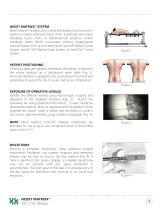
NEXXT MATRIXX® SYSTEM Nexxt Matrixx® straight and curved Interbodies may be used in posterior lumbar interbody fusion (PLIF), transforaminal lumbar interbody fusion (TLIF), or transforaminal posterior lumbar interbody fusion (tPLIF) procedures utilizing supplemental internal fixation such as the Nexxt Spine Inertia® Pedicle Screw System, Inertia® MIS Pedicle Screw System, or Facet Fixx® Screw System. PATIENT POSITIONING Following adequate general anesthesia, the patient is placed in the prone position on a radiolucent spine table (Fig. 1). Particular attention is applied to the positioning of...
Open the catalog to page 3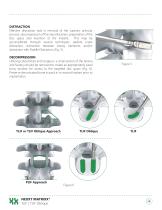
DISTRACTION Effective distraction aids in removal of the superior articular process, decompression of the neuroforamen, preparation of the disc space and insertion of the Implant. This may be accomplished through several techniques: pedicle screw distraction, distraction between boney elements, and/or distraction with Paddle Distractors (Fig. 5). DECOMPRESSION Utilizing osteotomes and rongeurs, a small section of the lamina and facet(s) should be removed to create an appropriately sized bony window for access to the targeted disc space (Fig. 6). Preserve decorticated bone to pack in or around...
Open the catalog to page 4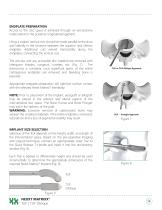
ENDPLATE PREPARATION Access to the disc space is achieved through an annulotomy made lateral to the posterior longitudinal ligament. Using a scalpel, vertical cuts should be made parallel to the dura and laterally in the foramen between the superior and inferior endplate. Additional cuts extend horizontally along the endplates, connecting the vertical cuts. The annulus and any accessible disc material are removed with interspace shavers, rongeurs, curettes, etc. (Fig. 7). The discectomy is complete once superficial layers of the entire cartilaginous endplates are removed and bleeding bone is...
Open the catalog to page 5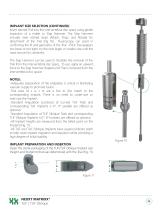
IMPLANT SIZE SELECTION (CONTINUED) Insert desired Trial into the intervertebral disc space using gentle impaction of a mallet or Slap Hammer. The Slap Hammer includes laser etched steps (Attach, Drop, and Rotate) for attachment of the Trial (Fig 10). Fluoroscopy can assist in confirming the fit and geometry of the Trial. If the Trial appears too loose or too tight, try the next larger or smaller size until the most secure fit is achieved. The Slap Hammer can be used to facilitate the removal of the Trial from the intervertebral disc space. To use, apply an upward force to the Slap Hammer. Repeat...
Open the catalog to page 6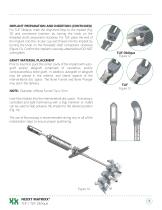
IMPLANT PREPARATION AND INSERTION (CONTINUED) For TLIF Oblique, mate the Alignment Keys to the implant (Fig. 12) and commence insertion by turning the knob on the threaded shaft component clockwise. For TLIF, place the end of the Implant into the circular cup and thread into the Implant by turning the knob on the threaded shaft component clockwise (Figure 13). Confirm the implant is securely attached but DO NOT overtighten. GRAFT MATERIAL PLACEMENT Prior to insertion, pack the center cavity of the implant with autograft and/or allograft comprised of cancellous and/or corticocancellous bone graft....
Open the catalog to page 7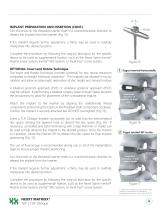
IMPLANT PREPARATION AND INSERTION (CONT.) Turn the knob on the threaded inserter shaft in a counterclockwise direction to release the implant from the Inserter (Fig. 15). If the Implant requires further adjustment, a Tamp may be used to carefully manipulate into desired position. Complete the procedure by following the surgical technique for the specific device to be used as supplemental fixation, such as the Nexxt Spine Inertia® Pedicle Screw System, Inertia® MIS System, or Facet Fixx® Screw System. OPTIONAL: Insert and Rotate Technique The Insert and Rotate Technique provides potential for...
Open the catalog to page 8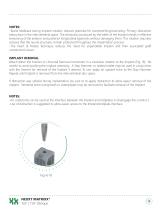
NOTES: -Tactile feedback during Implant rotation reduces potential for overstretching/oversizing. Primary distraction takes place in the intervertebral space. The distraction produced by the width of the Implant results in effective tensioning of the anterior and posterior longitudinal ligaments without damaging them. This rotation step also ensures that the neural structures remain protected throughout the implantation process. -The Insert & Rotate Technique reduces the need for expandable Implant and their associated graft containment issues. IMPLANT REMOVAL Attach either the Inserter or Universal...
Open the catalog to page 9
DEVICE DESCRIPTION Nexxt Matrixx® is a collection of additively manufactured spacers for cervical, lumbar/lumbosacral and thoracolumbar implantation. The basic shape of these implants is a structural column to provide surgical stabilization of the spine. Each device comprises an external structural frame having a roughened surface (~7µm). The intervening geometric lattices have pores 300-700µm. The inferior/superior aspects of the Nexxt Matrixx® open devices incorporate a large vertical cavity which can be packed with bone graft material. The inferior/superior aspects of the Nexxt Matrixx® solid...
Open the catalog to page 10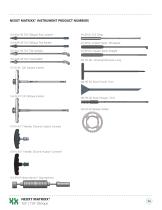
NEXXT MATRIXX® INSTRUMENT PRODUCT NUMBERS I54-XXL-XX TLIF Oblique Trial Lordotic* I54-XXP-XX TLIF Oblique Trial Parallel I21-09-01, Implant Tamp, 90 degree I56-XXL-XX TLIF Trial Lordotic I21-09-02, Implant Tamp, Straight I56-XXP-XX TLIF Trial Parallel* I35-50-01L, Universal Remover, Long I15-01-01, TLIF, Implant Inserter I54-01-01 TLIF Oblique Inserter I10-01-43 T-Handle, Silicone, Hudson Connect I10-01-34 T-Handle, Silicone, Hudson Connect* I54-20-01 Nexxt Matrixx® Slap Hammer NEXXT MATRIXX® TLIF / TLIF Oblique
Open the catalog to page 11All Nexxt Spine catalogs and technical brochures
 FACET FIXX®
3 Pages
 INERTIA® Deformity Portfolio
5 Pages
 HONOUR® PEEK Implant System
3 Pages
 HONOUR® ORB
8 Pages
 Saxxony®
12 Pages
 INERTIA®
3 Pages
 NEXXT MATRIXX®
3 Pages


- Interbody fusion cage
- PEEK interbody fusion cage
- Anterior interbody fusion cage
- Lumbar interbody fusion cage
- Spinal stabilization system
- Posterior spinal osteosynthesis unit
- Adult spinal osteosynthesis unit
- Cervical interbody fusion cage
- Titanium interbody fusion cage
- Posterior interbody fusion cage
- Metallic pedicle screw
- Transforaminal interbody fusion cage
- Polyaxial pedicle screw
- Thoraco-lumbar osteosynthesis unit
- Cannulated pedicle screw