
- Catalogs
- Nihon Kohden Europe
- esCCO Information Volume 1


esCCO Information Volume 1

esCCO Information Volume 1
Nihon Kohden introduces a novel non-invasive technology, esCCO, to measure continuous cardiac output using Pulse Wave Transit Time (PWTT) derived from ECG and SpO2 signals. This technology aims to enhance quality of care by providing volumetric information across all care levels.
Principle of esCCO
The esCCO technology calculates cardiac output using the formula CO = SV × HR = K × (α × PWTT + β) × HR, where SV is stroke volume, HR is heart rate, and PWTT is Pulse Wave Transit Time. This method shows a better correlation between stroke volume and PWTT compared to traditional pulse pressure methods.
Performance and Validation
Studies, including a multi-center study in 2009, have shown that esCCO correlates highly with cardiac output measurements obtained through the thermodilution technique. This validation supports its practical application in clinical settings.
Non-Invasive Calibration
esCCO offers non-invasive calibration by using patient information such as age, gender, height, weight, and an initial NIBP measurement. It can also be calibrated using cardiac output values from other devices like pulmonary artery catheters, ensuring reliable tracking of cardiac output changes.
Cost-Effectiveness
esCCO is integrated into the Nihon Kohden Patient Monitoring Series, providing an economical solution without additional running costs for accessories.
Figures and Data
Figures in the document illustrate the correlation between esCCO and traditional cardiac output measurement methods, demonstrating its accuracy and reliability in various clinical scenarios, including post-liver transplantation monitoring.
Conclusion
esCCO represents a significant advancement in non-invasive cardiac output monitoring, offering enhanced hemodynamic monitoring capabilities without extra costs, making it a valuable tool for improving patient care and safety.
Catalog excerpts
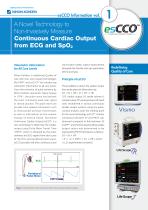
A Novel Technology to Non-Invasively Measure Continuous Cardiac Output from ECG and SpO2 Volumetric Information for All Care Levels non-invasive cardiac output measurement alongside the familiar vital sign parameters of ECG and SpO2. Nihon Kohden is redefining Quality of Care with new, non-invasive technologies like PWTT and esCCO TM by introducing volumetric information to all care levels. The possibility to derive the cardiac output Since the invention of pulse oximetry by from pulse pressure information by, Nihon Kohden researcher Takuo Aoyagi , in 1974 1) the pulse wave has become [CO: cardiac output; SV: stroke volume; K: the most commonly used vital signal constant value; PP: pulse pressure; HR: heart in clinical practice. The pulse wave can rate]established in various continuous provide time related information such cardiac output systems using the pulse- as intravascular pressure transmission contour-analysis, built the starting point as well as information on the volume for the novel technology esCCOTM. A better cha nge of art e rial blood. Estimated correlation between SV and PWTT was Continuous Cardiac Output (esCCO)is a observed compared to that between SV new technology to determine the cardiac , and PP2) and the formula providing cardiac output using Pulse Wave Transit Time output values was determined to be (PWTT)which is obtained by the pulse expressed by PWTT-Information as follows; oximetry and ECG-signals from each cycle of the ECG and peripheral pulse wave. esCCO provides real-time, continuous and CO = SV × HR =K× (α × PWTT + β) HR = esCCO × [α,β: experimental constants] Figure 1 : Pulse Wave Transit Time derived from ECG and pulse oximetry
Open the catalog to page 1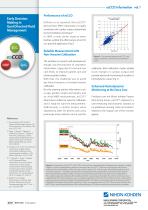
Early Decision Goal Directed Fluid History of blood gas analysis. VII Pulse oximetry. J Clin Monit, 1987 2) Sugo Y, Ukawa T,Takeda S, Ishihara H, Kazama T,Takeda Z. A Novel Continuous Cardiac Output Monitor Based on Pulse Wave Transit Time. Conf Proc continuous cardiac output trend solely utilizing routine cardiovascular monitors. J Clin esCCO ResearchTeam. continuous cardiac output measurement method based combined with pulse wave transit time. Eur J Anaesthesiol dysfunction in cirrhosis. Best Practice & Research Clinical Ishihara et al. reported that esCCO™ derived from PWTT-lnformation is...
Open the catalog to page 2All Nihon Kohden Europe catalogs and technical brochures
 Neurofax (EEG-1200)
4 Pages
 CPR assist (CPR-1100)
4 Pages
 cardiolife EMS (EMS-1052)
8 Pages
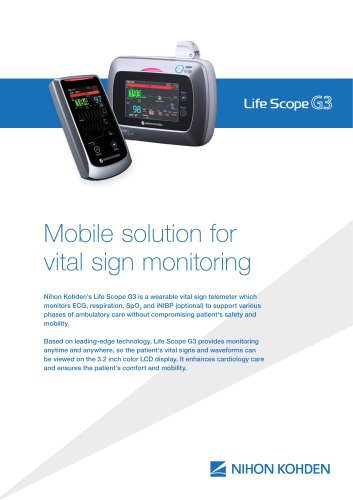 Life Scope G3
4 Pages
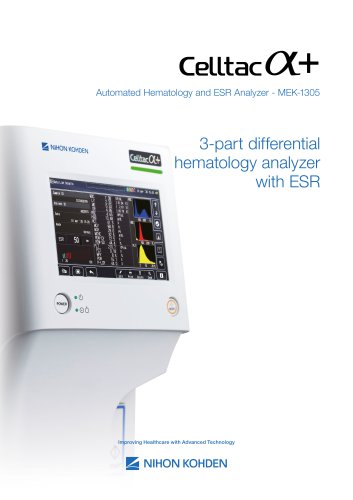 Celltac α+ (MEK-1305)
6 Pages
Archived catalogs
 Product Guide 2013 - 2014
40 Pages
 OLG-2800K
2 Pages
 Accessories and consumables
44 Pages
 ProductGuide 2013-2014
40 Pages
 QP-993PK HL7 Gateway Server
2 Pages
 TG-900 series CO2 Sensor Kit
4 Pages
 YAWARA CUFF 2
2 Pages
 corporate profile 2013
12 Pages
 ZM_ZS series Transmitters
2 Pages
 QB-905E ECG Viewer 3
2 Pages
 Product Guide 2014-2015
44 Pages
 MEE-1000A
8 Pages
 PMS-Brochure
8 Pages
 ECG-1950 VET
2 Pages
 EEG
EEG4 Pages
 EMG
EMG4 Pages
 aEEG
aEEG2 Pages
 Patientmonitoring
8 Pages
 BluPRO
2 Pages
 Life Scope J (BSM-9100)
2 Pages
 Corporate Profile
7 Pages
 cardiolife AED-3100
4 Pages
 Cardiofax C
4 Pages
 Life scope G9
4 Pages
 ViTrac
4 Pages
 Life_Scope_VS
4 Pages
 Cardiofax_S
4 Pages
 Neurofax EEG-1200
4 Pages
 esCCO_8755
4 Pages
 INBP
INBP12 Pages
 YZ-0194
3 Pages
 CAP-One
2 Pages
 SpO2 Probes
2 Pages
 CNS-9601J/K Central Monitors
12 Pages
 CNS-6201 Central Monitors
12 Pages
 R100 ventilator
4 Pages


- Patient monitor
- Tablet computer software
- Tablet PC software
- SpO2 sensor
- Blood pressure patient monitor
- Hematology analyzer
- Digital electrocardiograph
- EKG
- Automatic hematology analyzer
- ECG patient monitor
- SpO2 patient monitor
- Multi-parameter monitor
- Portable patient monitor
- Diagnostic software
- NIBP patient monitor
- Benchtop hematology analyzer
- Non-invasive ventilator
- External defibrillator
- Multi-parameter O2 monitor
- Compact patient monitor