


INBP

INBP
Nihon Kohden's iNIBP is a novel non-invasive blood pressure measurement algorithm that employs linear inflation technology. This report is designed to assist clinicians in understanding its performance, benefits, and limitations during perioperative use.
Technological Description of iNIBP
The iNIBP method involves slow cuff inflation while detecting oscillations, differing from the traditional step-deflation method. This results in reduced measurement times and lower inflation pressures, enhancing patient comfort without sacrificing accuracy. It is particularly beneficial when blood pressure fluctuates, as it adapts to changes without excessive pressure.
iNIBP Advantages
iNIBP provides quicker measurement times and adapts to blood pressure variations, reducing the need for repeated cycles and minimizing patient discomfort. It automatically switches to the deflation method if the inflation method cannot provide accurate readings due to environmental or physiological factors.
Case Studies
- Case 1: Laparoscopic Assisted Distal Gastrectomy
In a 68-year-old male with significant blood pressure variation, iNIBP efficiently completed measurements using the inflation method. - Case 2: Pelvic and Para-aortic Lymphadenectomy
In a 47-year-old female, iNIBP switched to deflation mode due to noise but completed measurements quickly when blood pressure increased. - Case 3: Laparoscopic Resection of Descending Colon
For a 72-year-old female with low amplitude pulse waves, iNIBP used both methods but was faster than conventional methods. - Case 4: Radical Prostatectomy
In a 65-year-old male, iNIBP maintained the inflation method throughout, impressing with its speed. - Case 5: Laparoscopic Uterine Myomectomy
In a 37-year-old female, iNIBP switched modes due to noise but predominantly used the inflation method.
Discussion
iNIBP's linear inflation technology provides accurate blood pressure readings by detecting oscillations during cuff inflation, offering a significant improvement over conventional methods in terms of speed and patient comfort.
Specifications and Technology
The iNIBP utilizes Linear Inflation Technology to measure blood pressure non-invasively, designed to minimize patient discomfort while ensuring precise readings.
Clinical Validation
Studies validating iNIBP include research by Jun Onodera and Yoshifumi Kotake, published in the Journal of Anesthesia, and a poster presentation by Junichi Sasaki and Shingo Hori at an international symposium. These studies confirm the efficacy of iNIBP in both surgical and emergency room settings.
Case Report
The case report from the Department of Anesthesiology at Toho University Ohashi Medical Center highlights the practical experiences and benefits of using iNIBP in the operating room.
Conclusion
Nihon Kohden encourages feedback on the iNIBP technology to enhance its application and benefit to patients and clinicians.
Catalog excerpts
Linear inflation Technology Non-invasive Blood Pressure Measurement Fighting Disease with Electronics
Open the catalog to page 1
C ONTENTS Introduction……………………………………………………………………………… 2 Technological Description of iNIBP iNIBP advantages………………………………………………………………………… 2 iNIBP technology adapts to each patient situation and condition ………………… 4 [Case 1] Laparoscopic assisted distal gastrectomy……………… 5 [Case 2] Pelvic lymphadenectomy, para-aortic lymphadenectomy [Case 3] Laparoscopic resection of descending c
Open the catalog to page 2
iNIBP Case Report – Experiences in OR Introduction iNIBP is Nihon Kohden's new non-invasive blood pressure measurement algorithm using linear inflation technology. This case report, which describes the perioperative use of iNIBP, is designed to help clinicians and healthcare professionals understand and appreciate the performance characteristics of iNIBP, including the advantages and limitations of the measurement. Technology Description of iNIBP iNIBP advantages Non-invasive blood pressure (NIBP) is commonly used as an important vital sign to evaluate patients' hemodynamic status. In the traditional...
Open the catalog to page 3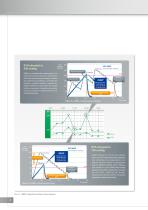
Cuff 300 pressure (mmHg) 250 iNIBP can complete the measurement in a shorter amount of time as it inflates the cuff while sensing blood pressure variation and detecting oscillations, whereas the deflation method needs to repeat the inflation-deflation cycle when the target inflation pressure, based on previous systolic pressure measurements are comparatively low. iNIBP Deflation method Deflation measurement completes Measurement completes as soon as SYS is determined Shorter measurement time Figure 3.a. iNIBP in blood pressure elevation Cuff 300 pressure (mmHg) 250 Measurement completes as soon...
Open the catalog to page 4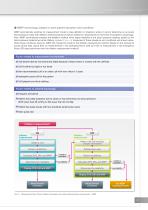
iNIBP Case Report – Experiences in OR iNIBP technology adapts to each patient situation and condition iNIBP automatically switches its measurement mode to step-deflation in situations where it cannot determine an accurate blood pressure value with inflation method because of factors related to measurement environment and patient's physiology. Also, iNIBP automatically employs the deflation method when signal reliability of the blood pressure reading, based on the blood pressure determined while inflating, is poor (Figure 4). Examples of these situations and conditions are shown below. When these...
Open the catalog to page 5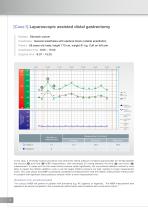
[Case 1] Laparoscopic assisted distal gastrectomy Disease : Stomach cancer Anesthesia : General anesthesia with epidural block (volatile anesthetic) Patient : 68 years old male, height 170 cm, weight 81 kg. Cuff on left arm Anesthesia time : 8:55 - 15:50 Surgical time : 9:37 - 15:25 in this case, a minimally-invasive procedure was performed. Blood pressure increased approximately 30 mmHg between the second (A) and third (B) NIBP measurement, then decreased 25 mmHg between the third rB) and fourth (C) measurement. in cases such as this where blood pressure varies significantly, the conventional...
Open the catalog to page 6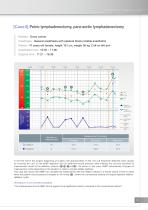
iNIBP Case Report - Experiences in OR [Case 2] Pelvic lymphadenectomy, para-aortic lymphadenectomy Disease : Ovary cancer Anesthesia : General anesthesia with epidural block {volatile anesthetic} Patient : 47 years old female, height 161 cm, weight 56 kg. Cuff on left arm Anesthesia time : 10:55 - 17:06 Surgical time : 11:21 - 16:39 in the first half of the surgery (beginning of surgery until approximately 14:30), the cuff frequently detected noise caused by touching the cuff, so the iNiBP algorithm did not determine blood pressure while inflating the cuff and switched its measurement mode to...
Open the catalog to page 7
Disease : Descending colon cancer Anesthesia : General anesthesia with epidural block {volatile anesthetic} Patient : 72 years female, height 151 cm, weight 74.5 kg. Cuff on left arm Anesthesia time : 9:05 - 15:49 Surgical time : 10:00 - 15:03 Deflation measurement Average Minimum Maximum The patient had low amplitude pulse wave and her blood pressure was relatively low (SYS 60-90/DIA 30-50 mmHg) during surgery. When the amplitude of oscillations is lower than a threshold, where it cannot determine an accurate blood pressure value with inflation mode, iNIBP determines NIBP value with the deflation...
Open the catalog to page 8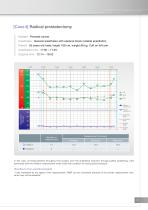
iNIBP Case Report - Experiences in OR [Case 4] Radical prostatectomy Disease : Prostate cancer Anesthesia : General anesthesia with epidural block (volatile anesthetic) Patient : 65 years old male, height 168 cm, weight 68 kg. Cuff on left arm Anesthesia time : 11:50 - 17:25 Surgical time : 12:14 - 16:52 Deflation measurement -Anesthesia starts -Anesthesia ends ---Surgery starts -Surgery ends Measurement time Average Minimum in this case, all measurements throughout the surgery, from the anesthesia Induction through patient awakening, were performed with the inflation measurement mode under the...
Open the catalog to page 9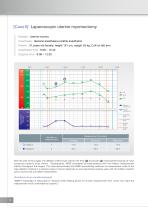
[Case 5] Laparoscopic uterine myomectomy Disease : Uterine myoma Anesthesia : General anesthesia (volatile anesthetic) Patient : 37 years old female, height 151 cm, weight 53 kg. Cuff on left arm Anesthesia time : 8:38 – 12:43 Surgical time : 9:08 – 12:25 Deflation measurement Inflation measurement Anesthesia starts Anesthesia ends Surgery starts Surgery ends After the start of the surgery, the deflation method was used for the third ( A ) and fourth ( B ) measurement because of noise caused by patient's body motion. Subsequently, iNIBP completed all measurements with the inflation measurement...
Open the catalog to page 10
iNIBP Case Report – Experiences in OR Discussion Nihon Kohden's Linear Inflation Technology, Non-invasive Blood Pressure Measurement,“iNIBP”determines blood pressure by , detecting oscillations during the initial inflation of the cuff. Compared to the conventional method, iNIBP can provide accurate blood pressure readings in less time without applying excessive pressure to the patient, leading to maximized comfort for patients. iNIBP allows clinicians to accurately measure blood pressure immediately and when this critical vital sign is needed the most, especially during dynamic blood pressure...
Open the catalog to page 11All Nihon Kohden Europe catalogs and technical brochures
 Neurofax (EEG-1200)
4 Pages
 CPR assist (CPR-1100)
4 Pages
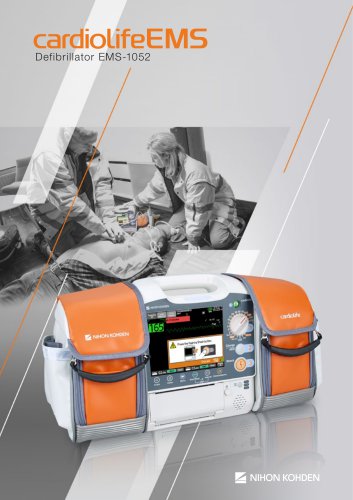 cardiolife EMS (EMS-1052)
8 Pages
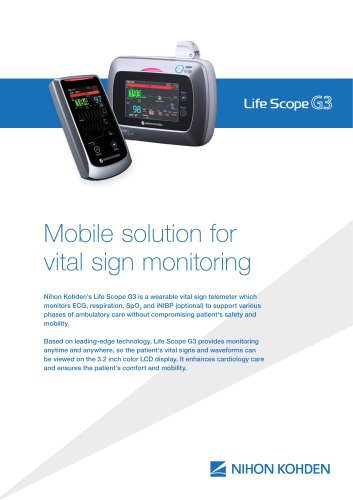 Life Scope G3
4 Pages
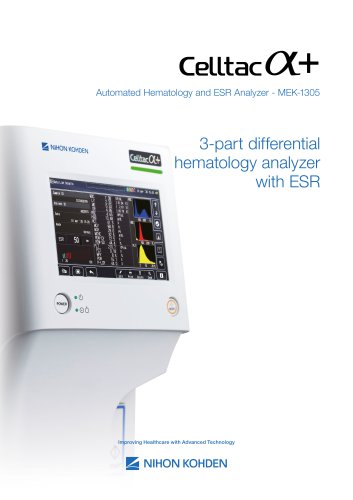 Celltac α+ (MEK-1305)
6 Pages
Archived catalogs
 Product Guide 2013 - 2014
40 Pages
 OLG-2800K
2 Pages
 Accessories and consumables
44 Pages
 ProductGuide 2013-2014
40 Pages
 QP-993PK HL7 Gateway Server
2 Pages
 TG-900 series CO2 Sensor Kit
4 Pages
 YAWARA CUFF 2
2 Pages
 corporate profile 2013
12 Pages
 ZM_ZS series Transmitters
2 Pages
 QB-905E ECG Viewer 3
2 Pages
 Product Guide 2014-2015
44 Pages
 MEE-1000A
8 Pages
 PMS-Brochure
8 Pages
 ECG-1950 VET
2 Pages
 EEG
EEG4 Pages
 EMG
EMG4 Pages
 aEEG
aEEG2 Pages
 Patientmonitoring
8 Pages
 esCCO Information Volume 1
2 Pages
 BluPRO
2 Pages
 Life Scope J (BSM-9100)
2 Pages
 Corporate Profile
7 Pages
 cardiolife AED-3100
4 Pages
 Cardiofax C
4 Pages
 Life scope G9
4 Pages
 ViTrac
4 Pages
 Life_Scope_VS
4 Pages
 Cardiofax_S
4 Pages
 Neurofax EEG-1200
4 Pages
 esCCO_8755
4 Pages
 YZ-0194
3 Pages
 CAP-One
2 Pages
 SpO2 Probes
2 Pages
 CNS-9601J/K Central Monitors
12 Pages
 CNS-6201 Central Monitors
12 Pages
 R100 ventilator
4 Pages


- Patient monitor
- Tablet computer software
- Tablet PC software
- SpO2 sensor
- Blood pressure patient monitor
- Hematology analyzer
- Digital electrocardiograph
- EKG
- Automatic hematology analyzer
- ECG patient monitor
- SpO2 patient monitor
- Multi-parameter monitor
- Portable patient monitor
- NIBP patient monitor
- Diagnostic software
- Benchtop hematology analyzer
- Non-invasive ventilator
- External defibrillator
- Compact patient monitor
- Multi-parameter O2 monitor