

- Products
- Catalogs
- News & Trends
- Exhibitions
AZ100

AZ100
Overview
This document provides a detailed technical description and component catalog for the Nikon AZ100 multi-purpose zoom microscope system. It covers the microscope’s optical specifications, illumination options, accessories, imaging integration, ergonomic features, and regulatory notes, emphasizing its versatility for biological and material science applications.
1. Microscope Configuration and Optical Specifications
- Observation Methods: Supports both transmitted light (brightfield, Nomarski DIC, simple polarizing, oblique illumination) and reflected light (fluorescence, Nomarski DIC, coaxial and LED illumination).
- Magnification and Zoom: Total magnification ranges from 5x to 400x with standard optics, extendable to 500x with coaxial illumination. The 8:1 zoom ratio combined with a three-position nosepiece achieves an 80:1 magnification range, the highest in its class.
- Objectives: Five objective types (AZ-Plan Apo and AZ-Plan Fluor) offer high numerical aperture and long working distances, optimized for DIC and fluorescence imaging.
- Eyepiece Tubes: Ergonomic trinocular tubes with adjustable inclination (0°–30°), interpupillary distance (50–75mm), and built-in 0.6x reduction optics enhance user comfort and image quality.
- Focus System: Double coarse/fine focusing with extended stroke (85mm on focus mount, 10mm on stage) facilitates comfortable focusing on tall or thick samples.
2. Illumination and Imaging Attachments
- Diascopic Illumination: AZ-STD stand with 100W halogen lamp for transmitted light applications.
- Episcopic Illumination: Includes AZ-ICI coaxial illuminator (1.25x, 100W halogen), C-FID bifurcated fiber optics, and AZ-LED ring illuminator with adjustable intensity.
- Epi-fluorescence Attachment: AZ-FL supports up to four filter cubes, enabling high signal-to-noise fluorescence imaging via a separated excitation light path.
- Fiber Illuminators: Mercury fiber illuminators (C-HGFI/HGFIE series) provide stable, pre-centered illumination minimizing thermal effects and lamp adjustments.
3. Accessories and Observation Enhancements
- Oblique Illumination Slider (AZ-OI): Inserts a diaphragm to block central light, enhancing relief contrast for transparent, colorless samples.
- Nomarski DIC Components: Prism holders, sliders, analyzers, lambda plates, and rotatable polarizers enable high-contrast, uniform coloration DIC imaging across magnifications.
- Sample Holders and Stages: Variety of holders for Petri dishes, hemacytometers, slides, Terasaki plates, and large travel stages (up to 150x150mm) accommodate diverse sample types and sizes.
- Thermo Plates and Incubators: Compatible with TOKAI HIT stage top incubators and thermo plates for live cell imaging under controlled temperature conditions.
4. Imaging and Digital Integration
- Digital Cameras: Nikon DS-Fi2 (5MP color, wide dynamic range) and DS-Fi1c (cooled CCD for fluorescence) cameras integrate seamlessly for high-quality image capture.
- Control Unit (DS-L3): Stand-alone unit with 8.4" touch panel and intuitive GUI for image acquisition, measurement, and data export without PC dependency.
5. Ergonomics and Usability Features
- Adjustable eyepiece tube inclination (0°–30°) to suit user posture and height.
- Zoom knob with click-stops allows precise magnification changes without removing eyes from eyepieces.
- Vertical optical system ensures on-axis image capture without inclination, maintaining image accuracy during zooming.
- Aperture stop dial enables contrast and depth of field adjustments tailored to specimen characteristics.
6. Technical and Regulatory Notes
- Power consumption for fiber illuminators is approximately 2–2.3A.
- The combined epi-fluorescence and diascopic DIC configuration weighs about 28kg.
- Specifications are subject to change without notice.
- Export controlled under Japanese Foreign Exchange and Foreign Trade Law to prevent unauthorized military use.
7. Critical Parameters and Recommendations
- Use AZ-FLDIC FL-DIC Prism Holder to mount epi-fluorescence and diascopic DIC attachments simultaneously.
- For UV excitation in fluorescence, employ mercury lamp housing type lamphouse.
- High numerical aperture and long working distance objectives are recommended for optimal DIC and fluorescence imaging.
- Adjust aperture stop to balance contrast and depth of field based on sample properties.
- Utilize ergonomic features and focusing adapters to maintain comfort during extended observations.
8. Component Catalog and Modular Assembly
- Lens Mounts and Nosepieces: Includes single (AZ-NPS) and triple (AZ-NP3) nosepieces, low-voltage focusing adapters (AZ-LV), and intermediate modules (LV-IMA/LV-IM).
- Stages and Holders: Diascopic (AZ-STGD) and episcopic (AZ-STGE) stages, stage glass (AZ-SG), dish holder adapters (AZ-SDA), and DIC lambda plates (AZ-EL).
- Illumination Components: Coaxial illuminator (AZ-ICI), neutral density filters (AZ-NCB, YM-ND 25), fiber optics illuminators (C-FID, C-FI115/230).
- DIC Components: Prism holders and sliders for epi and diascopic DIC (AZ-PH, AZ-EPS1/5, AZ-DPS1/5), analyzers, lambda plates, and rotatable polarizers.
- Fluorescence Components: Epi-fluorescence attachment (AZ-FL), FL-DIC prism holder (AZ-FLDIC), mercury lamp adapters (AZ-HGA), collector lenses (C-FCL), fiber adapters and precentered fiber illuminators (C-HGFI series), and controllers (C-HGFIE-C).
- Additional Accessories: Thermo plate adapters (AZ-STA), stage top incubators (MATS-U505S, INULG2A/E-ZILGW), stage adapters (AZS-ZA), and third-party digital camera adapters.
9. Compatibility and Limitations
- Some components require specific compatibility checks, especially regarding illumination modules.
- Simultaneous mounting of epi-fluorescence and diascopic DIC attachments requires dedicated adapters.
- Certain components cannot be combined with coaxial illuminators.
Summary
The Nikon AZ100 microscope system is a highly versatile and modular platform combining advanced zoom optics, multiple illumination methods, and sophisticated imaging capabilities including epi-fluorescence and diascopic DIC. Its ergonomic design and extensive accessory options support a wide range of biological and material science applications. The system facilitates seamless switching between observation modes and high-quality digital imaging, accommodating diverse sample types and sizes with specialized accessories to enhance contrast and imaging precision. Compatibility considerations and regulatory compliance are integral to system configuration.
Catalog excerpts

Multi-purpose Zoom Microscope Observation method Total magnification Zoom range Eyepiece tubes Inclination angle Interpupillary adjustment range Eyepiece lens Focus mount adapters Stands Stages Objective lens mounts Objective lenses Illuminators Epi-fluorescence attachment Power consumption Weight Transmitted light: brightfield, Nomarski DIC, simple polarizing, and oblique illumination observation Reflected light: Fluorescence, Nomarski DIC, coaxial illumination, and LED illumination observation 5x to 400x (depends on the combination of eyepiece lenses and objective lens), 6.25x to 500x when a coaxial illuminator is mounted 1 to 8 (zoom ratio: 8:1) 0.6x reduction optics built into photo port AZ-TE100 Ergonomic Trinocular Tube 100 (bino: photo 100:0/0:100), AZ-TE80 Ergonomic Trinocular Tube 80 (bino: photo 100:0/20:80), and AZ-TP DSC Tube 0.6x (direct tube type) 0 to 30 (with AZ-TE100/AZ-TE80 eyepiece tube) 50 to 75mm (with AZ-TE100/AZ-TE80 eyepiece tube) AZ-W 10x (FOV: 22mm) AZ-FM Focusing Mount Adapter (for AZ-STE/STD stand), AZ-SMZ SMZ Focusing Mount Adapter (for SMZ plain stand/BD stand), and AZ-LV LV Focusing Mount Adapter (for LV-IMA/LV-IM). AZ-STD Diascopic Stand/AZ-STE Episcopic Stand: (focus mount section: focusing stroke, 85mm; coarse, 18.5mm/rotation; fine, 3.27mm/rotation Stage focus section: focusing stroke, 10mm; coarse, 37.7mm/rotation ; fine, 0.27mm/rotation) C-PS160 Plain Stand, C-BD Diascopic Bright/Darkfield Stand AZ-STGD DIA Stage (150 x 100mm stroke), AZ-STGE EPI Stage (150 x 150mm stroke) AZ-NP3 Triple Nosepiece, AZ-NPS Single Nosepiece, AZ-FLDIC FL-DIC Prism Holder (used when simultaneously mounting epi-fluorescence and diascopic DIC attachments) AZ-Plan Apo 0.5x (NA: 0.05/WD: 54mm), AZ-Plan Apo 1x (NA: 0.1/WD: 35mm), AZ-Plan Fluor 2x (NA: 0.2/WD: 45mm) AZ-Plan Apo 4x (NA: 0.4/WD: 20mm), AZ-Plan Fluor 5x (NA: 0.5/WD: 15mm) Diascopic illuminator: AZ-STD Diascopic Stand (100W halogen), Episcopic illuminator: AZ-ICI Coaxial illuminator (device magnification:1.25x, 100W halogen), C-FID Plastic Fiber Optics Bifurcated Illuminator (100W halogen), AZ-LED LED Ring Illuminator (LED), Epi-fluorescence illuminator: C-HGFI/HGFIE HG Precentered Fiber Illuminator (manual/motorized, 130W mercury), Lamphouse HMX-4B (100W mercury) AZ-FL Epi-fluorescence Attachment (up to four filter cubes mountable) C-FI115/230 Fiber Illuminator: 2.3A, HG Precentered Fiber Illuminator: 2A Epi-fluorescence + diascopic DIC configuration: 28kg Epi-fluorescence + diascopic DIC configuration 140 Examples on cover: (First and second images from the left) Primary culture cells from the cerebellum of an 18-day-old mouse embryo. Fixed and double immunofluorescence stained on seventh day of cultivation. (Third image) Rat skull base (Forth image) Rat spinal cord/HRP labeling, counterstaining with cresylviolet (Fifth image) Zebra fish Samples provided by: Center of cover, second from right, and pages 2 and 3: Professor Tetsuo Sugimoto (Faculty of Medicine, Kansai Medical University Department of Anatomy and Brain Science) First and second from left side of cover and epifluorescence on page 4: Teiichi Furuichi, Ph.D. Lab.Head and Noriyuki Morita, Ph.D. (Brain Science Institute, RIKEN) First from right side of cover and differential interference on the bottom of page 4: Hitoshi Okamato MD, Ph.D. Lab.Head and Hideomi Tanaka, Ph.D. (Brain Science Institute, RIKEN) Specifications and equipment are subject to change without any notice or obligation on the part of the manufacturer. June 2012 ©2007/2008/2009/2012 NIKON CORPORATION The products detailed in the brochure are controlled by the Japanese Foreign Exchange and Foreign Trade Law and the International Export Control Regime. If there is a possibility that they may be utilized for the development of weapons of mass destruction, etc., they shall not be exported without authorization from the government. NIKON CORPORATION Shin-Yurakucho Bldg., 12-1, Yurakucho 1-chome Chiyoda-ku, Tokyo 100-8331 Japan phone: +81-3-3216-2375 fax: +81-3-3216-2385 http://www.nikon.com/instruments/ NIKON INSTRUMENTS INC. 1300 Walt Whitman Road, Melville, N.Y. 11747-3064, U.S.A. phone: +1-631-547-8500; +1-800-52-NIKON (within the U.S.A. only) fax: +1-631-547-0306 http://www.nikoninstruments.com/ NIKON INSTRUMENTS EUROPE B.V. Laan van Kronenburg 2, 1183 AS, Amstelveen, The Netherlands phone: +31-20-44-96-300 fax: +31-20-44-96-298 http://www.nikoninstruments.eu/ NIKON INSTRUMENTS (SHANGHAI) CO., LTD. CHINA phone: +86-21-6841-2050 fax: +86-21-6841-2060 (Beijing branch) phone: +86-10-5831-2028 fax: +86-10-5831-2026 (Guangzhou branch) phone: +86-20-3882-0552 fax: +86-20-3882-0580 NIKON SINGAPORE PTE LTD. SINGAPORE phone: +65-6559-3618 fax: +65-6559-3668 NIKON MALAYSIA SDN. BHD. MALAYSIA phone: +60-3-7809-3688 fax: +60-3-7809-3633 NIKON INSTRUMENTS KOREA CO., LTD. KOREA phone: +82-2-2186-8400 fax: +82-2-555-4415 NIKON CANADA INC. CANADA phone: +1-905-602-9676 fax: +1-905-602-9953 NIKON FRANCE S.A.S. FRANCE phone: +33-1-4516-45-16 fax: +33-1-4516-45-55 NIKON GMBH GERMANY phone: +49-211-941-42-20 fax:+49-211-941-43-22 NIKON INSTRUMENTS S.p.A. ITALY phone: +39-055-300-96-01 fax: +39-055-30-09-93 NIKON AG SWITZERLAND phone: +41-43-277-28-67 fax: +41-43-277-28-61 NIKON UK LTD. UNITED KINGDOM phone: +44-208-247-1717 fax: +44-208-541-4584 NIKON GMBH AUSTRIA AUSTRIA phone: +43-1-972-6111-00 fax: +43-1-972-6111-40 NIKON BELUX BELGIUM phone: +32-2-705-56-65 fax: +32-2-726-66-45
Open the catalog to page 1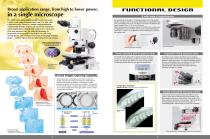
Broad application range, from high to lower power, A wide range of magnifications The AZ100 represents an all-new concept in zoom microscopes. It covers a wide range of magnifications, from 5x to 400x, all in a single microscope. Thanks to a smooth zooming mechanism combined with the triple nosepiece, the AZ100 can continuously switch magnifications extending from macro to micro observation of the same specimen. Enjoy the combined advantages of a stereoscopic microscope with a wide field of view and a long working distance, and a biological microscope boasting high-resolution images — AZ100 is...
Open the catalog to page 2All Nikon Instruments catalogs and technical brochures
 Super Resolution Microscopes
28 Pages
 HCA
HCA8 Pages
 DS-Fi3
16 Pages
 A1 HD25 / A1R HD25
15 Pages
 TI-E
TI-E32 Pages
 ECLIPSE TS2
8 Pages
 ECLIPSE TS2R
8 Pages
 N-SIME
6 Pages
 N-SIM N-STORM
24 Pages
 ECLIPSE E100 LED
8 Pages
 ECLIPSE Ti2
24 Pages
 A1 MP+ / A1R MP+
20 Pages
 DIGITAL SIGHT SERIES
16 Pages
 Eclipse LV100N-POL Ci-POL
8 Pages
 Eclipse Ti
32 Pages
 C2 Plus
16 Pages
 Biological Microscopes
24 Pages
 Stereomicroscopes
32 Pages
 SMZ18
SMZ1816 Pages
 N-SIM E
4 Pages


Archived catalogs
 A1 MP+ / A1R MP
15 Pages
 ShuttlePix
8 Pages
 Eclipse FN1
12 Pages
 NeoScope Brochure
16 Pages
 ShuttlePix Brochure
5 Pages
 Bio Station IMQ
8 Pages
 MiBrochure
2 Pages
 AZ_C1
AZ_C12 Pages
 High Content Microscopy
2 Pages
 C2+_2CE-SCHH-5
16 Pages
 A1+_A1R+_2CE-SBTH-9
13 Pages
 N-STORM 4.1
13 Pages
 A1_MP
A1_MP11 Pages
 A1+ / A1R+
13 Pages
 NIS-Elements
8 Pages
 Digital Sight Series
9 Pages
 AZ100M
8 Pages
 ShuttlePix P-400R
5 Pages
 Eclipse Ni
15 Pages
 Eclipse Ci-E/ Ci-L
5 Pages
 Eclipse E200POL
3 Pages
 Eclipse LV100ND POL/DS
2 Pages
 Eclipse E100 LED
4 Pages
 Eclipse E200 POL
3 Pages
 Biological Microscopes
12 Pages
 ECLIPSE LV100N POL 50i/ POL
4 Pages
 Eclipse E100-LED
8 Pages
 A1 MP+ / A1R MP+
11 Pages
 Digital Sight Series Brochure
16 Pages
- Analysis software
- Compound microscope
- Laboratory microscope
- Desktop microscope
- Visualization software
- Tablet computer software
- Tablet PC software
- Control software
- Laboratory software
- CMOS camera
- Camera with USB port
- LED microscope
- LED light source
- Capture software
- Training software
- Biology microscope
- HD camera
- Microscope camera
- Research microscope