
- Catalogs
- Nikon Instruments
- Microscope Objectives for Bioscience

- Products
- Catalogs
- News & Trends
- Exhibitions
Microscope Objectives for Bioscience

Microscope Objectives for Bioscience
Nikon has been a leader in optical technology since 1917, known for producing high-quality microscope objectives with exceptional clarity and performance. Their products integrate advanced optical and precision technologies.
CFI60 Optical System
Introduced in 1996, the CFI60 optical system enhances optical performance in biological microscopes. It features a 200mm tube lens focal length and a 60mm parfocal distance, allowing for higher numerical apertures (NA) and longer working distances. This system independently corrects chromatic aberrations in the objective and tube lens, improving contrast and image quality.
Nano Crystal Coat Technology
Nikon's Nano Crystal Coat technology, inspired by semiconductor manufacturing, reduces reflections and increases light transmittance through lenses. This anti-reflective coating uses nanometer-sized crystallized particles to eliminate ghost and flare effects, enhancing image brightness and clarity.
CFI Apochromat Series
The CFI Apochromat series provides lenses with high chromatic aberration correction across a wide wavelength range, ideal for spectral imaging and multi-wavelength acquisition. These lenses incorporate Nikon's Nano Crystal Coat technology, offering high transmittance and resolution for live-cell imaging.
Super Resolution Objectives
Nikon's super-resolution objectives, used in N-SIM and N-STORM microscopes, exceed the diffraction limit of conventional optical microscopes. These objectives enable high-resolution, time-lapse imaging of live cells, with N-SIM achieving resolutions of 115 nm and N-STORM reaching approximately 20 nm.
CFI Apochromat TIRF Series
These objectives feature an unprecedented NA of 1.49, suitable for TIRF observation and live cell imaging. They include a spherical aberration correction ring to maintain image quality despite cover glass thickness variations or temperature changes.
Specifications
The document lists various objectives with different magnifications, numerical apertures (NA), and working distances (WD). Key specifications include:
- CFI Plan Apochromat VC Series: High NA, long WD, suitable for multi-photon imaging.
- CFI Plan Fluor Series: High transmission rate, suitable for fluorescence and multi-purpose observations.
- CFI Achromat Series: Improved chromatic and spherical aberration correction.
Procedures
Instructions are provided for using the correction ring to adjust for cover glass thickness variations, ensuring optimal performance of high NA objectives.
Norms and Recommendations
The document emphasizes the importance of using the correct cover glass thickness (0.17mm) and proper cleaning techniques for immersion oil objectives to maintain image quality.
Key Features
- High NA objectives provide superior resolving power and brightness.
- Apodization phase ring reduces halo effects, enhancing phase contrast image quality.
- Objectives are designed for specific applications such as DIC, fluorescence, and phase contrast.
Applications
The objectives are suitable for various microscopy techniques, including:
- Fluorescence observation of cellular structures.
- Phase contrast for observing unstained intracellular structures.
- Advanced modulation contrast for high relief observation of transparent samples.
Conclusion
Nikon's CFI objectives offer a wide range of options for different microscopy needs, providing high-quality imaging through advanced optical technologies and design features.
Catalog excerpts
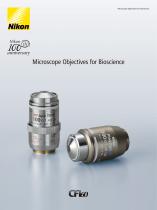
Microscope Objectives for Bioscience Microscope Objectives for Bioscience
Open the catalog to page 1
Tireless pursuit of the highest quality Each Nikon microscope objective is precision-crafted to provide the highest level of clarity and overall optical performance. World-class Nikon objectives, including renowned CFI60 infinity optics, deliver brilliant images of breathtaking sharpness and clarity, from ultralow to the highest magnifications. kiwami The Japanese calligraphy on the left reads as “kiwami,” which means to master or pursue excellence. Exceptional performance born from advanced technology in glass formation and lens manufacture Nikon’s extremely reliable high-tech products have...
Open the catalog to page 2
Nikon Master Craftperson Within the Nikon organization, there are dedicated personnel with the title of Nikon Master Craftperson. They have passed rigorous tests and possess a high degree of skill and expert knowledge, specifically for the production of objectives. Everyday, these “masters” utilize their techniques and knowledge to deliver unrivalled glass-based optical solutions. CFI60 Optical Path (Conceptual Diagram) Chromatic Aberration Free Chromatic Aberration Free Tube lens Beam splitter Development of CFI60 optical system In 1996, Nikon developed the CFI60 (Chromatic aberration Free Infinity)...
Open the catalog to page 3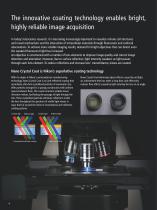
The innovative coating technology enables bright, highly reliable image acquisition In today’s bioscience research, it is becoming increasingly important to visualize minute cell structures and reveal mechanisms and the interaction of intracellular materials through fluorescent and confocal observations. To achieve more reliable imaging results, demand for bright objectives that can detect even the weakest fluorescent light has increased. An objective is constructed with a number of lens elements to improve image quality and correct image distortion and aberration. However, due to surface reflection,...
Open the catalog to page 4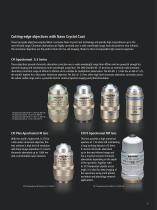
Cutting-edge objectives with Nano Crystal Coat These top-grade objectives employ Nikon’s exclusive Nano Crystal Coat technology and provide high transmittance up to the near-infrared range. Chromatic aberrations are highly corrected over a wide wavelength range, from ultraviolet to near infrared. The immersion objectives are the perfect choice for live-cell imaging, thanks to their incomparable high numerical aperture. CFI Apochromat λ S Series These objectives provide chromatic aberration correction over a wide wavelength range from 405nm and are powerful enough for spectral imaging and simultaneous...
Open the catalog to page 5
CFI Plan Apochromat Lambda Series Nano Crystal Coat guarantees optimum brightness • Nano Crystal Coat enables remarkably high transmission up to the near-infrared region. • Chromatic aberrations are corrected throughout a wavelength range from visible to near infrared. Bright, high-contrast images are captured during long-wavelength imaging, which is less phototoxic to live-cells. • Unmatched chromatic aberration correction, resolution and image flatness ensure the capture of high-quality brightfield images. Vastly improved transmission rate (CFI Plan Apochromat λ60x oil) 1 CFI Plan Apochromat...
Open the catalog to page 6
CFI SR Series Objectives for super resolution microscope N-SIM The SR (super resolution) objectives have been designed to provide superb optical performance with Nikon’s superresolution microscopes. The adjustment and inspection of lenses using wavefront aberration measurement have been applied to yield optical performances with the lowest possible asymmetric aberration. Reduced asymmetric aberration enables the capture of fluorescence bead images with even brightness during defocusing. CFI HP Series Objectives for super resolution microscope N-STORM The CFI HP (High Power) objectives are optimized...
Open the catalog to page 7
CFI Apochromat TIRF Series Objectives with an unparalleled NA of 1.49 M uch higher S/N ratio than a conventional model Sample: Q-Dot CFI Apochromat TIRF 100x oil, NA 1.49 (new product) Line profile Intensity level • Because of the unprecedented NA of 1.49—for use with a standard coverslip and immersion oil—these objectives enable the acquisition of bright, high S/N ratio images; so they are suitable for TIRF observation and live cell imaging. • Both the 60x and 100x lenses utilize the spherical aberration correction ring to reduce deterioration in image quality caused by deviations in cover glass...
Open the catalog to page 8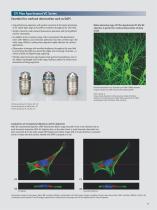
CFI Plan Apochromat VC Series Essential for confocal observation such as DAPI Water-immersion type CFI Plan Apochromat VC 60x WI objective is perfect for confocal observation of deep tissue • op performance objectives with perfect correction of chromatic aberrations T in the visible light range and excellent resolution throughout the view field. • erfect choice for multi-stained, fluorescence specimens and for brightfield P and DIC observation. I • n addition to the correction range of the conventional Plan Apochromat series (435–660nm), axial chromatic aberration has been corrected up to the...
Open the catalog to page 9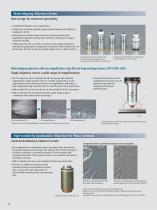
Water-dipping Objective Series New design for enhanced operability • Long WD and high NA at any magnification. • harper tips and broad approach angles provide improved accessibility for S manipulator control. • berrations are corrected even in the infra-red range with the highA magnification objectives, making them suitable for multi-photon imaging using infra-red light. 1 • 00xW objective with a correction ring that corrects spherical aberration induced by imaging depth or temperature fluctuations. With excellent infra-red transmission, this lens assures best quality images of even a thick specimen....
Open the catalog to page 10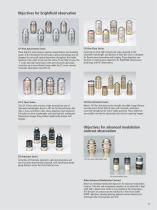
Objectives for brightfield observation CFI Plan Apochromat Series These high NA series feature superior image flatness and resolving power at the theoretical limit of today’s optical technology and are designed to correct all optical aberrations throughout the visible spectrum, from violet to red over the entire 25 mm field of view. The λ series has high transmission rates and chromatic aberration correction up to near-infrared range, while the VC series corrects chromatic aberrations from 405 nm. CFI Plan Fluor Series Featuring an extra-high transmission rate, especially in the ultraviolet wavelength,...
Open the catalog to page 11All Nikon Instruments catalogs and technical brochures
 Super Resolution Microscopes
28 Pages
 HCA
HCA8 Pages
 DS-Fi3
16 Pages
 A1 HD25 / A1R HD25
15 Pages
 TI-E
TI-E32 Pages
 ECLIPSE TS2
8 Pages
 ECLIPSE TS2R
8 Pages
 N-SIME
6 Pages
 N-SIM N-STORM
24 Pages
 ECLIPSE E100 LED
8 Pages
 ECLIPSE Ti2
24 Pages
 A1 MP+ / A1R MP+
20 Pages
 DIGITAL SIGHT SERIES
16 Pages
 Eclipse LV100N-POL Ci-POL
8 Pages
 Eclipse Ti
32 Pages
 C2 Plus
16 Pages
 Biological Microscopes
24 Pages
 Stereomicroscopes
32 Pages
 SMZ18
SMZ1816 Pages
 N-SIM E
4 Pages

Archived catalogs
 A1 MP+ / A1R MP
15 Pages
 ShuttlePix
8 Pages
 Eclipse FN1
12 Pages
 NeoScope Brochure
16 Pages
 ShuttlePix Brochure
5 Pages
 Bio Station IMQ
8 Pages
 MiBrochure
2 Pages
 AZ_C1
AZ_C12 Pages
 High Content Microscopy
2 Pages
 C2+_2CE-SCHH-5
16 Pages
 A1+_A1R+_2CE-SBTH-9
13 Pages
 N-STORM 4.1
13 Pages
 A1_MP
A1_MP11 Pages
 A1+ / A1R+
13 Pages
 NIS-Elements
8 Pages
 Digital Sight Series
9 Pages
 AZ100M
8 Pages
 ShuttlePix P-400R
5 Pages
 Eclipse Ni
15 Pages
 Eclipse Ci-E/ Ci-L
5 Pages
 AZ100
AZ1004 Pages
 Eclipse E200POL
3 Pages
 Eclipse LV100ND POL/DS
2 Pages
 Eclipse E100 LED
4 Pages
 Eclipse E200 POL
3 Pages
 Biological Microscopes
12 Pages
 ECLIPSE LV100N POL 50i/ POL
4 Pages
 Eclipse E100-LED
8 Pages
 A1 MP+ / A1R MP+
11 Pages
 Digital Sight Series Brochure
16 Pages
- Analysis software
- Laboratory microscope
- Desktop microscope
- Visualization software
- Tablet computer software
- Tablet PC software
- Control software
- CMOS camera
- Laboratory software
- Camera with USB port
- LED microscope
- LED light source
- Capture software
- Training software
- Biology microscope
- HD camera
- Microscope camera
- Research microscope