
- Catalogs
- Nikon Instruments
- Super Resolution Microscopes

- Products
- Catalogs
- News & Trends
- Exhibitions
Super Resolution Microscopes

Super Resolution Microscopes
The document introduces the N-SIM S and N-STORM super resolution microscopes, emphasizing their capabilities in achieving high-speed and high-resolution imaging, surpassing conventional light microscopes in capturing biological processes.
- N-SIM S: Utilizes structured illumination microscopy for ~115 nm lateral and ~269 nm axial resolution, with image acquisition speeds up to 15 fps for dynamic live cell imaging.
- N-STORM: Offers a 10-fold resolution improvement (~20 nm in XY) using stochastic optical reconstruction microscopy for molecular-level observation.
- N-SIM S supports TIRF-SIM, 2D-SIM, and 3D-SIM modes with automatic switching, allowing simultaneous two-channel imaging and larger fields of view (66 µm x 66 µm).
- Advanced pattern modulation technology enables fast and precise illumination pattern switching, with SIM using high spatial frequency laser interference for super-resolution images.
- Imaging of cellular structures like lamellipodia and microtubules, with case studies from research institutions demonstrating practical applications in biological research.
- N-SIM S includes components like the Ti2 inverted microscope and ORCA-Flash4.0 sCMOS camera, supporting multi-color imaging with up to 6 colors and various laser wavelengths.
The N-SIM S and N-STORM microscopes represent significant advancements in super-resolution microscopy, providing researchers with powerful tools for nanoscale imaging.
N-STORM technology enhances imaging at the nanoscopic scale, offering ten times the resolution of conventional microscopes, enabling dynamic super-resolution imaging with multi-color capability.
N-STORM achieves up to 50 nm axial and 20 nm lateral resolution, with proprietary methods for axial resolution enhancement and 3D-Stack function for thicker images.
Optimized optics and illumination systems increase acquisition speeds, allowing dynamic events to be captured with molecular-level resolution, facilitated by activator-reporter pairs.
Improved optics enhance molecule localization density, with a wide-view mode achieving an 80 μm x 80 μm imaging area.
STORM reconstructs images by combining high-accuracy localization of fluorophores in three dimensions, using stochastic activation for high precision fitting.
N-STORM includes a motorized inverted microscope, laser units, and high-performance cameras, supporting up to three-color imaging with a maximum field of view of 80 μm x 80 μm.
Nikon's dedicated objectives ensure low aberration and superb optical performance, with various immersion types available for different imaging needs.
The document details Nikon's N-SIM and N-STORM technologies for super-resolution microscopy, allowing high-resolution imaging of biological samples.
N-SIM supports multiple imaging modes, while N-STORM offers 2D and 3D-STORM modes, both integrable with confocal microscopes.
Nikon's NIS-Elements software provides a unified platform for image acquisition and analysis, featuring intuitive workflows and customizable settings.
The systems allow seamless switching between imaging modalities, with real-time display and batch processing analysis as key features.
Case studies demonstrate the systems' use in biological research, providing detailed molecular and anatomical data.
Includes safety warnings regarding laser radiation and compliance with international standards, emphasizing careful manual reading.
Contact details for Nikon's offices worldwide are provided for support and inquiries.
Catalog excerpts

Super Resolution Microscopes
Open the catalog to page 1
_N-SIM S_ Structured illumination microscopy 15 fps image acquisition Lateral resolution of -115 nm Axial resolution of ~269 nm
Open the catalog to page 2
The N-SIM S Super Resolution Microscope utilizes a unique high-speed structured illumination system to achieve acquisition speeds of up to 15 fps*, enabling fast biological processes to be captured at twice the spatial resolution of conventional light microscopes (~115nm** in XY). The N-STORM Super Resolution Microscope achieves a 10-fold improvement in resolution compared to conventional light microscopes (~20 nm in XY), enabling observation at the true molecular level. The N-SIM S and N-STORM can be easily combined within the same imaging system for greater flexibility in nanoscale imaging...
Open the catalog to page 3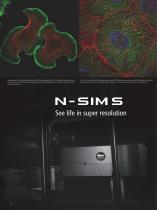
Lamellipodia of NG108 cell labeled with Alexa Fluor® 488 for actin (green) and TRITC-Phalloidin for microtubules (red). Photo courtesy of: Drs. Shizuha Ishiyama and Kaoru Katoh, The National Institute of Advanced Industrial Science and Technology (AIST) LLC-PK1 cell labeled with DAPI for nucleus (blue), Alexa Fluor® 488 for microtubules (green) and TRITC-Phalloidin for actin (red). Photo courtesy of: Dr. Kaoru Katoh, The National Institute of Advanced Industrial Science and Technology (AIST) See life in super resolution
Open the catalog to page 4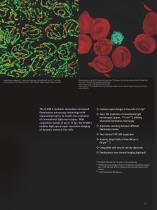
Synaptonemal complexes of C. elegans pachytene germ cells labeled with anti-SYP-1 antibodies. Photo courtesy of: Tyler Machovina and Dr. Judith Yanowitz, Magee-Womens Research Institute. Malaria parasite surface (MTIP) labeled with Alexa Fluor ® 488 (green), Erythrocyte membrane (Band 3) labeled with Alexa Fluor ® 568 (red), DNA labeled with DAPI (blue) Scientific Reports DOI:10.1038/s41598-018-22026-0 Photo courtesy of: Drs. Masayuki Morita, Eizo Takashima, Tadahiro Iimura, Takafumi Tsuboi, Proteo-Science Center, Ehime University The N-SIM S combines innovative structured illumination microscopy...
Open the catalog to page 5
Endosomes of COS7 cell labeled with YFP. Rapid movement of endosomes is captured at high resolution. Image acquisition speed: 6 fps Imaging mode: 3D-SIM Image courtesy of: Yasushi Okada, M.D., Ph.D., Department of Physics, Graduate School of Science, The University of Tokyo Scan the QR code to view a video illustrating super-resolution and widefield images. Capture rapid changes in live cells High-speed super-resolution imaging at 15 fps Nikon’s new high-speed structured illumination system utilizes a novel pattern modulation technology to generate fast and precise switching of illumination patterns....
Open the catalog to page 6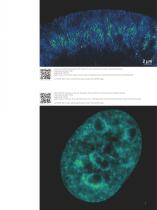
Growth cone of NG108 cell labeled with GFP-Lifeact for F-actin. Formation of actin mesh is captured at high-speed. Image acquisition speed: 10 fps Imaging mode: TIRF-SIM Image courtesy of: Drs. Minami Tanaka and Kaoru Katoh, The National Institute of Advanced Industrial Science and Technology (AIST) Scan the QR code to view a video illustrating super-resolution and widefield images. Histone H2B-GFP expressing in a HeLa cell. Visualization of fine movements of chromatin domains in different locations. Image acquisition speed: 3.9 fps Imaging mode: 3D-SIM Image courtesy of: Yuko Sato, Ph.D. and...
Open the catalog to page 7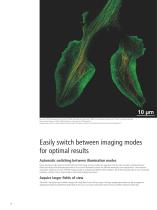
Two-color TIRF-SIM imaging of growth cone of NG108 cell labeled with Alexa Fluor ® 488 for F-actin (green) and Alexa Fluor ® 555 for microtubules (orange) Reconstructed image size: 2048 x 2048 pixels (66 μm x 66 μm with a 100X objective) Sample courtesy of: Drs. Shizuha Ishiyama and Kaoru Katoh, The National Institute of Advanced Industrial Science and Technology (AIST) Easily switch between imaging modes for optimal results Automatic switching between illumination modes Newly-developed, high-speed structured illumination technology not only enables fast acquisition rates but also automatic switching...
Open the catalog to page 8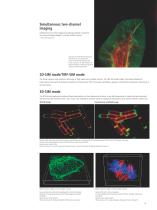
Simultaneous two-channel imaging Simultaneous two-color imaging is possible by utilizing an optional Two Camera Imaging Adaptor* and two sCMOS cameras. * Andor Technology Ltd. Growth cone of NG108 cell expressing GFP-LifeAct (F-actin, green) and mCherry-tubulin (microtubules, red) Photo courtesy of: Dr. Kaoru Katoh, The National Institute of Advanced Industrial Science and Technology (AIST) 2D-SIM mode/TIRF-SIM mode This mode captures super-resolution 2D images at high speed with incredible contrast. The TIRF-SIM mode enables Total Internal Reflection Fluorescence observation at double the resolution...
Open the catalog to page 9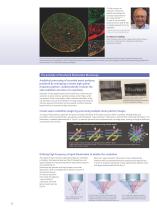
“N-SIM provides the resolution necessary to identify and evaluate the structural organization of the nuclear lamina*1, *2. Its ease of use and stable performance has made N-SIM an integral research tool in my laboratory.” *1 ol Biol Cell. 2015 Nov 5; 26(22):4075-86. M *2 Nature . 2017 Mar 9; 543(7644):261-264. Dr. Robert D. Goldman Ellison Foundation Senior Scholar, Stephen Walter Ranson Professor, Chair, Dept. of Cell & Mol. Biol., Feinberg School of Medicine, Northwestern University Lamin B1 (red) and Lamin C (green) form separate but interacting meshworks within the lamina of the embryonic...
Open the catalog to page 10
Ti2-E with double layer configuration with Perfect Focus Unit Motorized HG fiber illuminator Intensilight TI2-LA-HTIRF H-TIRF module with TI2-LA-FL Epi-Fl module TI2-LA-NS2 N-STORM module 2 with TI2-LA-FL Epi-Fl module** TI2-FT N-SIM motorizedfilter turret LU-NV series laser unit ORCA-Flash4.0 sCMOS camera (Hamamatsu Photonics K.K.) * Required when used with confocal system * Required when configured with N-STORM *** Supplied with microscope main body N-SIM S Specifications Lateral resolution (FWHM of beads in xy) *1 These values are measured using 100 nm diameter beads excited by a 488 nm laser....
Open the catalog to page 11
a: Hippocampal neurons and glia in culture b: Growth cone of a neuron in culture Experience the nanoscale universe
Open the catalog to page 12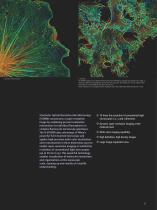
c: Glia in a neuronal culture d: COS cells 3D-STORM imaging of actin labeled with Alexa Fluor ® 647 Phalloidin using depth-code pseudo color. Image “a” shows four types of actin organization, from bottom left to top right: the cell body of a neuron, a glial cell with stress fibers, a neuronal dendrite with spines, and an axon. Photos courtesy of: Dr. Christophe Leterrier, NeuroCyto team, NICN CNRS-AMU UMR7259, Marseille, France STochastic Optical Reconstruction Microscopy (STORM) reconstructs a super-resolution image by combining precise localization information for individual fluorophores in...
Open the catalog to page 13All Nikon Instruments catalogs and technical brochures
 HCA
HCA8 Pages
 DS-Fi3
16 Pages
 A1 HD25 / A1R HD25
15 Pages
 TI-E
TI-E32 Pages
 ECLIPSE TS2
8 Pages
 ECLIPSE TS2R
8 Pages
 N-SIME
6 Pages
 N-SIM N-STORM
24 Pages
 ECLIPSE E100 LED
8 Pages
 ECLIPSE Ti2
24 Pages
 A1 MP+ / A1R MP+
20 Pages
 DIGITAL SIGHT SERIES
16 Pages
 Eclipse LV100N-POL Ci-POL
8 Pages
 Eclipse Ti
32 Pages
 C2 Plus
16 Pages
 Biological Microscopes
24 Pages
 Stereomicroscopes
32 Pages
 SMZ18
SMZ1816 Pages
 N-SIM E
4 Pages


Archived catalogs
 A1 MP+ / A1R MP
15 Pages
 ShuttlePix
8 Pages
 Eclipse FN1
12 Pages
 NeoScope Brochure
16 Pages
 ShuttlePix Brochure
5 Pages
 Bio Station IMQ
8 Pages
 MiBrochure
2 Pages
 AZ_C1
AZ_C12 Pages
 High Content Microscopy
2 Pages
 C2+_2CE-SCHH-5
16 Pages
 A1+_A1R+_2CE-SBTH-9
13 Pages
 N-STORM 4.1
13 Pages
 A1_MP
A1_MP11 Pages
 A1+ / A1R+
13 Pages
 NIS-Elements
8 Pages
 Digital Sight Series
9 Pages
 AZ100M
8 Pages
 ShuttlePix P-400R
5 Pages
 Eclipse Ni
15 Pages
 Eclipse Ci-E/ Ci-L
5 Pages
 AZ100
AZ1004 Pages
 Eclipse E200POL
3 Pages
 Eclipse LV100ND POL/DS
2 Pages
 Eclipse E100 LED
4 Pages
 Eclipse E200 POL
3 Pages
 Biological Microscopes
12 Pages
 ECLIPSE LV100N POL 50i/ POL
4 Pages
 Eclipse E100-LED
8 Pages
 A1 MP+ / A1R MP+
11 Pages
 Digital Sight Series Brochure
16 Pages
- Analysis software
- Compound microscope
- Laboratory microscope
- Desktop microscope
- Visualization software
- Tablet computer software
- Tablet PC software
- Control software
- CMOS camera
- Laboratory software
- Camera with USB port
- LED microscope
- LED light source
- Capture software
- Training software
- Biology microscope
- HD camera
- Microscope camera
- Research microscope