


- Company
- Products
- Catalogs
- News & Trends
- Exhibitions
GBR

GBR
Catalog excerpts
Jahrbuch Implantologie SPECIAL PRINT Edition 2014 • Volume 20 What is Guided Bone Regeneration (GBR) capable of today? Dr med. dent. Bastian Wessing, Dr med. dent. Martin Emmerich,MSc
Open the catalog to page 1
What is Guided Bone Regeneration (GBR) capable of today? GBR is frequently necessary to reconstruct atrophied jaw regions before and/or during insertion of dental implants. It may be necessary not only for mechanical reasons i.e. the secure stabilisation of the implants in the insertion area, but also for the restoration of the “red-white aesthetics” without using pink ceramic material. Here the authors answer the question as to whether GBR is a viable alternative to autogenous block bone graft transplants, and further describe the relevant success factors. Dr med. dent. Bastian Wessing, Dr med....
Open the catalog to page 2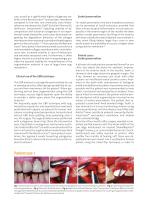
ture, as well as a significantly higher collagenase stability of the Remaix/creos™ xeno.protect membrane compared to the–also non-chemically cross-linked– reference membrane, Bio-Gide® (Geistlich Pharma AG, Wolhusen, Switzerland).35 Exploring stability of decomposition with bacterial collagenase in an experimental model allowed for conclusions to be drawn regarding the degradation behaviour of the collagen membranes when exposed to periodonthopathogenic germs in the oral cavity.23–26 At our practice the Remaix/ creos™ xeno.protect membrane proved successful as a new resorbable collagen membrane...
Open the catalog to page 3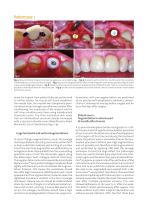
Fig. 5: Metal-reinforced long-term temporary appliance, i.e. bonded bridge. – Fig. 6: Implant insertion after four months (note the completely maintained buccal volume of the jaw ridge). – Fig. 7: Occlusal “emergence profile” after conditioning with a temporary appliance (figure shows screw-connected gingival shaper). – Fig. 8: Position of the customised zirconium dioxide abutment (NobelProcera). There is no ischemia of gingiva due to individualisation of impression post. – Fig. 9: En-face view of completed zirconium dioxide crown at insertion (tooth 11 also treated with Procera crown). move...
Open the catalog to page 4
post surgery, the patient did not experience any further pain. However, pain control during the initial stage was achieved with regular administration of ibuprofen 400 mg 2–3 times per day. After healing of the augmentation material, the operation site showed a wide jaw ridge with vital, newly formed bone (bleeding with pilot drilling and removal of Bio-Oss® particles in the surface region). After a healing time of six months, two NobelReplace® Conical Connection (Nobel Biocare AG, Zurich, Switzerland) measuring 4 x 11.5 mm were inserted in the areas 12 and 21. The implants were inserted with...
Open the catalog to page 5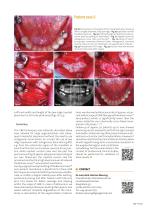
Patient case 3 Fig. 18: Occlusal view: in the region of the missing teeth 36, 37 and 45, 46 there is a highly atrophied, sharp jaw ridge. – Fig. 19: Operation site with atrophied jaw bone. – Fig. 20: Drilling through compact bone into cancellous bone for yielding of “bone blood”. – Fig. 21: Applied mixture of autogeneous bone chips and Bio-Oss® – Fig. 22: Remaix™/creos™ xeno.protect membrane (Matricel GmbH, Herzogenrath, Germany) fixed by titanium pins for stabilisation of augmentation material. – Fig. 23: Postoperative OPG image. – Fig. 24: Occlusal view after removal of suture three weeks after...
Open the catalog to page 6All Nobel Biocare Services AG catalogs and technical brochures
 All-on-4® digital workflow
26 Pages
 X-Guide
2 Pages
 Product catalog 2024/2025
220 Pages
 NobelPearl™
8 Pages

Archived catalogs
 Posterior_Solution_Brochure
6 Pages
 On1 concept
6 Pages
 Temporay snap abutment
2 Pages
 creos
creos4 Pages
 Nobelspeedy
6 Pages
 All-on-4 ®
6 Pages
 creos™
16 Pages
 Product Catalog 2017/18
372 Pages
 TiUnite
2 Pages
 All-on-4
6 Pages
 4® treatment concept
16 Pages
 Conical connection
8 Pages
 Exceptional brochure long
28 Pages
 creos xenograft brochure
16 Pages
 Global Course Catalog 2016
64 Pages


- Nobel Biocare implant abutment
- Nobel Biocare titanium implant abutment
- Nobel Biocare straight implant abutment
- Dental surgery instrument kit
- Nobel Biocare titanium dental implant
- Internal implant abutment
- Nobel Biocare conical dental implant
- Angled implant abutment
- Nobel Biocare straight dental implant
- Dental implant surgery instrument kit
- Hexagonal implant abutment
- Screw implant abutment
- Nobel Biocare internal dental implant
- Nobel Biocare cylindrical dental implant
- Dental implant analog
- Internal hexagon implant abutment
- Straight dental implant analog
- Nobel Biocare narrow dental implant