


- Company
- Products
- Catalogs
- News & Trends
- Exhibitions
TiUnite

TiUnite
The document presents a comprehensive meta-analysis of the TiUnite implant surface, highlighting its effectiveness in supporting peri-implant health, bone maintenance, and overall treatment success over the long term.
Key Findings
- Implant Success Rates: The TiUnite implant surface shows a 95.1% success rate at the implant level over 10 years and over 99% at the implant level after 1 year.
- Bone Maintenance: The marginal bone level change from implant insertion at a 5-year follow-up is minimal, with a change of -0.9 mm considered successful.
- Peri-implantitis Prevalence: Low prevalence of peri-implantitis is reported, with a low estimate of 1.36%.
- Study Scope: The analysis includes 106 prospective studies, covering 12,803 TiUnite implants and 4,694 patients.
Methodology
The meta-analysis screened 32,519 publications and included all patients with a TiUnite implant evaluated in clinical studies with a minimum of 20 patients and 12 months post-loading.
Conclusion
The TiUnite implant surface promotes a healthy bone response during the first year, which remains stable over the long term. There is strong evidence of high implant survival and low rates of peri-implantitis with TiUnite surface implants.
Additional Information
For more details, visit nobelbiocare.com/tiunite. Note that some products may not be available in all markets, and the device is restricted to sale by or on the order of a licensed dentist.
Catalog excerpts
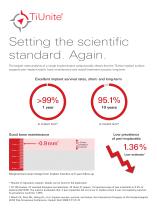
Setting the scientific standard. Again. The largest meta-analysis of a single implant brand unequivocally shows that the TiUnite implant surface supports peri-implant health, bone maintenance and overall treatment success, long term. Excellent implant survival rates, short- and long-term Good bone maintenance -1 mm Marginal bone level change from implant insertion at 5-year follow-up * Results of regression analysis. Details can be found in full publication. † Of 106 studies, 47 reported biological complications. Of these 47 papers, 19 reported cases of peri-implantitis in 5.2% of patients (64/1229). The authors postulated that, if peri-implantitis did not occur in studies where it was not explicitly reported, its prevalence would be 1.36%. ‡ Misch CE, Perel ML, Wang HL, et al. Implant success, survival, and failure: the International Congress of Oral Implantologists (ICOI) Pisa Consensus Conference. I
Open the catalog to page 1
The largest meta-analysis of a single implant brand prospective studies publications screened No cherry picking Includes all patients with a TiUnite implant prospectively evaluated in a clinical study with a minimum of 20 patients and 12 months post-loading. 99TiUnite promotes a healthy bone response during the first year which remains stable over the long term. 99Strong evidence of high implant survival with TiUnite surface. 99Low rates of reported peri-implantitis in patients with TiUnite surface implants. Karl M, Albrektsson T. Clinical performance of dental implants with a moderately rough...
Open the catalog to page 2All Nobel Biocare Services AG catalogs and technical brochures
 All-on-4® digital workflow
26 Pages
 X-Guide
2 Pages
 Product catalog 2024/2025
220 Pages
 NobelPearl™
8 Pages

Archived catalogs
 Posterior_Solution_Brochure
6 Pages
 On1 concept
6 Pages
 Temporay snap abutment
2 Pages
 creos
creos4 Pages
 Nobelspeedy
6 Pages
 All-on-4 ®
6 Pages
 creos™
16 Pages
 Product Catalog 2017/18
372 Pages
 All-on-4
6 Pages
 4® treatment concept
16 Pages
 Conical connection
8 Pages
 GBR
GBR6 Pages
 Exceptional brochure long
28 Pages
 creos xenograft brochure
16 Pages
 Global Course Catalog 2016
64 Pages


- Nobel Biocare implant abutment
- Nobel Biocare titanium implant abutment
- Nobel Biocare straight implant abutment
- Dental surgery instrument kit
- Nobel Biocare titanium dental implant
- Internal implant abutment
- Nobel Biocare conical dental implant
- Angled implant abutment
- Nobel Biocare straight dental implant
- Dental implant surgery instrument kit
- Hexagonal implant abutment
- Bone substitute
- Screw implant abutment
- Nobel Biocare internal dental implant
- Nobel Biocare cylindrical dental implant
- Dental implant analog
- Internal hexagon implant abutment
- Straight dental implant analog
- Nobel Biocare narrow dental implant