

Onyx® in the Hospital Setting: a Six Month Study

Onyx® in the Hospital Setting: a Six Month Study
The white paper discusses a six-month study on the use of the Onyx® fingertip pulse oximeter in a hospital setting, highlighting its impact on reducing oximetry costs, enhancing patient care, and improving staff efficiency.
Background
Many hospital units face challenges with limited pulse oximeters, leading to time lost in searching for devices and impacting patient care. The Onyx® is a compact, all-in-one digital fingertip pulse oximeter designed to be easily carried by caregivers, allowing for immediate patient assessment.
Study Overview
The study was conducted in a 500-bed tertiary care facility, focusing on a 32-bed medical-surgical unit. The Onyx replaced traditional handheld oximeters, excluding patients on continuous SpO2 monitoring. Clinicians reported time saved and improved patient care.
Challenges Identified
- High sensor costs and frequent inventory depletion.
- Delays in patient assessment due to unavailable handheld units.
- Inadequate battery life and time spent managing sensor inventory.
Implementation Plan
Each clinician received an Onyx with a carrying case and lanyard. They were instructed to use it for routine vital signs and spot-checks, reporting time saved and effects on patient care.
Results
- 100% of clinicians found the Onyx easy to use and a time saver.
- Nurses saved an average of 21 minutes per shift, while respiratory therapists saved 100 minutes.
- 94% of clinicians felt the Onyx enhanced patient care.
- Cost savings were significant, with a reduction in sensor costs and improved efficiency.
Cost and Efficiency Savings
The study demonstrated substantial cost savings, with the initial investment in Onyx units offset by reduced sensor costs and increased efficiency.
Clinician Feedback
Feedback was overwhelmingly positive, with clinicians appreciating the convenience and time efficiency of the Onyx, allowing for more frequent and immediate patient assessments.
Technological Features
The Onyx incorporates PureLight® and PureSAT® technologies, ensuring accurate SpO2 readings and reducing false alarms, even in challenging environments.
Conclusion
The Onyx® pulse oximeter proved to be a valuable tool in the hospital setting, enhancing patient care, reducing costs, and improving staff efficiency.
Catalog excerpts
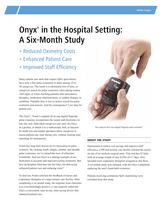
White Paper Onyx in the Hospital Setting: A Six-Month Study ® • Reduced Oximetry Costs • Enhanced Patient Care • Improved Staff Efficiency Many patient care units that require SpO2 spot-checks have only a few pulse oximeters to share among 10 to 30 caregivers. The result is a substantial loss of time, as caregivers search for pulse oximeters when taking routine vital signs, or when checking patients after procedures, therapies, medication administration, or sudden changes in condition. Valuable time is lost as nurses search for pulse oximeters and sensors. And the consequence? Less time for patient care. The Onyx®, Nonin’s original all-in-one digital fingertip pulse oximeter, incorporates the sensor and electronics in one tiny unit. Individual caregivers can carry the Onyx in a pocket, or attach it to a stethoscope, belt, or lanyard. Its small size and simple operation allow caregivers to assess patients any time during care, without wasting time searching for instruments. The original all-in-one digital fingertip pulse oximeter™ About the Study Nonin has long been known for its innovation in pulse oximetry. By creating small, simple, reliable, and durable pulse oximeters, we’ve earned the trust of clinicians worldwide. And our Onyx is a shining example of our dedication to accurate and innovative pulse oximeters. But how do hospital clinicians rate the Onyx for delivering enhanced patient care and reducing costs? Determined to realize cost savings and improve staff efficiency, a 500 bed tertiary care facility enlisted the nurses on one of its medical-surgical units. This unit has 32 beds with an average length of stay (LOS) of 4.7 days. Also included were respiratory therapists assigned to that floor. A six-month study was initiated, with the Onyx completely replacing the unit’s hand-held oximeters. To find out, Nonin solicited the feedback of nurses and respiratory therapists at a large tertiary care facility. After completing a six-month study, the response from clinicians was overwhelmingly positive: a vast majority called the Onyx a convenient, easy-to-use, time-saving device that enhanced patient care. Patients receiving continuous SpO2 monitoring were excluded from this study.
Open the catalog to page 1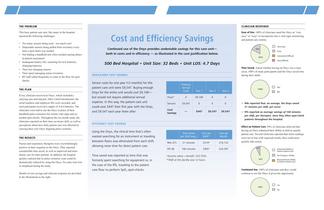
The Problem Clinician Response This busy patient care unit, like many in the hospital, reported the following challenges: Ease of Use. 100% of clinicians rated the Onyx as “very easy” or “easy” to incorporate into a vital signs monitoring and patient care routine. • Too many sensors being used – too much cost! • Disposable sensors being pulled from inventory every time a spot-check was needed • Not finding a handheld unit when needed causing delays in patient assessment • Inadequate battery life; searching for new batteries, changing batteries • Time lost changing sensors • Time spent managing...
Open the catalog to page 2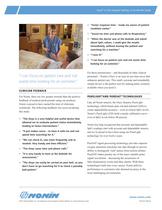
Onyx® in the Hospital Setting: A Six-Month Study • “Faster response time – made me aware of patient condition earlier.” • “Saved me time and phone calls to Respiratory.” • “When the doctor was at the bedside and asked about SpO2 values, I could give the results immediately, without leaving the patient and searching for a machine.” • “I love it!” • “I can focus on patient care and not waste time looking for an oximeter.” “I can focus on patient care and not waste time looking for an oximeter.” Clinician Feedback For Nonin, there are few greater rewards than the positive feedback of medical professionals...
Open the catalog to page 3All Nonin catalogs and technical brochures
 Unmatched Pulse Oximetry
1 Page
 NoninConnect Elite 3240
4 Pages
 8204CA
4 Pages
 8000 series
2 Pages
 6000 C series
2 Pages


Archived catalogs
 SenSmart® 8006 Hybrid Sensor
2 Pages
 WristOx2 ® Model 3150 USB
2 Pages
 Narcotrend Compact-M
2 Pages
 9840/8500 Series
1 Page
 Onyx III 9591
2 Pages
 USB-Desaturation
1 Page
 Capnography-for-CPR.
2 Pages
 Nonin3230-3231
4 Pages
 PalmSAT 2500 Brochure
2 Pages
 Capnography Pain Management
2 Pages
 CapnographyEMSTransport
2 Pages
 RespSense
2 Pages
 Why Nonin Sensors
4 Pages
 PureSAT Advantage
2 Pages
 Product Catalog
21 Pages
 Avant 2120
2 Pages
 Model 7500 Series
2 Pages
 PureLight Sensors Brochure
2 Pages
 3150 Sleep Flyer
2 Pages
 LifeSense VET Brochure
2 Pages
 Nonin Onyx Brochure
6 Pages
 LifeSense®
2 Pages
 WristOx 3100 Brochure
2 Pages
 ipod Specifications
6 Pages
 WIDESCREEN Pulse Oximeter
2 Pages
 Vet Family Brochure
4 Pages
 System Story Brochure
2 Pages
 OEM Xpod Brochure
2 Pages
 Avant® 9600
2 Pages
 Onyx II, Model 9560 Brochure
3 Pages
 Avant® 9700
2 Pages
 Model 8500 Series
2 Pages
 Capnography Use in Homecare
2 Pages
 EQUANOX?, Model 7600
2 Pages
 Flexi-Form ® III 7000 Series
2 Pages
 Cloth 6000C Series
2 Pages
 Onyx Vantage 9590
2 Pages
 Dr Petty GO2 Brochure
13 Pages
 nVision
4 Pages
 2500A VET Spec Sheet
2 Pages
 PulseSense VET Brochure
2 Pages
 RespSense VET Brochure
2 Pages
 9847V Brochure
2 Pages
 Model 8500AV Brochure
2 Pages
 3150 Ambulatory Flyer
2 Pages
 LifeSense®
2 Pages
 WristOx2?
2 Pages
 9840 Series
2 Pages
 Model 7500
4 Pages
 SpO2 Disposable Sensors
4 Pages
 9500 Spec Sheet
2 Pages
 Onyx® II 9550
2 Pages
 Onyx9550
4 Pages
 Vet Family Brochure Old
4 Pages
 LifeSense® Old
2 Pages
 Product catalog
21 Pages
 System Story Brochure Old
4 Pages
 Avant® 9600
1 Page
 Onyx® II, Model 9560
4 Pages


- Analysis software
- Patient monitor
- Medical sensor
- Tablet computer software
- Tablet PC software
- SpO2 sensor
- Reporting software
- Medical pulse oximeter
- Windows software
- SpO2 patient monitor
- Portable patient monitor
- Online software
- Battery-powered pulse oximeter
- Dental software
- Clinical patient monitor
- Fingertip SpO2 sensor
- CO2 patient monitor
- Data management software