
- Catalogs
- NORAV Medical
- NECG SE-301


NECG SE-301
NECG SE-301
This manual provides guidance on the operation and maintenance of the SE-301 Electrocardiograph, emphasizing compliance to avoid malfunctions or accidents. Unauthorized reproduction of the content is prohibited.
The SE-301 Electrocardiograph is intended for use in hospitals by trained professionals to acquire ECG signals from patients. It is not suitable for home use or direct cardiac application.
- Indications for Use: For acquiring ECG signals from adult and pediatric patients in healthcare facilities.
- Warnings: Avoid use in the presence of flammable anesthetics or high static electricity. Use only manufacturer-supplied accessories.
- Cautions: Follow proper operation procedures to prevent equipment damage or inaccurate data.
Instructions include loading recorder paper, preparing the patient, and connecting cables and electrodes.
Details on entering patient information and printing ECG reports are provided.
Guidance on transmitting, copying, and deleting ECG records, as well as printing patient records.
Information on configuring work modes, filters, patient information, and transmission settings.
Chapters dedicated to identifying and resolving common errors.
Instructions for cleaning and disinfecting the device and its components, as well as battery maintenance.
Information on available accessories and warranty details.
Appendices provide detailed safety, environmental, physical, power supply, and performance specifications.
- Use non-polarizing electrodes to avoid DC offset voltage during defibrillation.
- Pacemakers may affect equipment results.
- Disposable electrodes are mandatory for defibrillation.
- Avoid using electrodes of dissimilar metals.
- Do not touch the patient or equipment during ECG and defibrillator use.
- Maintain a 20cm distance between WIFI equipment and the human body.
- Ensure all connected equipment complies with IEC/EN standards.
- The device is not safe for MRI environments.
- Only authorized personnel should replace the battery.
- Dispose of batteries according to local regulations.
- Device restricted to sale by or on the order of a physician.
- Operate within specified temperature ranges.
The SE-301 is a 3-channel electrocardiograph capturing ECG signals from 12 leads simultaneously, featuring a high-quality thermal recorder and various operational modes.
- Load thermal paper correctly.
- Prepare the patient by explaining the procedure and cleaning the skin.
- Reusable and disposable electrodes are available, with identifiers and color codes complying with standards.
- Ensure cleanliness and proper placement of electrodes.
- Ensure no electromagnetic interference and proper connections.
- Enter patient information manually or via network connection.
- ECG records can be saved, transmitted, and deleted as needed.
- Instructions for deleting and printing patient records.
- Details on configuring work modes, filters, and transmission settings.
- Common error messages and their causes.
- Solutions for operating, printing, and transmission problems.
- Use approved cleaning agents and perform regular maintenance checks.
Regular checks on the integrity of the patient cable are essential.
Clean electrodes after use and replace if oxidized.
Dispose of the device and accessories according to local regulations.
Use only manufacturer-supplied accessories.
The manufacturer guarantees products meet specifications within the warranty period.
Safety: Complies with IEC and EN standards.
Environment: Operating temperature is 5ºC to 40ºC.
Physical: Dimensions and weight specifications.
Power Supply: Operates on 100V-240V with a built-in lithium battery.
Performance: Features a thermal dot-matrix recorder.
Complies with CISPR 11 standards for specific electromagnetic environments.
Details on frequency bands, technologies, and recommended separation distances.
Catalog excerpts

About this Manual P/N: 01.54.456811 MPN: 01.54.456811017 Release Date: December 2018 Statement This manual will help you understand the operation and maintenance of the product better. It is reminded that the product shall be used strictly complying with this manual. User's operation failing to comply with this manual may result in malfunction or accident for which the manufacturer. (hereinafter called the manufacturer) cannot be held liable. The manufacturer owns the copyrights of this manual. Without prior written consent of the manufacturer, any materials contained in this manual shall not...
Open the catalog to page 2
The instrument is used in accordance with the instructions for use. Terms Used in this Manual This guide is designed to give key concepts on safety precautions. WARNING A WARNING label advises against certain actions or situations that could result in personal injury or death. CAUTION A CAUTION label advises against actions or situations that could damage equipment, produce inaccurate data, or invalidate a procedure. NOTE A NOTE provides useful information regarding a function or a procedure.
Open the catalog to page 3
SE-301 Electrocardiograph User Manual Safety Guidance Chapter 1 Safety Guidance This chapter provides important safety information related to the use of the 3-Channel Electrocardiograph. 1.1 Indications for Use/Intended Use The intended use of the 3-Channel Electrocardiograph is to acquire ECG signals from adult and pediatric patients (beginning at birth through 21 years of age) through body surface ECG electrodes. The electrocardiograph is intended to be used only in hospitals or healthcare facilities by doctors and trained healthcare professionals. The cardiogram recorded by the 3-Channel Electrocardiograph...
Open the catalog to page 7
SE-301 Electrocardiograph User Manual Safety Guidance 1. The electrocardiograph is provided for the use of qualified physicians or personnel professionally trained. They should be familiar with the contents of this user manual before operation. 2. Only qualified service engineers can install this equipment, and only service engineers authorized by the manufacturer can open the shell. Otherwise, safety hazards may happen. 3. The EQUIPMENT is protected against malfunction caused by electrosurgery. 4. EXPLOSION HAZARD - Do not use the electrocardiograph in the presence of flammable anesthetic mixture...
Open the catalog to page 8
SE-301 Electrocardiograph User Manual Safety Guidance 13. To avoid a polarization or DC offset voltage, use non-polarizing electrodes(which will not form a DC offset voltage when subjected to a DC current) such as silver/silver-chloride types if there is a situation where there is a likelihood that a defibrillation procedure will be necessary. 14. There is no danger for patients with pacemakers. However, if a pacemaker is used, the results given by the equipment may be invalid, or lose the clinical significance. 15. Disposable electrodes must be used during defibrillation. 16. Electrodes of dissimilar...
Open the catalog to page 9
SE-301 Electrocardiograph User Manual Safety Guidance 25. Do not connect any equipment or accessories that are not approved by the manufacturer or that are not IEC/EN 60601-1 approved to the electrocardiograph. The operation or use of non-approved equipment or accessories with the electrocardiograph is not tested or supported, and electrocardiograph operation and safety are not guaranteed. 26. Any non-medical equipment (such as the external printer) is not allowed to be used within the patient vicinity (1.5m/6ft.). 27. Multiple portable socket-outlets shall not be placed on the floor. 28. Do...
Open the catalog to page 10
SE-301 Electrocardiograph User Manual Safety Guidance 32. If multiple instruments are connected to a patient, the sum of the leakage currents may exceed the limits given in the IEC/EN 60601-1 and may pose a safety hazard. Consult your service personnel. 33. The potential equalization conductor can be connected to that of other equipment when necessary, to make sure that all these devices are connected to the potential equalization bus bar of the electrical installation. 34. The electrocardiograph shall not be serviced or maintained while in use with a patient. 35. The appliance coupler or mains...
Open the catalog to page 11
SE-301 Electrocardiograph User Manual Safety Guidance 1. Improper operation may cause the lithium battery (hereinafter called battery) to be hot, ignited or exploded, and it may lead to the declination of the battery capacity. It is necessary to read the user manual carefully and pay more attention to warning messages. 2. Only qualified service engineer authorized by the manufacturer can open the battery compartment and replace the battery, and batteries of the same model and specification as manufacturer configuration should be used. 3. DANGER OF EXPLOSION -- Do not reverse the anode and the...
Open the catalog to page 12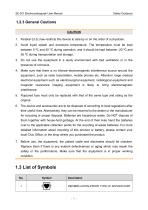
SE-301 Electrocardiograph User Manual Safety Guidance 1. Federal (U.S.) law restricts this device to sale by or on the order of a physician. 2. Avoid liquid splash and excessive temperature. The temperature must be kept between 5 °C and 40 °C during operation, and it should be kept between -20 °C and 55 °C during transportation and storage. 3. Do not use the equipment in a dusty environment with bad ventilation or in the presence of corrosive. 4. Make sure that there is no intense electromagnetic interference source around the equipment, such as radio transmitters, mobile phones etc. Attention:...
Open the catalog to page 13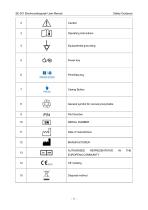
SE-301 Electrocardiograph User Manual Safety Guidance Operating instructions Casing Button General symbol for recovery/recyclable Part Number SERIAL NUMBER AUTHORISED REPRESENTATIVE IN THE EUROPEAN COMMUNITY Disposal method
Open the catalog to page 14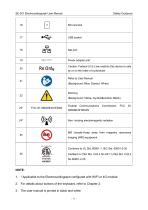
SE-301 Electrocardiograph User Manual Safety Guidance Power adapter port Caution: Federal (U.S.) law restricts this device to sale by or on the order of a physician Refer to User Manual 21 (Background: Blue; Symbol: White) Warning 22 (Background: Yellow; Symbol&Outline: Black) Non- ionizing electromagnetic radiation MR Unsafe–Keep away from magnetic resonance imaging (MRI) equipment NOTE: 1. * Applicable to the Electrocardiograph configured with WIFI or 4G module. 2. For details about buttons of the keyboard, refer to Chapter 2. 3. The user manual is printed in black and white. - 9 -
Open the catalog to page 15All NORAV Medical catalogs and technical brochures
 Norav User Guide
12 Pages
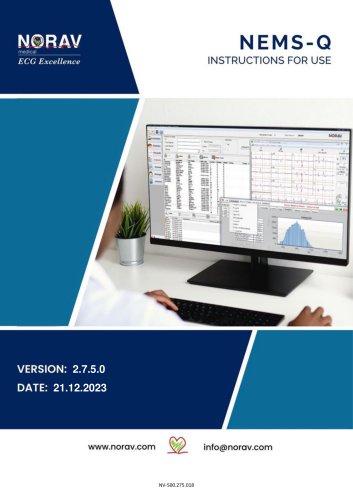 NEMS-Q
44 Pages
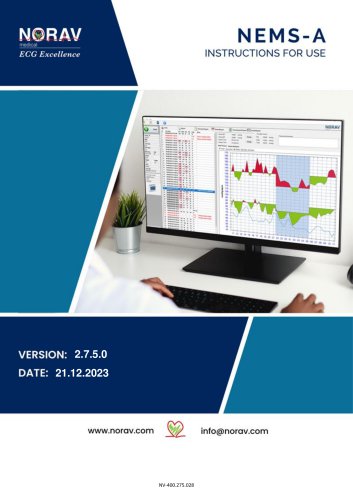 NEMS-A
33 Pages
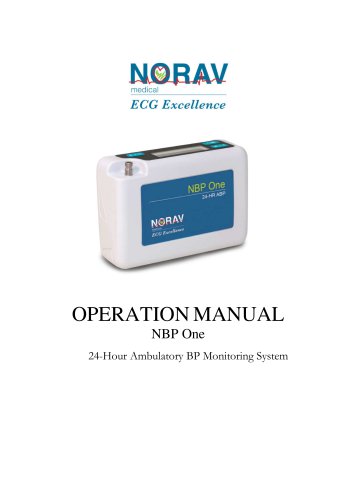 NBP One Ambulatory Blood Pressure
35 Pages
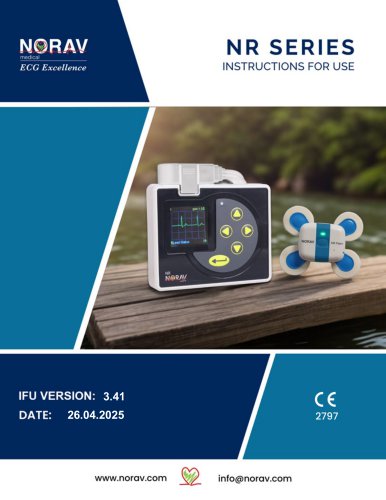 NR SERIES
40 Pages
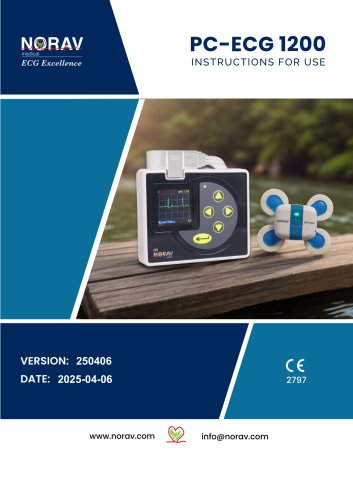 PC-ECG1200
143 Pages
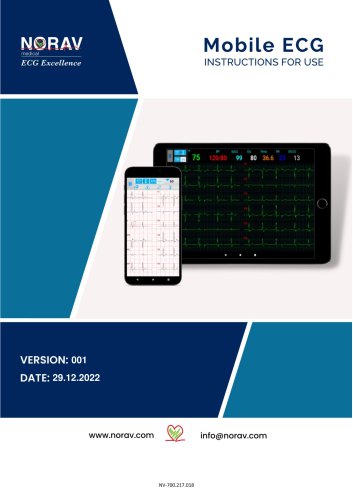 Mobile ECG
91 Pages
 NECG SE-1200 Pro
81 Pages
 Telemetry Tango Mobile
4 Pages
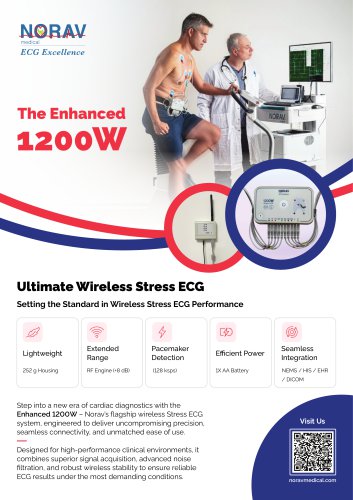 Enhanced 1200W
4 Pages
 Telemetry
30 Pages
Archived catalogs
 Stress Test ECG
4 Pages
 Resting ECG
6 Pages
 Holter
4 Pages
 ECG Management System
2 Pages
 Thermal Printers
4 Pages
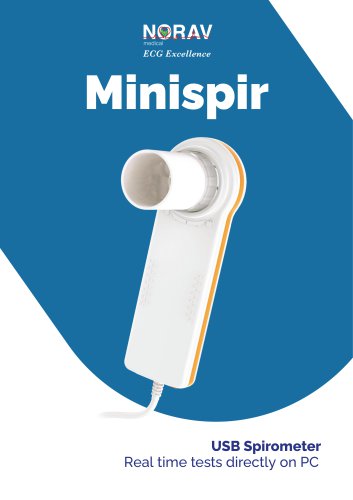 System Spirometer Minispir
6 Pages

- Medical dolly
- Hospital trolley
- Medical device trolley
- Anodized aluminum trolley
- Analysis software
- Plastic trolley
- Patient monitor
- SpO2 monitor
- Visualization software
- Equipment trolley
- Tablet computer software
- Tablet PC software
- Reporting software
- Medical pulse oximeter
- Windows software
- Height-adjustable trolley
- Blood pressure patient monitor
- NORAV digital electrocardiograph
- Compact trolley