
- Catalogs
- NSK Europe Ltd.
- LARGE SIZE ROLLING BEARINGS

LARGE SIZE ROLLING BEARINGS

LARGE SIZE ROLLING BEARINGS
The document is the Large-Size Rolling Bearing Catalog by NSK, addressing the need for higher speeds, precision, and reliability in rolling bearings. It provides a comprehensive range of bearings and technical information to assist in selecting the appropriate type for various applications.
- Selection of Bearing Size: Discusses bearing life, dynamic load ratings, and fatigue life, emphasizing the importance of selecting the correct bearing size based on dynamic load ratings.
- Bearing Tolerances: Covers standards for bearing tolerances to ensure proper fit and function.
- Fitting and Internal Clearances: Highlights the importance of correct fits and internal clearances for optimal performance.
- Lubrication: Explains the purposes, methods, and types of lubricants used to enhance performance and longevity.
- Bearing Materials: Describes materials used for bearing rings, rolling elements, and cages, emphasizing material selection for durability.
Includes detailed tables for various types of bearings, providing information on dimensions, load ratings, and other critical specifications.
Highlights special NSK bearings designed for specific applications, such as steel mills and industrial robots, with application drawings and appendices for reference.
- Rolling Fatigue Life: Defined as the period during which bearings operate satisfactorily, considering factors like noise, vibration, and material fatigue.
- Basic Dynamic Load Rating: A measure of the load a bearing can endure for a specified number of revolutions.
- Temperature Adjustments: Discusses the impact of high temperatures on bearing material and necessary adjustments to load ratings.
- Life Adjustment Factors: Factors such as reliability, material improvements, and operating conditions that influence the adjusted rating life of bearings.
The catalog serves as a comprehensive guide for selecting the optimal bearing for various applications, with detailed technical information and support from NSK engineers available for further assistance.
Lubrication is crucial for prolonging the fatigue life of rolling contact surfaces, preventing overheating and deterioration.
Divided into grease and oil lubrication, with the choice depending on application and operating conditions.
Discusses grease quantity, replacement, and replenishing intervals.
Describes various oil lubrication methods, including oil bath, drip feed, splash, circulating, jet, oil mist, and oil-air lubrication.
Discusses lubricating grease and oil, with properties depending on base oil viscosity and thickener type.
Provides recommended viscosities for bearings under normal operating conditions.
Describes materials used for bearing rings and rolling elements, with chemical compositions detailed in tables.
Discusses materials used for pressed and machined cages, with chemical compositions provided.
Describes single-row deep groove ball bearings and their suitability for high-speed applications.
1. Triple-Ring Bearings: Feature specially designed inner rings and cages to improve lubrication.
2. Crossed Roller Bearings: Designed for industrial robots, sustaining both radial and axial loads.
1. Crossed Roller Bearings: Used in rotating joints of robots.
2. Special NSK Bearings: Include ladder bearings and sealed-clean bearings for various applications.
1. Internal Clearances: Provides tables for recommended fits and internal clearances.
2. Preloading: Increases rigidity and improves positioning accuracy.
1. Basic Load Ratings: Includes tables listing basic load ratings.
2. Dimensions and Mass: Provides dimensions and approximate mass for various models.
1. Sealed-Clean Bearings: Feature flexible seals and special grease.
2. Double-Split Bearing Units: Offer high load capacity and easy handling.
Catalog excerpts
LARGE SIZE ROLLING BEARINGS
Open the catalog to page 1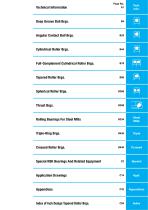
Technical Information Deep Groove Ball Brgs. Tech. Info. Angular Contact Ball Brgs. Cylindrical Roller Brgs. Full-Complement Cylindrical Roller Brgs. Tapered Roller Brgs. Spherical Roller Brgs. Thrust Brgs. Rolling Bearings For Steel Mills Steel Mills Triple-Ring Brgs. Crossed Roller Brgs. Application Drawings Index of Inch Design Tapered Roller Brgs. Special NSK Bearings And Related Equipment
Open the catalog to page 2
Introduction to NSK Large-Size Rolling Bearing Catalog (CAT. No. E125f) We want to thank you for your interest in this edition of our Large-Size Rolling Bearing Catalog. Recently, operating requirements for machines and other equipment that use rolling bearings have become increasingly severe and diversified. Accordingly, rolling bearings, which are highly important machine elements, must be designed to satisfy more and more stringent requirements for higher speeds, greater precision, higher reliability, and other challenging demands. We edited this Large-Size Rolling Bearing Catalog to reflect...
Open the catalog to page 3
1. SELECTION OF BEARING SIZE 1.1 Bearing Life The various functions required of rolling bearings vary according to the bearing application. These functions must be performed for a prolonged period. Even if bearings are properly mounted and correctly operated, they will eventually fail to perform satisfactorily due to an increase in noise and vibration, loss of running accuracy, deterioration of grease, or fatigue flaking of the rolling surfaces. Bearing life, in the broad sense of the term, is the period during which bearings continue to operate and to satisfy their required functions. This bearing...
Open the catalog to page 7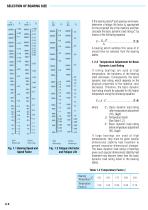
SELECTION OF BEARING SIZE Ball Bearings Roller Bearings Fig. 1.1 Bearing Speed and Speed Factor If rolling bearings are used at high temperature, the hardness of the bearing steel decreases. Consequently, the basic dynamic load rating, which depends on the physical properties of the material, also decreases. Therefore, the basic dynamic load rating should be adjusted for the higher temperature using the following equation: 1.2.3 Temperature Adjustment for Basic Dynamic Load Rating If the bearing load P and speed n are known, determine a fatigue life factor f h appropriate for the projected life...
Open the catalog to page 8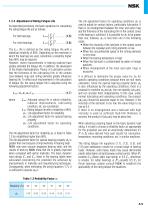
1.2.4 Adjustment of Rating Fatigue Life As described previously, the basic equations for calculating the rating fatigue life are as follows: The life adjustment factor for reliability a 1 is listed in Table 1.3 for reliabilities higher than 90%. The life adjustment factor for special bearing property a 2 is greater than one because of improvements in bearing steel. NSK now uses vacuum degassed bearing steel, and the results of tests by NSK show that life is greatly improved when compared with earlier materials. The basic dynamic load ratings C r and C a listed in the bearing tables were calculated...
Open the catalog to page 9
SELECTION OF BEARING SIZE 1.3 Calculation of Bearing Loads 1.3.2 Average of Fluctuating Load The loads applied on bearings generally include the weight of the body to be supported by the bearings, the weight of the revolving elements themselves, the transmission power of gears and belting, the load produced by the operation of the machine in which the bearings are used, etc. These loads can be theoretically calculated, but some of them are difficult to estimate. Therefore, it become necessary to correct the estimates using empirically derived data. When the load applied on bearings fluctuates,...
Open the catalog to page 10
Fig. 1.3 Incremental Load Variation Fig. 1.4 Simple Load Fluctuation 1.4 Dynamic Equivalent Load In some cases, the loads applied on bearings are purely radial or axial loads; however, in most cases, the loads are a combination of both. In addition, such loads usually fluctuate in both magnitude and direction. In such cases, the loads actually applied on bearings cannot be used for bearing life calculations; therefore, a hypothetical load that has a constant magnitude and passes through the center of the bearing, and will give the same bearing life that the bearing would attain under actual conditions...
Open the catalog to page 11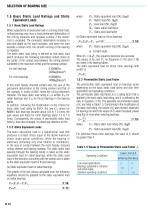
SELECTION OF BEARING SIZE 1.5 Basic Static Load Ratings and Static Equivalent Loads 1.5.1 Basic Static Load Ratings When subjected to an excessive load or a strong shock load, rolling bearings may incur a local permanent deformation of the rolling elements and raceway surface if the elastic limit is exceeded. The nonelastic deformation increases in area and depth as the load increases, and when the load exceeds a certain limit, the smooth running of the bearing is impeded. The basic static load rating is defined as that static load which produces the following calculated contact stress at the...
Open the catalog to page 12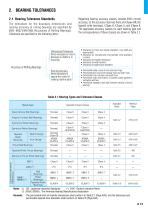
2. BEARING TOLERANCES 2.1 Bearing Tolerance Standards Regarding bearing accuracy classes, besides ISO normal accuracy, as the accuracy improves there are Class 6X (for tapered roller bearings), Class 6, Class 5, and Class 4. The applicable accuracy classes for each bearing type and the correspondence of these classes are shown in Table 2.1. The tolerances for the boundary dimensions and running accuracy of rolling bearings are specified by ISO 492/199/582 (Accuracies of Rolling Bearings). Tolerances are specified for the following items: Dimensional Tolerances Items necessary to mount bearings...
Open the catalog to page 13
BEARING TOLERANCES (Reference) Rough definitions of the items listed for Running Accuracy and their measuring methods are shown in Fig. 2.1, and they are described in detail in ISO 5593 (Rolling Bearings-Vocabulary) and JIS B 1515 (Rolling Bearings-Tolerances) and elsewhere. Supplementary Table Running Accuracy Inner Ring Outer Ring Dial Gauge Only the shaft or housing or central washer is to be rotated. Measuring Weight Measuring Weight Stops at two points for inside or outside surface Supporting pins at three points around circumference Fig. 2.1 Measuring Methods for Running Accuracy (summarized)...
Open the catalog to page 14
Symbols for Boundary Dimensions and Running Accuracy d &ds &dmp Vdp Nominal bore diameter Deviation of a single bore diameter Single plane mean bore diameter deviation Bore diameter variation in a single radial plane Mean bore diameter variation Nominal outside diameter Deviation of a single outside diameter Single plane mean outside diameter deviation Outside diameter variation in a single radial plane Mean outside diameter variation Nominal inner ring width Deviation of a single inner ring width Inner ring width variation Nominal outer ring width Deviation of a single outer ring width Outer...
Open the catalog to page 15All NSK Europe Ltd. catalogs and technical brochures
 NEW BEARING DOCTOR
44 Pages
 BEARING DESIGNATION SYSTEMS
48 Pages
 ROLLING BEARINGS
704 Pages



Archived catalogs
 DH/DS Series
1 Page
 K1-L
K1-L1 Page
 K1
K11 Page
 NH and NS Series
1 Page
 HA / HS Series
1 Page
 TECHNICAL REPORT
302 Pages