
- Catalogs
- NSK Europe Ltd.
- TECHNICAL REPORT

TECHNICAL REPORT

TECHNICAL REPORT
- ISO Dimensional System: This system standardizes the dimensions of rolling bearings to ensure global compatibility, covering bore diameter, outside diameter, width, and chamfer dimensions. It includes dimensions from a bore size of 0.6 mm to an outside diameter of 2500 mm, with specific equations for radial and thrust bearings.
- Formulation of Bearing Numbers: Bearing numbers are not standardized by ISO but often follow systems like SKF. Japanese manufacturers use a 4 or 5-digit system combining width and diameter series symbols. Bore diameter symbols are derived from the bore size, with specific rules for dimensions less than 17 mm.
This document discusses factors affecting the life and reliability of rolling bearings, focusing on the Weibull distribution, reliability factors, and lubrication impact.
The document explains that bearing life can exceed the theoretical curve of the Weibull distribution, introducing reliability factors (a1) for different reliability percentages.
Besides rolling fatigue, lubrication, wear, sound, and accuracy are crucial for bearing durability.
The rolling fatigue life is closely related to lubrication, with the oil film parameter (L) indicating the lubrication state.
The document describes calculating the oil film parameter using EHL theory.
Examples illustrate the calculation of the oil film parameter for different bearings and conditions.
Oil shortage and shearing heat generation can reduce the oil film parameter, affecting bearing life.
Fatigue life prediction requires understanding all fatigue breakdown phenomena.
Sub-surface fatigue is governed by internal shearing stress, while surface fatigue is influenced by lubrication conditions.
This document provides an in-depth analysis of bearing fatigue, focusing on surface and sub-surface fatigue patterns.
Bearings often fail due to surface fatigue before sub-surface fatigue.
The dynamic load rating is crucial for determining the fatigue life of bearings.
Static load ratings are defined by the contact stress at the center of the contact area.
Bearing loads are classified by magnitude, time, and direction.
Understanding fatigue patterns and load ratings is essential for optimizing bearing design and extending service life.
The document discusses fitting practices for bearings, focusing on interference fit.
The document outlines the importance of load magnitude in determining interference fit.
Temperature rise affects interference or clearance due to different coefficients of linear expansion.
The document explains calculating effective interference and the importance of selecting the right fit.
Mounting and withdrawal loads are calculated using the thick-walled cylinder theory.
The document concludes with a discussion on tolerances for bore diameter and outside diameter.
This section provides detailed specifications for diameter deviations in bearings of normal class.
The document discusses fitting practices for four-row tapered roller bearings.
Internal clearance is crucial for bearing performance, affecting load distribution, noise, and vibration.
This section provides a step-by-step procedure for calculating residual internal clearance after mounting.
The document explains how interference fits affect radial clearance.
The document discusses the fit of bearing rings on shafts and housings.
The document addresses the reduction in radial internal clearance caused by temperature differences.
For single-row deep groove ball bearings, the document defines radial and axial internal clearances.
The document explains the relationship between radial clearance and contact angle.
The document includes tables and figures illustrating relationships between various parameters.
The document discusses the geometry and relationships in ball bearings.
Several equations describe relationships between radial and axial clearances.
The document explains how the contact angle varies for different bearing series.
Angular clearance in double-row angular contact ball bearings is defined similarly to single-row bearings.
Methods for measuring internal clearance in combined tapered roller bearings are detailed.
The document outlines methods for adjusting internal clearance when mounting tapered roller bearings.
The section on bearing internal load distribution examines the effects of radial and axial loads.
The document references several figures and tables illustrating relationships between clearances and load distributions.
The document provides detailed equations and specifications for analyzing the behavior of rolling elements.
Radial clearance affects the load factor, denoted as ε.
The contact between a rolling element and raceway is analyzed using Hertz theory.
For roller bearings, the document provides equations to calculate contact surface pressure and contact area width.
Examples demonstrate the application of the equations, including calculations for specific bearing models.
The document provides detailed equations and methodologies for calculating starting and running torques.
For high-speed ball bearings, the running torque is expressed as M = Ml + Mv.
The running torque is analyzed based on rolling resistance and sliding friction.
The document discusses the change in contact angle due to axial load.
Figures and tables illustrate relationships between calculated and actual values.
The document provides comprehensive methodologies for calculating starting and running torques.
The document provides empirical equations for calculating the allowable axial load.
For high-speed operations, forced lubrication is recommended.
Spindle bearings should be filled with a standard amount of grease.
The document discusses the importance of selecting appropriate grease and filling amounts.
The document includes tables with coefficients of dynamic friction and grease filling recommendations.
- Cylindrical Roller Bearings: Lists different series and their free space ratios.
- Tapered Roller Bearings: Emphasizes the importance of selecting appropriate grease.
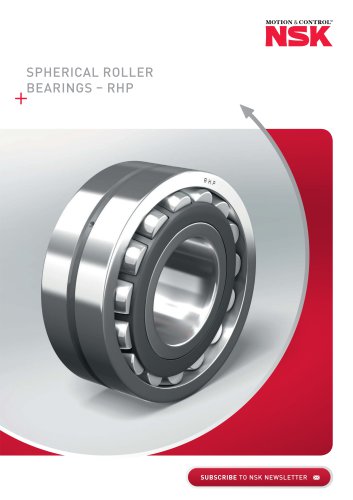
- Spherical Roller Bearings: Known for self-aligning ability and capacity to handle large loads.
- NSK's Dedicated Greases: Details specific greases like NS7, NSC, ENS, ENR, EA3, EA6, and WPH.
- NS7 and NSC Greases: Developed for induction motor bearings.
- ENS and ENR Greases: Suitable for high-temperature and high-speed ball bearings.
- EA3 and EA6 Greases: Designed for commutator motor shafts.
- WPH Grease: Specifically for water pump bearings.
- Proper selection and application of grease are crucial for maintaining bearing performance.
- Attention to grease filling amounts and conditions is necessary to prevent issues.
- Specific greases are recommended based on the operating environment.
The document discusses the characteristics and applications of various greases and bearing materials.
WPH grease is designed for water pump bearings, offering high reliability in severe environments.
These greases are optimal for automotive electric accessory bearings.
The document compares national standards for rolling bearing steel.
NSK Z steel is developed to enhance rolling fatigue life.
Materials like high-speed steel and SUS 440C are used for high-temperature applications.
Aging deformation can lead to inner ring creep.
The document underscores the importance of selecting appropriate greases and materials for bearings.
Rolling bearings must withstand high loads, high speeds, and prolonged operation.
Ceramics offer superior corrosion, heat, and wear resistance.
Polymers are used for bearing cages due to their lightweight and corrosion resistance.
Plastic cages, particularly those made from nylon, are increasingly replacing metal cages.
This section discusses the calculation of forces acting on hypoid gears.
Worm gears have their load calculated based on gear ratio and efficiency.
Rolling bearings are standardized internationally, with Japan following JIS standards.
This section explains the permanent deformation occurring at contact points in bearings.
The document discusses the calculation of bearing mass using the apparent specific gravity 'k'.
The cage projects perpendicularly from the outer ring.
Natural frequencies involve radial and axial vibrations.
Vibration and noise in bearings are categorized into inherent design issues and those caused by external factors.
Finite Element Methods (FEM) are used to analyze dynamic and thermal problems in bearing systems.
The document provides detailed technical insights into bearing specifications and design considerations.
The document discusses the load distribution in rolling elements of bearings.
Ultra-precision Ball Bearings for Gyroscopes: These bearings are critical for gyroscopes used in airplanes and ships.
The document includes several tables and figures illustrating the specifications and performance characteristics of various bearings.
1. Sealed Bearings: Nitrile rubber seals are color-coded for different contact types.
1. Evaluation Tests: Figures and tables illustrate the design and test results of various bearings.
1. Application Conditions: Tables provide detailed specifications for different bearing types.
NSK's range of special bearings is designed to meet the demanding requirements of modern machinery.
These bearings are designed to withstand harsh environments.
Used in steelmaking plants, these bearings are designed for low-speed, heavy-load conditions.
These bearings are designed for high-speed, maintenance-free operation.
Tables and figures provide detailed dimensions and load ratings for various bearing types.
The document provides contact details for NSK sales offices across Europe, the Middle East, and Africa.
Catalog excerpts

TECHNICAL REPORT
Open the catalog to page 1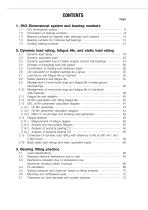
1. ISO Dimensional system and bearing numbers 1.1 1.2 1.3 1.4 1.5 ISO Dimensional system …………………………………………………………… 6 Formulation of bearing numbers…………………………………………………… 8 Bearing numbers for tapered roller bearings (inch system) ………………… 10 Bearing numbers for miniature ball bearings ………………………………… 12 Auxiliary bearing symbols ……………………………………………………… 14 2. Dynamic load rating, fatigue life, and static load rating Dynamic load rating ……………………………………………………………… Dynamic equivalent load ………………………………………………………… Dynamic equivalent load of triplex angular contact ball bearings …………… Average of fluctuating load...
Open the catalog to page 2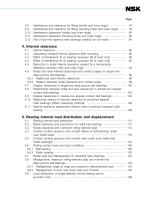
Interference and clearance for fitting (shafts and inner rings) ……………… Interference and clearance for fitting (housing holes and outer rings)……… Interference dispersion (shafts and inner rings) ……………………………… Interference dispersion (housing bores and outer rings) …………………… Fits of four-row tapered roller bearings (metric) for roll necks ……………… Internal clearance ………………………………………………………………… Calculating residual internal clearance after mounting ……………………… Effect of interference fit on bearing raceways (fit of inner ring) …………… Effect of interference fit on bearing raceways (fit of outer ring) ……………...
Open the catalog to page 3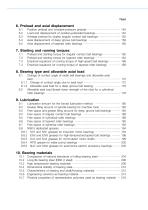
Position preload and constant-pressure preload ……………………………… Load and displacement of position-preloaded bearings……………………… Average preload for duplex angular contact ball bearings …………………… Axial displacement of deep groove ball bearings …………………………… Axial displacement of tapered roller bearings ………………………………… Preload and starting torque for angular contact ball bearings ……………… Preload and starting torque for tapered roller bearings ……………………… Empirical equations of running torque of high-speed ball bearings ………… Empirical equations for running torque of tapered roller bearings ………… 8. Bearing type...
Open the catalog to page 4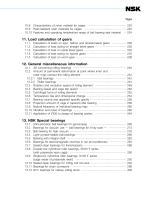
Pages 10.8 Characteristics of nylon material for cages …………………………………… 220 10.9 Heat-resistant resin materials for cages ……………………………………… 222 10.10 Features and operating temperature range of ball bearing seal material … 224 Calculation Calculation Calculation Calculation Calculation loads on spur, helical, and double-helical gears …………… load acting on straight bevel gears …………………………… load on spiral bevel gears ……………………………………… load acting on hypoid gears …………………………………… load on worm gear ……………………………………………… 12. General miscellaneous information JIS concerning rolling bearings …………………………………………………...
Open the catalog to page 5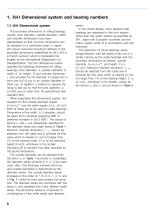
1. ISO Dimensional system and bearing numbers 1.1 ISO Dimensional system The boundary dimensions of rolling bearings, namely, bore diameter, outside diameter, width, and chamfer dimensions have been standardized so that common dimensions can be adopted on a worldwide scale. In Japan, JIS (Japan Industrial Standard) adheres to the boundary dimensions established by ISO. ISO is a French acronym which is translated into English as the International Organization for Standardization. The ISO dimensional system specifies the following dimensions for rolling bearings: bore diameter, d, outside diameter,...
Open the catalog to page 6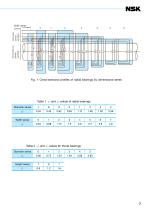
Fig. 1 Cross-sectional profiles of radial bearings by dimensional series Table 1 fD and fB values of radial bearings Diameter series Width series Table 2 fD and fT values for thrust bearings Diameter series Height series
Open the catalog to page 7All NSK Europe Ltd. catalogs and technical brochures
 NEW BEARING DOCTOR
44 Pages
 BEARING DESIGNATION SYSTEMS
48 Pages
 ROLLING BEARINGS
704 Pages
 LARGE SIZE ROLLING BEARINGS
564 Pages



Archived catalogs
 DH/DS Series
1 Page
 K1-L
K1-L1 Page
 K1
K11 Page
 NH and NS Series
1 Page
 HA / HS Series
1 Page