
- Catalogs
- NuAire Laboratory Equipment
- HEPA versus ULPA Filters


HEPA versus ULPA Filters

HEPA versus ULPA Filters
A biosafety cabinet (BSC) is essential in laboratories for handling biological materials, ensuring safety, and preventing cross-contamination. The choice between HEPA and ULPA filters is crucial for optimal BSC performance.
HEPA (High Efficiency Particulate Air) and ULPA (Ultra-Low Particulate Air) filters are the primary types used in BSCs. HEPA filters are efficient in removing airborne particulates, allergens, and bacteria, while ULPA filters offer higher filtration efficiency but are more expensive and energy-intensive.
Standards such as NSF/ANSI 49 and EN12469 define BSC performance parameters. HEPA filters are tested under IEST-RP-CC001 and EN1822-1 standards, while ULPA filters are tested similarly but with higher efficiency requirements.
HEPA filters effectively trap particles through collision and electrostatic attraction. They have a long lifespan (5-15 years) and minimal pressure drop, making them cost-effective and energy-efficient.
ULPA filters, though more efficient, are costlier and have a shorter lifespan (5-8 years). They require more power due to higher resistance, impacting BSC design and operational costs.
Consider the following factors:
- Filter Standard: Ensure compatibility with BSC standards.
- Level of Filtering: HEPA filters are adequate for most biomedical applications.
- Price: ULPA filters are more expensive and require frequent replacement.
- BSC Configuration: ULPA filters reduce airflow, necessitating design adjustments.
HEPA filters are generally sufficient for biological work in BSCs, offering cost and energy efficiency. ULPA filters are more suited for industries like semiconductor manufacturing.
NuAire provides laboratory equipment ensuring personnel, product, and environmental protection globally.
- NSF/ANSI 49-2016: Guidelines for the design, construction, performance, and certification of biosafety cabinetry.
- EN 12469: 2000: Performance criteria for microbiological safety cabinets.
- IEST-RP-CC001: Standards for HEPA and ULPA filters.
- EN1822-1:2009: Classification and performance testing for high-efficiency air filters.
- ISO 29463-1:2017: Standards for high-efficiency filters and filter media for air particle removal.
- Biosafety in Microbiological and Biomedical Laboratories, 6th ed.: Comprehensive guidelines for biosafety in laboratories.
NuAire provides a range of laboratory equipment including laminar airflow workstations, custom solutions, centrifuges, compounding isolators, polypropylene fume hoods, CO2 incubators, ultralow freezers, and biosafety cabinets.
Laboratories should consider their specific needs and compliance with relevant standards when choosing between HEPA and ULPA filters to ensure optimal safety and performance.
Catalog excerpts

HEPA VS ULPA WHICH FILTER SHOULD YOUR BIOSAFETY CABINET USE? NuAire, Inc. | 2100 Fernbrook Lane | Plymouth, MN 55447 | U.S.A. | www.nuaire.com
Open the catalog to page 1
HEPA VERSUS ULPA: Which Filter Should Your Biosafety Cabinet Use? A biological safety cabinet (BSC) is one of the most important pieces of equipment in virtually every laboratory that handles low-to-moderate risk biological materials. A BSC maintains a safe environment for personnel, and prevents cross-contamination of the work product in industries such as large healthcare providers, testing facilities, or pharmaceutical manufacturers. Among the many important components determining the effectiveness of a BSC, the most critical is the air filter. HEPA vs. ULPA Filters There are two primary types...
Open the catalog to page 2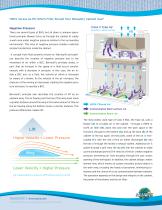
HEPA Versus ULPA: Which Filter Should Your Biosafety Cabinet Use? Class II Type A2 Negative Pressure Biosafety Cabinet Airflow There are several types of BSCs but all share a common opera- tional principle. Blowers force air through the cabinet to create a work area under negative pressure relative to the surrounding environment. This area of negative pressure isolates materials (product protection) inside the cabinet. A concept from fluid dynamics known as “Bernoulli’s principle” can describe the creation of negative pressure due to the movement of air within a BSC. Bernoulli’s principle states,...
Open the catalog to page 3
HEPA Versus ULPA: Which Filter Should Your Biosafety Cabinet Use? Airborne particulate such as dust or mold spores is prevented from passing through a HEPA filter by collision with filter media fibers, as well as electrostatic attraction, causing the particles to become trapped inside the filter. for both HEPA and ULPA. The European Union’s EN 12469 BSC The filter is integral to the safety and protection of personnel and standard applies European Standard EN1822-1. Each has a differ- of the materials in the work space. Without the filter, air pass- ing over the work space could pick up contaminants,...
Open the catalog to page 4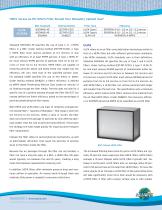
HEPA Versus ULPA: Which Filter Should Your Biosafety Cabinet Use? ULPA FILTERS BSC Standard NSF/ANSI 49 NSF/ANSI 49 EN12469 Filter Type ULPA Type F ULPA Type K ULPA U15 Standard NSF/ANSI 49 specifies the use of type C or J HEPA filters in a BSC. Under testing method IEST-RP-CC001, a type ULPA refers to an air filter using fabrication technology similar to C HEPA filter must remove particles of 0.3 microns in size that of a HEPA filter, but with different performance standards. with an efficiency of at least 99.99 percent. A type J HEPA fil- Like HEPA standards, ULPA standards vary in their definitions....
Open the catalog to page 5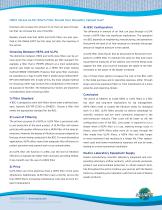
HEPA Versus ULPA: Which Filter Should Your Biosafety Cabinet Use? thickness will increase the amount of air that can pass through, but that can increase the size of the BSC. The difference in amount of air that can pass through a ULPA Readers should note that HEPA and ULPA filters are also specified in ISO 29463-1:2017 but this does not alter the meaning of this article. Choosing Between HEPA and ULPA The distinction between HEPA and ULPA style filters can be unclear given the range of testing methods per BSC standard. For example, a filter that is 99.995 efficient at a most penetrating particle...
Open the catalog to page 6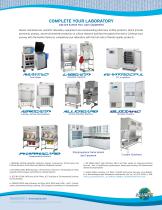
COMPLETE YOUR LABORATORY Add and Extend Your Lab’s Capabilities NuAire manufactures scientific laboratory equipment and compounding pharmacy airflow products, which provide personnel, product, and environmental protection in critical research facilities throughout the world. Continue your journey with the NuAire family by completing your laboratory with the full suite of NuAire quality products. Laminar Airflow Workstations Compounding Isolators Biosafety Cabinets NU-608 CLASS I ANIMAL Animal HandlingBEDDING DISPOSAL CABINET Stations Polypropylene Fume Hoods and Casework i. NSF/ANSI 49-2016:...
Open the catalog to page 7All NuAire Laboratory Equipment catalogs and technical brochures
 PharmaGard Compounding Isolators
20 Pages
 LabGard ES LP NU-640 AH BSC
12 Pages
 LabGard ES NU-677
8 Pages
 NU-543
20 Pages
 NU-540
20 Pages
 NuWind Centrifuge Tube Chart
3 Pages
 NU-5700 CO2 Incubator
2 Pages
 FumeGard NU-156
2 Pages



Archived catalogs
 FumeGard NU-162
4 Pages
 FumeGard NU-164
4 Pages
 General_Overview_Brochure
4 Pages
 ADVANCED SAFETY ENGINEERING
6 Pages
 General Purpose Centrifuge
24 Pages


- Laboratory freezer
- 1-door freezer
- Laboratory incubator
- Electric freezer
- Temperature-control laboratory incubator
- Stainless steel freezer
- Laboratory hood
- Benchtop laboratory incubator
- Manual defrost freezer
- Stainless steel laboratory incubator
- Freezer with opaque door
- Heating laboratory incubator
- Laboratory workstation
- Mobile freezer
- Laboratory biosafety cabinet
- Forced convection laboratory incubator
- Aseptic isolator
- Box freezer
- Vaccine freezer