


ALIF

ALIF
This document provides an overview of Anterior Lumbar Interbody Fusion (ALIF), a surgical procedure for treating certain spinal conditions. It emphasizes that the information is general and should not replace discussions with healthcare professionals.
About the Spine
The human spine consists of 24 vertebrae divided into cervical, thoracic, and lumbar regions, plus the sacral bones. Vertebrae are connected by joints, with intervertebral discs acting as shock absorbers and allowing movement.
Spinal Cord and Cauda Equina
The spinal cord runs from the brain to the upper lumbar spine, with nerves continuing as the cauda equina. Spinal nerves exit the spine at each level.
Causes of Pain
Pain can result from instability or pressure on nerve roots, spinal cord, or cauda equina. Conditions include Degenerative Disc Disease, Degenerative Spondylolisthesis, and Degenerative Scoliosis.
Treatment Options
Non-surgical treatments include rest, heat, ice, medication, injections, and physical therapy. Surgery, such as ALIF, is considered if symptoms persist.
ALIF Procedure
ALIF involves accessing the spine from the front to remove a damaged disc and inserting a bone graft to promote fusion. This approach avoids muscle stripping.
Suitability for ALIF
ALIF may be suitable for patients needing interbody fusion and who have tried non-surgical treatments. It may not be suitable for those with certain medical conditions.
Surgical Process
Steps include making an incision, removing the disc, inserting an implant, and stabilizing with a plate and screws.
Post-Surgery
Postoperative care involves monitoring, medication, and activity guidelines. Risks include anesthesia issues, nerve damage, and ongoing pain.
Frequently Asked Questions
Topics include showering, scarring, driving, and traveling post-surgery.
Resources
Additional information is available at nuvasive.com and thebetterwayback.org, which offers patient support and education.
Catalog excerpts

ALIF Anterior Lumbar Interbody Fusion This booklet provides general information on ALIF. It is not meant to replace any personal conversations that you might wish to have with your physician or other member of your healthcare team. Not all the information here will apply to your individual treatment or its outcome.
Open the catalog to page 1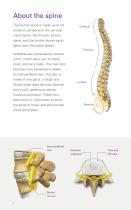
About the spine The human spine is made up of 24 bones or vertebrae in the cervical (neck) spine, the thoracic (chest) spine, and the lumbar (lower back) spine, plus the sacral bones. Thoracic Vertebrae are connected by several joints, which allow you to bend, twist, and carry loads. The main joint between two vertebrae is called an intervertebral disc. The disc is made of two parts, a tough and fibrous outer layer (annulus fibrosis) and a soft, gelatinous center (nucleus pulposus). These two parts work in conjunction to allow Sacrum the spine to move, and also provide shock absorption. Intervertebral...
Open the catalog to page 2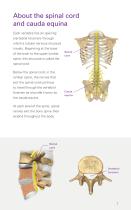
About the spinal cord and cauda equina Each vertebra has an opening (vertebral foramen) through which a tubular nervous structure travels. Beginning at the base of the brain to the upper lumbar spine, this structure is called the Spinal cord spinal cord. Below the spinal cord, in the lumbar spine, the nerves that exit the spinal cord continue to travel through the vertebral foramen as a bundle known as the cauda equina. Cauda equina At each level of the spine, spinal nerves exit the bony spine then extend throughout the body. Spinal cord Vertebral foramen
Open the catalog to page 3
What can cause pain? There are several primary causes of spine problems. The majority of the symptoms are caused by either instability or by disc, bone or ligaments pressing onto the nerve roots, spinal cord, and/or cauda equina. Degenerative Disc Disease (DDD) During the natural aging process, the discs between each vertebral body can lose their flexibility, height, and elasticity which can cause a tear in the tough outer layer of the disc, causing the disc to herniate, bulge, or leak the gelatinous core. The bulges or leakages can end up compressing the nerve roots, spinal cord, and/or cauda...
Open the catalog to page 4
What are treatment options? Many symptoms can be treated without surgery including rest, heat, ice, medication, injections, and physical therapy. It is important to speak with a physician about the best option. If symptoms do not improve with conservative treatment, physicians may recommend spinal surgery. Surgery is reserved for those who do not gain relief from non-operative forms of treatment, patients whose symptoms are increasing or worsening, and/or patients that present with a spinal condition which indicates the need for surgery. What is an Anterior Lumbar Interbody Fusion (ALIF)? In...
Open the catalog to page 5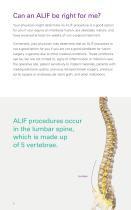
Can an ALIF be right for me? Your physician might determine an ALIF procedure is a good option for you if you require an interbody fusion, are skeletally mature, and have received at least six weeks of non-surgical treatment. Conversely, your physician may determine that an ALIF procedure is not a good option for you if you are not a good candidate for fusion surgery in general due to other medical conditions. These conditions can be, but are not limited to: signs of inflammation or infection near the operative site, patient sensitivity to implant materials, patients with inadequate bone quality,...
Open the catalog to page 6
What to expect Before surgery Your physician will review your condition and explain treatment options, including medications, physical therapy, and other surgeries. Should you have any questions regarding the procedure, do not hesitate to ask your surgeon. Your physician will provide thorough preoperative instructions.
Open the catalog to page 7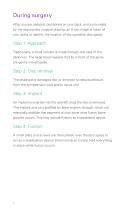
During surgery After you are sedated, positioned on your back, and surrounded by the appropriate surgical draping, an X-ray image is taken of your spine to identify the location of the operative disc space. Step 1: Approach Traditionally, a small incision is made through one side of the abdomen. The large blood vessels that lie in front of the spine are gently moved aside. Step 2: Disc removal The diseased or damaged disc is removed to reduce pressure from the symptomatic cord and/or nerve root. Step 3: Implant An implant is inserted into the void left once the disc is removed. This implant acts...
Open the catalog to page 8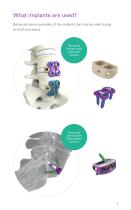
What implants are used? Below are some examples of the implants that may be used during an ALIF procedure: Interbody implant with plate and screws Interbody with Screws (Standalone Device)
Open the catalog to page 9
After surgery After surgery you will wake up in the recovery room, where your vital signs will be monitored and your immediate postoperative condition will be carefully observed. Once the medical staff feels that you are doing well, you will be returned to your room in the hospital. Your physician will determine the best postoperative course for you. This will include any medications to take home, as well as a prescribed program of activities. Your physician will provide instructions on wound care, exercises, and limitations to postoperative activity. What are the potential risks of an ALIF procedure?...
Open the catalog to page 10
Frequently asked questions Can I shower after surgery? Depending on your surgical incision, you may have showering restrictions. Ask your physician for appropriate instructions. Will I have a scar? Your physician will discuss the incisions that will be made during an ALIF surgery. When can I drive? For a period of time after your surgery, you may be cautioned about activities such as driving. Your physician will tell you when you may drive again. Can I travel? The implants used in the ALIF procedure may activate a metal detector. Because of increased airport security measures, please call your...
Open the catalog to page 11
Resources For more information about ALIF, please visit: nuvasive.com If you would like to learn more about patient support and education for chronic back, leg, and neck pain sufferers and their loved ones, please visit: thebetterwayback.org If you have any questions about ALIF or spine surgery, please call or visit your physician, who is the only one qualified to diagnose and treat your spinal condition. This patient information brochure is not a replacement for professional medical advice.
Open the catalog to page 14All NuVasive catalogs and technical brochures
 PCF
PCF12 Pages
 CTDR
CTDR4 Pages
 ACDF
ACDF12 Pages
 XLIF® CORPECTOMY
12 Pages
 XLIF
XLIF18 Pages
- Bone plate
- Interbody fusion cage
- PEEK interbody fusion cage
- Lumbar interbody fusion cage
- Anterior interbody fusion cage
- Arthrodesis plate
- Spinal stabilization system
- Posterior spinal osteosynthesis unit
- Metallic arthrodesis plate
- Adult spinal osteosynthesis unit
- Cervical interbody fusion cage
- Titanium interbody fusion cage
- Posterior interbody fusion cage
- Transforaminal interbody fusion cage
- Cervical vertebra arthrodesis plate
- Thoraco-lumbar osteosynthesis unit
- Surgical navigation system
- Vertebral corpectomy prosthesis
- Optical surgical navigation system
- 2 levels arthrodesis plate