

- Company
- Products
- Catalogs
- News & Trends
- Exhibitions
Air Next Research Article

Air Next Research Article
Catalog excerpts
RESEARCH ARTICLE Validation of the portable Air-Smart Spirometer ´ ´ ´ ´ Cristina Ramos Hernandez1,2*, Marta Nuñez Fernandez1, Abel Pallares Sanmartın3, ´ Cecilia Mouronte Roibas1,2, Luz Cerdeira Domınguez1, Maria Isabel Botana Rial1,2, ´ Nagore Blanco Cid3, Alberto Fernandez Villar1,2 1 Department of Pneumonology, University Hospital Complex of Vigo, Pontevedra, Spain, 2 Neumo Vigo I + i. Institute of Health Research South Galicia (IISGS), Vigo, Pontevedra, Spain, 3 Department of Pneumonology, Hospital Complex of Pontevedra, Vigo, Pontevedra, Spain * [email protected] OPEN ACCESS ´ ´ ´ Citation: Ramos Hernandez C, Nuñez Fernandez M, ´ Pallares Sanmartın A, Mouronte Roibas C, Cerdeira ´ Domınguez L, Botana Rial MI, et al. (2018) Validation of the portable Air-Smart Spirometer. PLoS ONE 13(2): e0192789. https://doi.org/ 10.1371/journal.pone.0192789 Editor: Christophe Leroyer, Universite de Bretagne Occidentale, FRANCE Received: July 20, 2017 Accepted: January 30, 2018 Published: February 23, 2018 ´ Copyright: © 2018 Ramos Hernandez et al. This is an open access article distributed under the terms of the Creative Commons Attribution License, which permits unrestricted use, distribution, and reproduction in any medium, provided the original author and source are credited. Data Availability Statement: All relevant data are within the paper. For any additional data queries please contact the authors at cristina.ramos. [email protected]. Funding: The authors received no specific funding for this work. Competing interests: The authors have declared that no competing interests exist. The Air-Smart Spirometer is the first portable device accepted by the European Community (EC) that performs spirometric measurements by a turbine mechanism and displays the results on a smartphone or a tablet. Methods In this multicenter, descriptive and cross-sectional prospective study carried out in 2 hospital centers, we compare FEV1, FVC, FEV1/FVC ratio measured with the Air Smart-Spirometer device and a conventional spirometer, and analyze the ability of this new portable device to detect obstructions. Patients were included for 2 consecutive months. We calculate sensitivity, specificity, positive and negative predictive value (PPV and NPV) and likelihood ratio (LR +, LR-) as well as the Kappa Index to evaluate the concordance between the two devices for the detection of obstruction. The agreement and relation between the values of FEV1 and FVC in absolute value and the FEV1/FVC ratio measured by both devices were analyzed by calculating the intraclass correlation coefficient (ICC) and the Pearson correlation coefficient (r) respectively. Results 200 patients (100 from each center) were included with a mean age of 57 (± 14) years, 110 were men (55%). Obstruction was detected by conventional spirometry in 73 patients (40.1%). Using a FEV1/FVC ratio smaller than 0.7 to detect obstruction with the Air SmartSpirometer, the kappa index was 0.88, sensitivity (90.4%), specificity (97.2%), PPV (95.7%), NPV (93.7%), positive likelihood ratio (32.29), and negative likelihood ratio (0.10). The ICC and r between FEV1, FVC, and FEV1 / FVC ratio measured by the Air Smart Spirometer and the conventional spirometer were all higher than 0.94.
Open the catalog to page 1
Validation of Air-Smart Spirometer Conclusion The Air-Smart Spirometer is a simple and very precise instrument for detecting obstructive airway diseases. It is easy to use, which could make it especially useful non-specialized care and in other areas. Introduction The characteristics of portable devices including low cost, are simplicity of use, and reliability of results. Then they open new possibilities to optimize the diagnosis and monitoring of respiratory diseases. Obstructive airway disorders are of particular interest, because despite a prevalence of 5–10% in the general population, the...
Open the catalog to page 2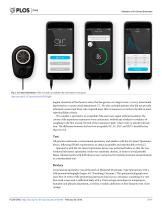
Validation of Air-Smart Spirometer Fig 1. Air Smart Spirometer. After 6 seconds of exhalation the chronometer turns green. https://doi.org/10.1371/journal.pone.0192789.g001 angina, aneurism of the thoracic artery that has grown or is large in size (>6 cm), intracranial hypertension or acute retinal detachment [7].. We also excluded patients who did not provide informed consent and those who required more than 8 maneuvers in order to be able to meet reproducibility criteria. We consider a spirometry as acceptable if the start were rapid, without hesitation, the course of the expiratory manoeuvre...
Open the catalog to page 3
Validation of Air-Smart Spirometer The University Hospital Complex of Vigo used Quajer Gli reference values for conventional spirometers [8].The Hospital Complex of Pontevedra used the reference values recommended by SEPAR [7]. The Air Smart Spirometer (Fig 1) is a small portable device that connects to the smartphone at the headphone jack. Its dimensions are 79 x 56 x 20 mm and it weighs 50g. It includes a lithium battery, designed to have a half-life of 2 years (or 1000 spirometries). It has a turbine mechanism (Flow Mir) to perform measurements inside the disposable single use nozzles. The...
Open the catalog to page 4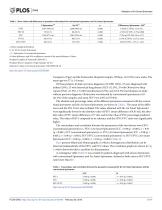
Validation of Air-Smart Spirometer Table 1. Mean values and differences of parameters determined by conventional spirometer and Air Smart Spirometer.
Open the catalog to page 5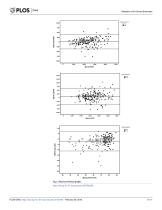
Validation of Air-Smart Spirometer Fig 2. Bland and Altman graphs. https://doi.org/10.1371/journal.pone.0192789.g002
Open the catalog to page 6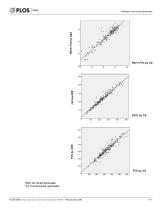
Validation of Air-Smart Spirometer
Open the catalog to page 7
Validation of Air-Smart Spirometer Fig 3. Correlation graphs. https://doi.org/10.1371/iournal.pone.0192789.g003 Of the 83 patients with an obstructive ratio determined with conventional spirometer, 8 (9.63%) would not have been detected with the Air Smart-Spirometer. In 2 of these the diagnosis of airflow obstruction would be ruled out if we had used the lower limit of normality instead of FEV1/FVC ratio <0.7. In 3 of these 8 patients, FVC obtained wasn't reproducible between the portable and the conventional device, while FEV1 was. In the other 2 cases there was reproducibility between FEV1...
Open the catalog to page 8All NuvoAir catalogs and technical brochures
 Air Next Brochure
1 Page
 Air Next Product Catalogue
17 Pages