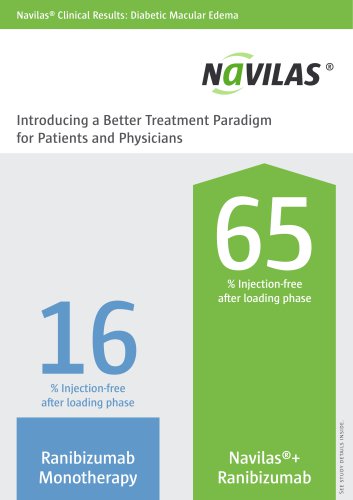
Navilas® - The Clinical eCaseBook

Navilas® - The Clinical eCaseBook
Catalog excerpts
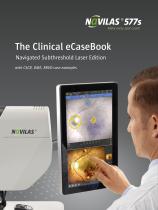
The Clinical eCaseBook Navigated Subthreshold Laser Edition with CSCR, DME, BRVO case examples
Open the catalog to page 1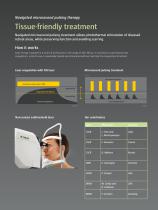
Tissue-friendly treatment Navigated microsecond pulsing treatment allows photothermal stimulation of diseased retinal areas, while preserving function and avoiding scarring. How it works Laser energy is applied in a series of brief pulses in the range of 100-300 ps. In contrast to conventional laser coagulation, retinal tissue is repeatedly heated and stimulated without reaching the coagulation threshold. Non-contact subthreshold laser Our contributors Case Physician Country
Open the catalog to page 2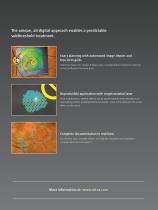
The unique, all-digital approach enables a predictable subthreshold treatment. Exact planning with automated image import and free-form grids Imported diagnostic images enable exact, standardizable treatment planning using (confluent) free-form grids. Reproducible application with target-assisted laser With a pedal press, several effects can be applied quickly and precisely in an alternating pattern avoiding thermal crosstalk - even in the absence of a visual effect on the retina. Complete documentation in real-time For the first time, invisible effects are digitally visualized and treatment...
Open the catalog to page 3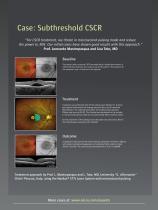
Baseline This patient with recurrent CSCR presented with a significant amount of subretinal fluid reducing the visual acuity of the patient. The duration of the symptoms was >4 months in last episode. Treatment Treatment was performed with 577nm yellow laser (Navilas ®). A dense spot pattern delivered to the leakage area and the area of subretinal detachement. The selected parameters were 100ms pulse duration, 100pm spot size and 5% DC. The titration was performed at the arcades in microsecond pulsing mode until a barely visible effect could be noted. For the treatment of the leakage areas the...
Open the catalog to page 4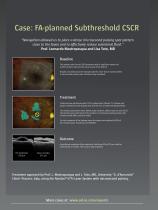
Baseline This patient with chronic CSCR presented with a significant amount of subretinal fluid reducing the visual acuity of the patient. Despite oral medication the fluid persisted for more than 6 months before a microsecond pulsing laser treatment was scheduled. Treatment Treatment was performed with 577nm yellow laser (Navilas ®). A dense spot pattern delivered to the leakage area and the area of subretinal detachement. The selected parameters were 100ms pulse duration, 100pm spot size and 5% DC. The titration was performed at the arcades in microsecond pulsing mode until a barely visible...
Open the catalog to page 5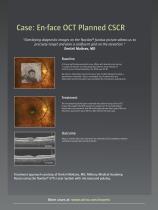
Baseline A 59 year old female presented in our offices with blurred vision during "a couple of months" and was diagnosed with an acute episode of Central serous chorioretinopathy. Her BCVA was 20/40. We took an observation period of around two months followed to allow a spontaneous resolution. Due to unchanged size of edema after this observation period the patient was scheduled for microsecond pulsing laser. Treatment The microsecond pulsing laser treatment was planned using en face OCT image. We targeted flat RPE elevation in upper part of neuroepithelium detachment and covered it with 98 confluently...
Open the catalog to page 6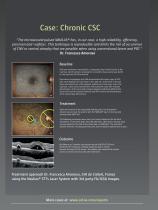
"The microsecond pulsed NAVI LAS® has, in our case, a high reliability, efficiency, precision and «safety». This technique is reproducible and limits the risk of occurrence ofCNV or central atrophy that are possible when using conventional lasers and PDT." Dr. Francesca Amoroso Baseline A 49-year-old woman consulted for a progressive loss of visual acuity in the right eye, which had been evolving for six months. Visual acuity was 20/40 on the right and 20/20 on the left. Fluorescein angiography and ICGA demonstrated the classic signs of CSC, with nasal leakage from the fovea to the right eye....
Open the catalog to page 7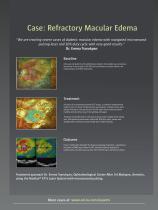
Baseline A 61-year-old patient with proliferative diabetic retinopathy was showing a decreased visual acuity of 20/250 and a refractory macular edema, not responding to anti-VEGF injections. Treatment On basis of an imported external OCT image, a confluent subthreshold pattern over the most thickened area was planned. Caution zones were placed directly on the macula and on the optic nerve head to prevent healthy and sensitive tissue from getting damaged. Titration was performed in continuous wave mode outside of the vessel arcs. Microsecond pulses were used with 10% duty cycle, power was doubled...
Open the catalog to page 8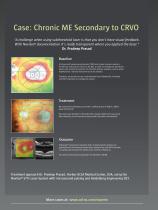
Baseline A 62-year-old female presented with CRVO and chronic macular edema in her left eye reducing the vision to 20/100. In order to manage the significant edema she received 9 injections of anti-VEGF without response. Due to ocular hypertension a steroid treatment had to be avoided. Therefore, we decided to use a subthreshold laser followed by 3 monthly anti-VEGF injections to manage the edema. Treatment We covered the edematous area with a confluent grid of 100pm, 100ms spots and 15% DC. The power was titrated in CW mode until a barely visible burn was noted. After switching to microsecond...
Open the catalog to page 9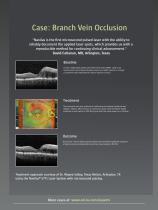
''Navilas is the first microsecond pulsed laser with the ability to reliably document the applied laser spots, which provides us with a reproducible method for continuing clinical advancement." David Callanan, MD, Arlington, Texas Baseline A male middle-aged patient presented with severe BRVO. Little to no improvement was achieved despite several anti-VEGF injections. A single ps treatment was attempted to reduce injection burden. Treatment The treatment plan was outlined as confluent grid covering thickened area (100pm, 100ms). After titration in continuous wave mode (endpoint barely visible...
Open the catalog to page 10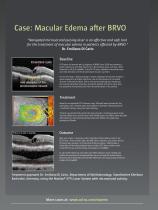
Baseline A 76-years old woman with a diagnosis of BRVO since 2016 was showing a good response to anti-VEGF injections in the previous years, but also a mild reduction in VA (0.1 logMAR). In the OCT B-scan, subfoveal intraretinal cysts and mild alterations of the photoreceptor tissues is present. On the FA image, a diffuse leakage is shown. Although the patient showed a good response to anti-VEGF injections, due to the presence of a minimal amount of intraretinal fluid, with a microsecond pulsing laser treatment the risks of intravitreal injections should be avoided and at the same time, the possibility...
Open the catalog to page 11All OD-OS catalogs and technical brochures
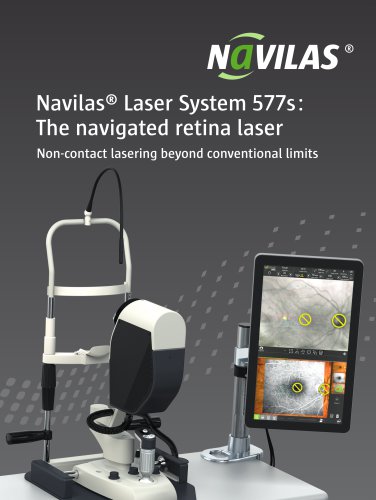 Navilas® 577s
11 Pages