
- Catalogs
- OI Analytical
- 4430 PID


4430 PID

4430 PID
The 4430 Photoionization Detector (PID) is a gas chromatography (GC) detector designed to selectively respond to aromatic and olefinic hydrocarbons, even in the presence of alkanes and other saturated hydrocarbons. It features a unique Window Sweep™ design to prevent contamination of the UV lamp window and allows for the analysis of photosensitive compounds.
The detector operates by irradiating the sample stream with high-energy ultraviolet light in the reaction chamber. Compounds with an ionization potential lower than the UV lamp's energy are ionized, and the resulting ion current, proportional to the compound concentration, is amplified and output by the GC's electrometer.
- Unique UV-lamp Window Sweep design minimizes fouling.
- Lampsaver™ circuit extends lamp life by turning off when not in use.
- Can interface with ELCD, XSD™, or FID to form a tandem detector.
- Includes a detector vent for undesirable sample solvents.
- Compatible with both packed and capillary columns.
- Engineered for specific GC models, ensuring easy operation and maintenance.
- USEPA Methods (502.2, 503.1, 602, 8020, 8021)
- BTEX, GRO, DRO, and VPH analysis
- Aromatics, olefins, alkenes, and alkynes
- Underground storage tank monitoring
- Waste characterization
- Air pollution and industrial hygiene
- Standard: 5 ppb each in 5 mL H2O
- Gas Flow: 10 mL/min (He) Carrier, 20 mL/min (He) Makeup
- Oven: 35 °C for 10 min, to 200 °C at 4 °C/min, hold at 200 °C for 10 min
- P&T Sample Concentrator: Standard EPA Method 502.2, Tenax®/Silica/Charcoal Trap
- Column: Rtx® - 502.2, 105 m x 0.53 mm I.D. x 3.0-µm film thickness
- Weight: 3 kg (5.5 lb)
- Controller Dimensions: 14.5 cm H x 6.9 cm W x 23 cm D
- Maximum Operating Temperature: 250 °C
- Materials: Glass-lined stainless steel inlet, gold-plated stainless steel ion chamber
- Dynamic Range: >106
- Linear Range: >106
- Sensitivity: <40 pg Benzene
- Lamp Current: 0–1.60 mA (in 9 steps)
- Lampsaver Time: 0.5–2 hr, reset by external contact
- Gas Requirements: He (99.999% purity)
- Power Requirements: 105–125 (±10%) VAC/25 VA, 210–240 (±10%) VAC/25 VA
The 4430 PID is protected under U.S. Patent number 4,804,846. Performance can be affected by several factors, including the GC, column, gas flows, and compound class.
Catalog excerpts
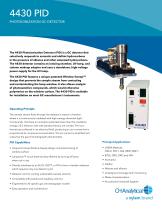
4430 PIDPHOTOIONIZATION GC DETECTOR The 4430 Photoionization Detector (PID) is a GC detector that selectively responds to aromatic and olefinic hydrocarbons in the presence of alkanes and other saturated hydrocarbons. The 4430 detector contains an ionizing chamber, UV lamp, and column makeup adaptor and uses a standalone, high-voltage power supply for the UV lamp. The 4430 PID features a unique patented Window Sweep™ design that prevents the sample stream from contacting and contaminating the lamp window. It also allows analysis of photosensitive compounds, which would otherwise polymerize on the window surface. The 4430 PID is available for installation on most GC manufacturer's instruments. Operating Principle The sample stream flows through the detector's reaction chamber where it is continuously irradiated with high-energy ultraviolet light. Compounds that have an ionization potential lower than the irradiation energy (10.2 electron volts with standard lamp), are ionized. The ions formed are collected in an electrical field, producing an ion current that is proportional to compound concentration. The ion current is amplified and output by the gas chromatograph's electrometer. PID Capabilities • Unique UV-lamp Window Sweep design minimizes fouling of window surface • Lampsaver™ circuit extends lamp lifetime by turning off lamp when not in use • Directly interfaces to an ELCD, XSD™, or FID to form a tandem detector which requires only one detector port • Detector vent for venting undesirable sample solvents • Compatible with packed and capillary columns • Engineered to fit specific gas chromatograph models • Easy operation and maintenance Principal Applications • USEPA Methods (502.2, 503.1,602, 8020, 8021) • BTEX, GRO, DRO and VPH • Aromatics • Olefins • Alkenes and alkynes • Underground storage tank monitoring • Waste characterization • Air pollution/industrial hygiene OTAnalytical 3 a xylem brand
Open the catalog to page 1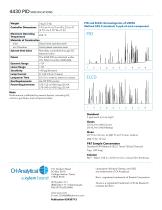
PID and ELCD chromatograms of USEPA Method 502.2 standard, 5 ppb of each component Note Performance is affected by several factors, including GC, column, gas flows, and compound class. Standard 5 ppb each in 5 mL H2O Gases 10 mL/min (He) Carrier 20 mL/min (He) Makeup Oven 35 °C for 10 min, to 200 °C at 4 °C/min, hold at 200 °C for 10 min P&T Sample Concentrator Standard EPA Method 502.2, Tenax®/Silica/Charcoal Trap (#9 Trap) Column Rtx® - 502.2, 105 m x 0.53 mm I.D. x 3.0-pm film thickness a xylem brand 151 Graham Road PO Box 9010 College Station, Texas 77842-9010 (979) 690-1711 (800) 653-1711...
Open the catalog to page 2All OI Analytical catalogs and technical brochures
 Eclipse 4760
2 Pages
 4551A Water Autosampler
2 Pages
 4450 PID/FID
2 Pages
 1080 TOC Analyzer
8 Pages
 5383 PFPD
2 Pages
 Aurora 1030D Spec Sheet
2 Pages
 Aurora 1030W TOC Analyzer
4 Pages


Archived catalogs
 5320 ELCD
2 Pages
 5360/5360A XSD™
2 Pages
 Dumatherm Brochure
7 Pages
 Soxtherm Brochure
7 Pages
 CHROM-LINK®
2 Pages
 Hydrotherm Brochure
7 Pages
 Nutrient Pollution Analysis
4 Pages
 Food Safety & Quality
4 Pages
 Series 4000 MINICAMS®
2 Pages


- Analysis software
- Sample preparation system
- Automatic sample processor
- Control software
- Laboratory testing system
- Reporting software
- Laboratory software
- Laboratory sample preparation system
- Benchtop sample preparation system
- Automated software
- Traceability software
- Control analyser
- Analyser for the pharmaceutical industry
- Transparent tubing
- Temperature testing system
- Chromatography system
- Flow testing system
- Environmental analysis tester
- Testing system with touchscreen
- Medical gas tubing