
- Catalogs
- OI Analytical
- 5320 ELCD


5320 ELCD

5320 ELCD
- Quick-change reactor design and disposable resin cartridge.
- Analog-controlled reactor temperature and solvent flow.
- Optimized for capillary columns.
- Solvent venting via GC timed-event relay.
- Direct interface with most GC brands and models.
- Can form a tandem detector with a 4430 PID.
- Detectable Mass: Minimum 1 pg lindane, Maximum 5 µg lindane.
- Dynamic Range: 5 x 10⁶.
- Selectivity: Cl/HC > 106, Cl/N > 105, Cl/S > 105.
- Reactor Temperature: 800 – 1,100 °C in 100 °C increments.
- Solvent Flow: Adjustable, 0-200 µL/min.
- Detector Output: 0-1 V or 0-10V.
- Operational Modes: Halogen, Sulfur, Nitrogen.
- Gas Requirements: Hydrogen, ultrahigh purity (99.999% or better).
- Power Requirements: 90–260 V AC (±10%), 47–63 Hz, 200 W.
- Detector Controller Weight: 3.8 kg (8.4 lb).
- Dimensions: 21.0 cm H x 12.7 cm W x 30.5 cm D.
Catalog excerpts

ELECTROLYTIC CONDUCTIVITY GC DETECTOR The 5320 Electrolytic Conductivity Detector (ELCD) is designed for selective detection of halogen-containing compounds. The 5320 ELCD consists of three principal components: the reactor assembly, the cell-solvent assembly, and the detector controller. The ELCD's primary mode of operation is the halogen mode (X); sulfur (S) and nitrogen (N) modes are also available. Each detection mode kit contains all of the required materials (except the solvent) to operate the ELCD in the specified mode. Operating Principle The ELCD converts halogen compounds eluting from a GC column to an ionizable gas (HX) using reductive conditions in a high-temperature catalytic microreactor. Gaseous reaction products carried into the detector cell become dissolved in a deionized solvent, which increases the electrolytic conductivity of the mixture. The detector amplifies this instantaneous change in conductivity, producing a signal proportional to the mass of halogen in the original compound. ELCD Capabilities • Quick-change reactor design, disposable resin cartridge, and reliable solvent system • Analog-controlled reactor temperature and solvent flow • Detector base optimized for capillary columns • Solvent venting using GC timed-event relay • Direct interface with most GC brands and models • Directly interfaces to a 4430 PID without a transfer line to form a tandem detector that requires only one detector port Principal Applications • USEPA Methods (502.1,502.2, 601,608, 611,8010, 8021) • VOCs • Pesticides • Halogenated Compounds • QA/QC • Petroleum Products • Process Control, Testing, and Analysis • Fluorinated and Chlorinated Contaminants in Process Streams Ol-Analytical Spa xylem brand
Open the catalog to page 1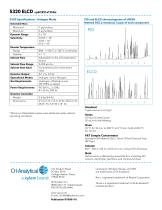
5320 Specifications - Halogen Mode PID and ELCD chromatograms of USEPA Method 502.2 standard, 5 ppb of each component Detectable Mass * Minimum Detectable masses were obtained under optimal operating conditions. 5 ppb each in 5 mL H2O Gases 10 mL/min (He) Carrier 20 mL/min (He) Makeup Oven 35 °C for 10 min, to 200 °C at 4 °C/min, hold at 200 °C for 10 min P&T Sample Concentrator Standard EPA Method 502.2, Tenax®/Silica/Charcoal Trap (#9 Trap) Column Rtx® - 502.2, 105 m x 0.53 mm I.D. x 3.0-pm film thickness Note Performance is affected by several factors, including GC, column, electrolyte, gas...
Open the catalog to page 2All OI Analytical catalogs and technical brochures
 Eclipse 4760
2 Pages
 4551A Water Autosampler
2 Pages
 4450 PID/FID
2 Pages
 1080 TOC Analyzer
8 Pages
 5383 PFPD
2 Pages
 4430 PID
2 Pages
 Aurora 1030D Spec Sheet
2 Pages
 Aurora 1030W TOC Analyzer
4 Pages


Archived catalogs
 5360/5360A XSD™
2 Pages
 Dumatherm Brochure
7 Pages
 Soxtherm Brochure
7 Pages
 CHROM-LINK®
2 Pages
 Hydrotherm Brochure
7 Pages
 Nutrient Pollution Analysis
4 Pages
 Food Safety & Quality
4 Pages
 Series 4000 MINICAMS®
2 Pages


- Analysis software
- Sample preparation system
- Automatic sample processor
- Control software
- Laboratory testing system
- Reporting software
- Laboratory sample preparation system
- Laboratory software
- Benchtop sample preparation system
- Automated software
- Traceability software
- Control analyser
- Transparent tubing
- Analyser for the pharmaceutical industry
- Temperature testing system
- Chromatography system
- Flow testing system
- Environmental analysis tester
- Medical gas tubing
- Testing system with touchscreen